
Introduction
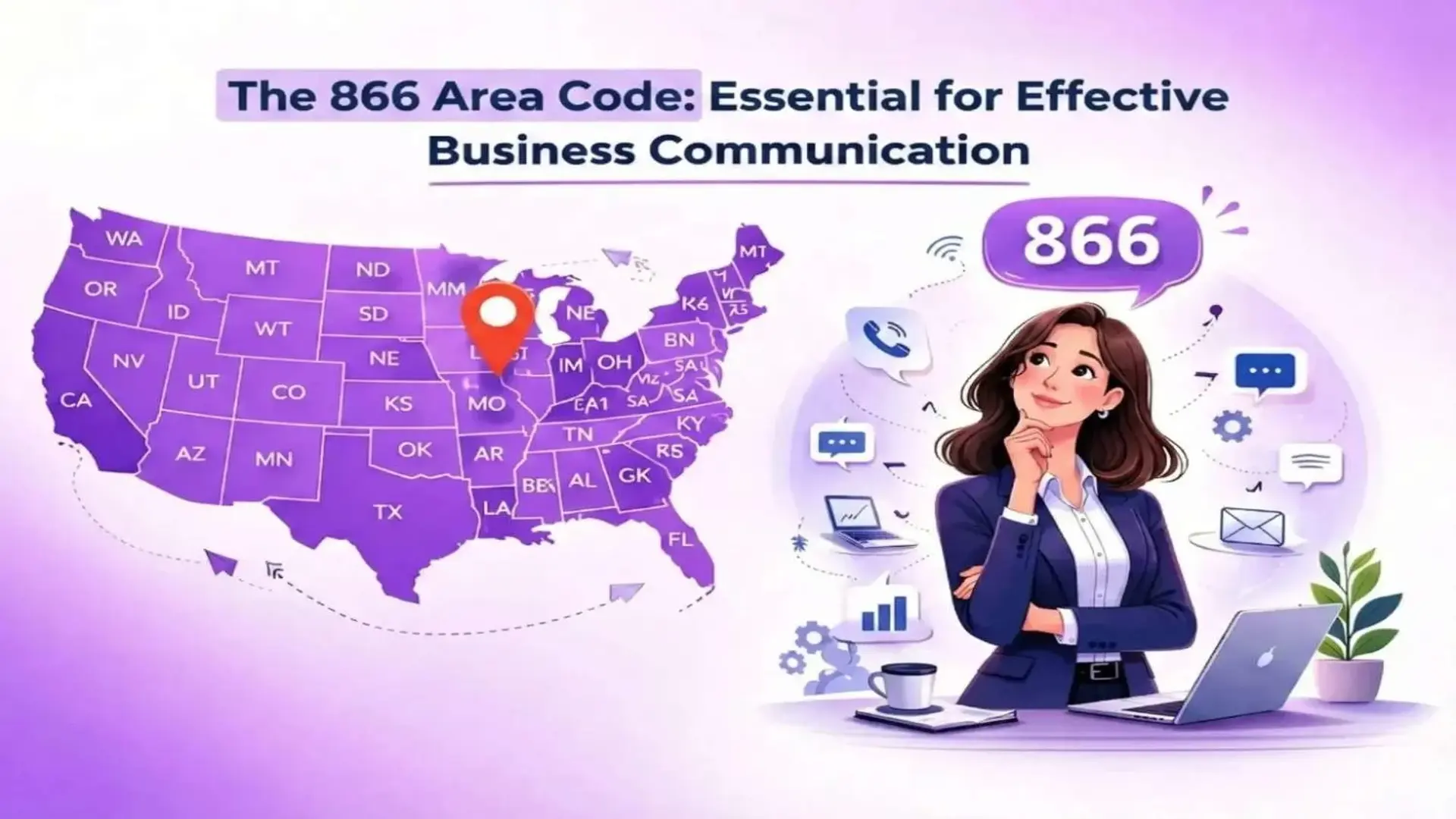
If you've ever called a customer service line, booked a doctor's appointment, or returned a delivery, there's a good chance you dialed a 1-866 number. The 866 area code is one of seven toll-free prefixes recognized across the United States, Canada, and most Caribbean countries, and it works a little differently from a normal geographic area code.
This guide covers what the 866 prefix actually is, how toll-free routing works under the hood, why scammers gravitate toward toll-free numbers, and how a business can claim a memorable 866 number of its own. The technical and historical details below come from the North American Numbering Plan Administrator (NANPA) and FCC rulemaking records.
What Is the 866 Area Code?
866 sits in a category of its own: a toll-free code with no city, state, or province behind it. A caller who dials a 1-866 number pays nothing for the call — the business that owns the line covers the per-minute inbound cost through its telecom provider instead. Every toll-free code, 866 included, shares one dialing format across North America:
- United States — all 50 states, plus territories
- Canada — all 10 provinces and 3 territories
- Bermuda, Trinidad and Tobago, Barbados, the Bahamas, the Dominican Republic, Jamaica, and most Caribbean NANP members
Because that dialing format is shared across the North American Numbering Plan (NANP), an 866 number rings the same whether the caller is next door or three time zones away, with no long-distance charge, no roaming fee, and no country code to dial from inside the NANP.
Key Benefits of Using a 866 Phone Number
An 866 number removes cost as a reason not to call, which measurably increases how often customers actually pick up the phone instead of giving up on an email or a contact form. It also reads as a more established, professional setup than a local cell number, which matters for a business still building its reputation.
Looking for a reliable toll-free number? Learn more about our US toll-free number options.
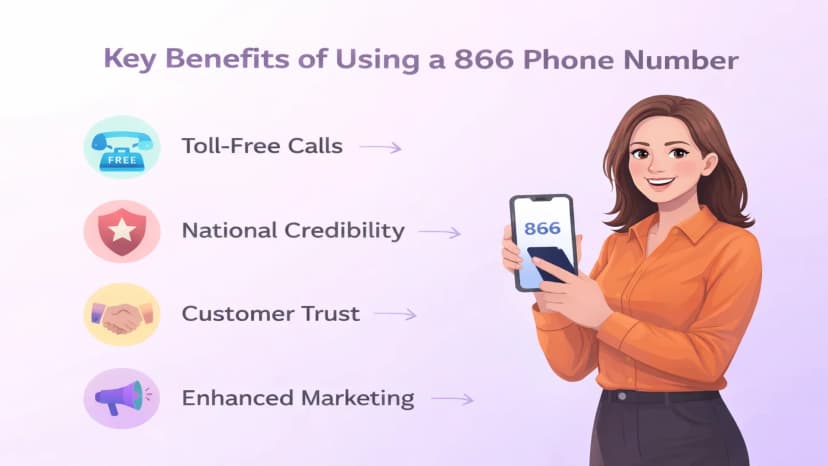
A single 866 number also lets a business operate from anywhere while keeping one consistent contact point for every customer, regardless of which state or time zone they're calling from. That removes the need to juggle separate regional numbers as the business grows into new markets.
For call centers specifically, toll-free routing sends each call straight to the right team or agent based on the caller's needs before anyone even picks up. Pairing that with CRM tools, like Ringflow, means reps see relevant customer history the moment the call connects.
Geographic Coverage and Time Zone Considerations
The 866 prefix covers the entire United States, from Alaska and Hawaii to the mainland, along with Canada and most Caribbean NANP members, since it isn't pinned to any single state or time zone. That reach is exactly why setting business hours takes a bit more planning than it would for a purely local number.
Calls can arrive from any of the four continental time zones at once, so most businesses run their scheduling and IVR routing off Eastern Time as the reference point, with overflow rules for after-hours calls from Pacific or Mountain callers. Call centers handling steady volume across all four zones benefit most from getting that scheduling logic right.
How to Obtain an 866 Area Code Number
Getting an 866 number typically takes a few business days. Start by searching available numbers through a toll-free provider's lookup tool to find a sequence that's easy for customers to remember.
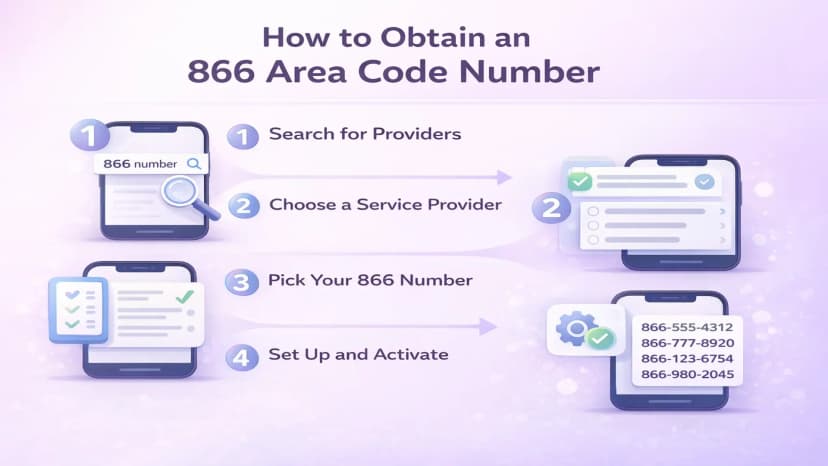
A digit sequence that spells something out or repeats a pattern sticks in a caller's memory better than a random one, so it pays to browse a little longer before settling on a number. From there, sign up with a provider that supports the 866 code, confirm the business details it asks for, and the number activates once setup is complete and ready to take calls.
Reverse Lookup Services and Caller Identification
Reverse lookup tools are super handy for figuring out who's behind an incoming 866 area code call. They help you double-check if it's legit and dodge any shady stuff. Keeping good logs of your business calls gets easier too with today's tracking features. Stick with well-known, secure reverse lookup platforms that protect your own info while delivering accurate details. Before picking up an unfamiliar one, a quick check can save you trouble—especially useful in call center in 866 local area environments where calls pour in constantly.
Is the 866 Area Code a Scam?
The 866 code itself is not the problem — nothing about the prefix makes a call more or less trustworthy than one from 800 or 877. What makes it look risky is that scammers spoof toll-free numbers specifically because they read as professional and safe to answer. The FTC has documented thousands of complaints tied to 1-866 spoofing every year, which is why this question keeps coming up.
Common 866 Scam Types
- Fake IRS or tax-debt calls. A spoofed 866 caller pretends to be the IRS, threatens arrest, and demands payment by gift card or wire. The IRS does not call to demand immediate payment.
- Auto-warranty calls. Recorded message claims your warranty is about to expire. There is no warranty; the goal is to harvest VIN, payment, or personal information.
- Tech-support fraud. Caller claims to be from a major software brand and asks for remote access to your computer to fix a non-existent virus.
- Prize and sweepstakes scams. Voicemail says you have won a prize or gift card and need to call an 866 number to claim it. The callback usually requests a small fee or banking details.
- Bank impersonation. Caller poses as a bank fraud department and asks you to verify your card number, security code, or one-time passcode.
How STIR/SHAKEN Helps (and Where It Falls Short)
Since 2021, U.S. carriers have been required to implement STIR/SHAKEN — a caller-ID authentication framework that signs calls so they cannot be silently spoofed. Most modern phones display a verification badge or 'Caller Verified' label when a call passes the check. Toll-free 866 calls go through the same framework, but verification is not bulletproof; some originating networks still let unverified calls through.
How to Verify a Real 866 Number
- Hang up if anything feels off. Legitimate businesses do not pressure you to stay on the line.
- Look up the company's official number directly on its website or on the back of your bank/insurance card.
- Call that official number and ask whether the original call was genuine.
- Never read a one-time passcode or PIN over the phone, even to a verified-looking 866 line.
- Report the number to the FTC at reportfraud.ftc.gov — this feeds into national enforcement.
Why a Business Uses an 866 Number
The case for putting an 866 number on a business card comes down to a handful of concrete advantages:
- Recognition. Caller trust. People are more likely to dial a 1-866 number than an unfamiliar local prefix, especially in support and sales contexts.
- National reach. A single 866 number can route nationwide, so a small business in Reno looks the same as a national call center in Atlanta.
- Higher inbound conversion. Free-to-call removes price as a friction point for support, returns, and inbound sales.
- Vanity options. Vanity numbers — 1-866-LAW-FIRM, 1-866-CAR-LOAN — are still legal and easy to find on the 866 prefix.
- Portability. Under FCC rules, the business owns the number, not the carrier. Switching providers does not mean losing the line.
- Built-in features. Modern providers ship 866 numbers with IVR, call queuing, voicemail-to-email, recording, and analytics — all on top of the toll-free routing.
Get started with your US toll-free number today. Explore our seamless process.
Healthcare practices, online retailers, and tech startups are among the heaviest adopters of 866 numbers, largely because removing the cost of calling lowers the barrier for a customer to report an issue instead of quietly churning.
Platforms like Ringflow pair that toll-free line with call routing, recording, and analytics, so the number itself is only part of the improvement — the surrounding tooling is what actually moves satisfaction scores.
Advanced Features Available with 866 Numbers
Most 866 providers bundle in features beyond basic call answering: automatic call routing and forwarding to the right team, and voicemail transcription so a missed call doesn't require dialing in to check it.
Call recording and analytics reveal where calls stall or drop, IVR menus route callers to the right department before a human is involved, and CRM integrations surface caller history the moment a rep picks up.
Implementing 866 Area Code for Your Business
Rolling out an 866 number works best when it starts with a look at existing call patterns — peak hours, typical call reasons, and which features (routing, IVR, recording) the team will actually use from day one.
After launch, the numbers that matter are answer rate, average call duration, and how many calls resolve without a transfer. Those track whether the toll-free line is actually reducing friction for customers, not just adding a new number to manage.
How an 866 Number Works
An 866 number is free to the caller yet still rings at a specific business anywhere in the country, thanks to a routing system maintained by the toll-free industry under FCC oversight. Here is the call flow, simplified:
- A caller dials 1-866-XXX-XXXX from any phone in the NANP.
- The originating carrier queries the SMS/800 database — a centralized routing registry maintained by Somos, the official toll-free numbering administrator.
- That database returns the Responsible Organization (RespOrg) on record for the dialed number, plus its routing translation.
- The RespOrg routes the call through its switching network to whatever destination the business has configured — a landline, a SIP trunk, a VoIP softphone, a call center queue, or a mobile phone.
- The caller pays nothing; the business pays its provider for the inbound minute, typically billed in 6-second increments after the first 30 seconds.
That translation step is what lets one 866 number fan out to several destinations at once — a main support desk, an overflow agent working remotely, and a backup line — all ringing off the same dialed number. It's also why the number stays put even if the business switches providers: ownership sits with the business, so a RespOrg change doesn't mean a new number.
Industries That Rely on 866 Numbers
High-volume industries get the most out of a toll-free line, since they're the ones absorbing the per-call cost across the largest number of inbound calls:
- Healthcare and insurance — appointment lines, claims, prescription refills
- E-commerce and retail — order support, returns, refunds
- Banks, credit unions, and lenders — fraud lines, account servicing
- Government agencies — public benefit hotlines, tax help
- SaaS and B2B technology — enterprise support and onboarding
- Logistics and delivery — driver dispatch, customer ETAs
- Travel and hospitality — booking lines, post-stay support
Toll-Free Codes Compared (800 vs 888 vs 877 vs 866 vs 855 vs 844 vs 833)
All seven codes are functionally identical for callers — the dialing experience and cost (free to the caller) are the same. The differences come down to launch date, inventory availability, and how memorable the number feels.
| Toll-Free Code | Launched | Status | Practical Difference |
|---|---|---|---|
| 800 | January 1967 | Mostly exhausted | Hardest to obtain. Premium vanity numbers can resell for $10K+. |
| 888 | March 1996 | Limited inventory | Vanity inventory thinning. Often considered the second-best choice after 800. |
| 877 | April 1998 | Available | Good balance of recognition and inventory. Easy vanity options. |
| 866 | July 29, 2000 | Available | First toll-free code of the millennium. Wide vanity inventory. |
| 855 | October 2010 | Widely available | Strong inventory; common choice for new businesses. |
| 844 | December 2013 | Widely available | Strong inventory; younger code, less brand recognition. |
| 833 | June 2017 | Newest, abundant | Largest available pool. Lower brand familiarity with general callers. |
In short: every toll-free code works the same. The choice is mostly about whether the specific number you want is available, and whether you care about caller familiarity. A new healthcare line in 2026 will see almost no difference between an 866 and an 855 number.
Conclusion
An 866 number is a toll-free code first launched in 2000, with the same free-to-call routing as 800, 888, and 877, but a much wider pool of available and vanity numbers still open today. That combination of recognition and availability is why it remains a common first choice for a business setting up its first toll-free line.
The scam risk described above applies to the toll-free format generally, not to 866 specifically — the same verification habits work regardless of which toll-free prefix is calling. Paired with a provider like Ringflow that layers routing, recording, and analytics on top of the raw number, an 866 line does the job of both a professional contact point and a source of data on how calls are actually going.
Ready to take the next step? Get your US toll-free number now!
Ready when you are
Sound Bigger Than You Are — Claim a Toll-Free 866 Number
Give your business a toll-free 866 number with Ringflow. Set up in minutes — free trial, no card required.
Frequently Asked Questions
Yes. 866 is one of seven toll-free codes in the North American Numbering Plan, alongside 800, 888, 877, 855, 844, and 833.
The 866 area code is not tied to any geographic location—it's a non-geographic toll-free prefix that works across the entire United States, Canada, and most Caribbean countries in the North American Numbering Plan.
Both are toll-free codes that are free for callers and function identically. The main differences are launch date and availability: 800 launched in 1967 and is mostly exhausted (premium vanity numbers can resell for thousands), while 866 launched in 2000 and still has wide vanity inventory.
An 866 number works across the North American Numbering Plan, including the U.S., Canada, and most Caribbean members, with no long-distance or roaming fees for callers inside the NANP. Calls from outside the NANP may not reach a toll-free number or may incur charges.
Yes. The '1' is the North American country code dialed before the toll-free prefix, so 1-866 and 866 refer to the same toll-free number.