
Introduction
Call forwarding is a phone feature that sends an incoming call to a different number before it reaches the phone that was dialed. You will also see it called call diversion, and people search for the same idea as call diverting or as "what does call forwarded mean."
This guide explains what the term means, the types of forwarding and their standard codes, how it differs from call transfer, whether texts are forwarded, and what forwarded calls can cost, with pointers to setting it up and turning it off.
- Call forwarding, or call diversion, redirects a call to another destination, and the two terms are generally interchangeable.
- There are four common types: unconditional (all calls), busy, no answer and unreachable. Their standard codes are 21, 67, 61 and 62.
- Call transfer is different: it moves a call that is already connected, either announced or unannounced.
- Forwarding moves calls, not texts. Verizon says it won't forward text messages.
- Forwarded calls can cost money, and some carriers limit forwarding to international numbers.
What Does Call Forwarding Mean?
Call forwarding, or call diversion, is a telephony feature of telephone switching systems that redirects a call to another destination, as Wikipedia's entry on call forwarding describes it.
In everyday terms, a forwarded call is one that never rang the number the caller dialed. If you set it up, calls to your number ring the destination you chose instead. On an iPhone the setting lives under Settings > Apps > Phone > Call Forwarding, where a green slider shows it is on and which number your calls are going to.
Call Forwarding, Call Diverting and Call Diversion: Same Thing?
Yes, for practical purposes. Call forwarding and call diversion both describe a feature that routes a call to a third party, and the terms are generally interchangeable. "Call diverting" is just a variation of the same wording, and ISDN systems use a related term, call deflection.
The Types of Call Forwarding
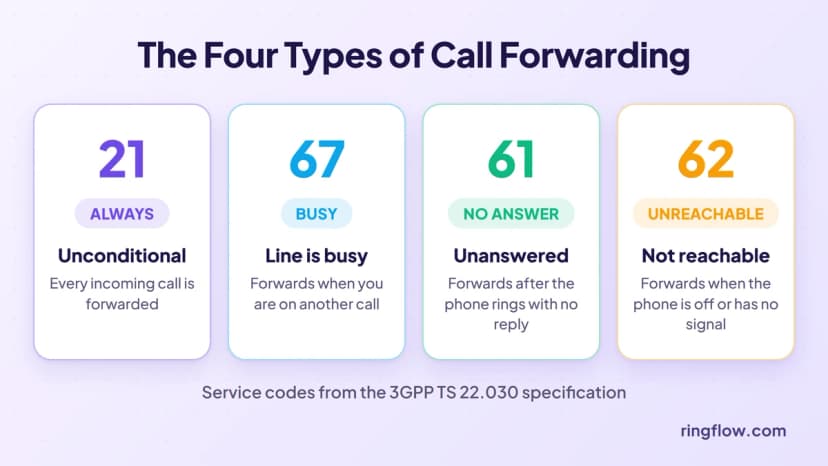
| Type | Standard name | When it forwards | Standard code |
|---|---|---|---|
| Unconditional (always) | CFU | Every incoming call | 21 |
| Busy | CFB | When your line is busy | 67 |
| No answer | CFNRy | When you don't answer | 61 |
| Unreachable | CFNRc | When your phone is off or out of reach | 62 |
| Selective | Varies by provider | Only calls from chosen callers | Varies by service |
The service codes come from the 3GPP TS 22.030 specification, and the abbreviations are the standard names for each type. On a Samsung Galaxy phone the menu lists always, busy, unanswered and unreachable as separate options.
Because each type is its own setting, a phone can have one active while the others are off. That is why, if you want forwarding gone, it helps to know which type you are clearing.
How Call Forwarding Works
Forwarding is handled by the phone network, not by the handset alone. The network checks the forwarding setting for the number that was dialed and redirects the call before it reaches your phone. That is why the setting is changed with codes dialed to the network, such as Verizon's *72 to start and *73 to stop, or the standard GSM codes where * registers or activates a feature, # deactivates it and ## erases it.
Two behaviors surprise people. AT&T notes that call forwarding overrides wireless voicemail, and that if the number a call is forwarded to is busy, callers hear a busy signal.
Which Type of Call Forwarding Fits Which Situation?
There is no single best type. The right one depends on why you want calls to go somewhere else:
- Always (unconditional). Use it when the phone won't be with you, such as on a trip or after a lost handset. Every call goes to the other number, so the original phone stops ringing.
- Busy. Use it so a second caller still reaches someone while you are on a call.
- No answer. Use it as a fallback. The phone rings first, and if you don't pick up, the call moves on to another number.
- Unreachable. Use it for a phone that is switched off or out of coverage, so calls don't hit a dead end.
Each type is its own setting, so they can be combined. Some people point busy, no answer and unreachable at the same backup number so a call is caught in every case, while leaving unconditional forwarding off. Whatever mix you choose, note the numbers involved, because forwarding you forgot about is a common reason calls go missing.
Call Forwarding vs Call Transfer
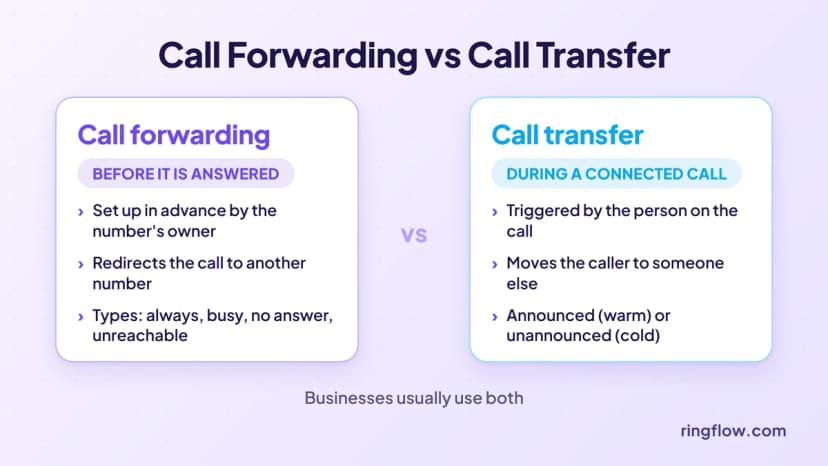
A call transfer relocates an existing call to another phone or attendant console, so it happens after someone has answered. Forwarding is a setting that redirects a call before it is answered.
| Call forwarding | Call transfer | |
|---|---|---|
| When it happens | Before the call is answered | During a connected call |
| Who triggers it | The number's owner, in advance | The person on the call, at the moment |
| Kinds | Unconditional, busy, no answer, unreachable, selective | Announced (attended) or unannounced (blind) |
| Typical use | Reach you when you are away or busy | Hand a caller to the right person |
In an announced transfer, the person transferring puts the caller on hold and speaks to the receiving party first. In an unannounced transfer, the call moves without notice. Call centers add their own names: a warm transfer includes talking to the receiving person before handing over, while a cold transfer often just passes the caller along.
In a business setting you usually use both. Forwarding decides where a call goes when it arrives, and transfer lets the person who answered move it to someone else.
Does Call Forwarding Forward Text Messages?
No. Call forwarding moves calls only. Verizon states that it won't forward text messages you receive on your mobile phone, only calls. On an iPhone, sharing texts with your other devices is a separate feature, Text Message Forwarding, under Settings > Apps > Messages.
What Call Forwarding Costs and Where It Stops
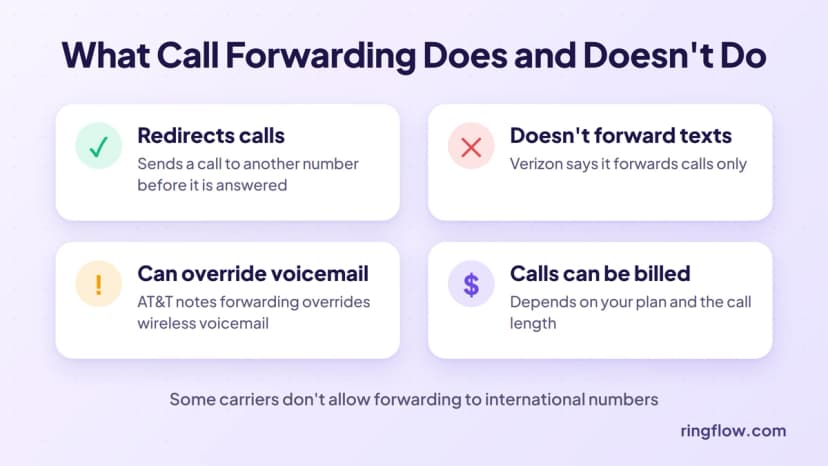
- Billing. Verizon says there is no monthly fee for forwarding on most plans, but without unlimited minutes you are billed for forwarded calls under your plan. AT&T says forwarded calls incur charges based on call length.
- Who pays. In general, the owner of the forwarding line pays any toll charges for the forwarded leg.
- International numbers. AT&T says wireless call forwarding cannot go to international numbers, so check your own carrier's limits.
- Voicemail. AT&T notes forwarding overrides wireless voicemail, so calls that are forwarded won't reach your own voicemail box.
How to Set Call Forwarding Up or Turn It Off
On Verizon, dial *72 followed by the 10-digit number to forward all calls, *71 followed by a number to forward calls you don't answer, and *73 to turn forwarding off. On networks that follow the GSM standard, *21*number# turns on forwarding for all calls and ##21# clears it. On an iPhone, use Settings > Apps > Phone > Call Forwarding.
For step-by-step instructions, see our guides on how to forward calls and how to turn off call forwarding, which also covers checking for forwarding you didn't set up.
Call Forwarding for Business Numbers
Businesses use the same idea with more control. Typical rules include:
- Sending calls to a mobile phone outside office hours.
- Ringing a colleague when a line is busy or unanswered.
- Routing calls to a team instead of one person's handset.
- Keeping the same business number when staff change, rather than re-pointing forwarding on personal phones.
Business phone systems typically keep those rules in an admin portal or app rather than on a handset, which keeps routing consistent when people join, leave or travel.
Ringflow lets a team take calls on one business number in mobile and desktop apps. Start a free trial and see how it fits your calls.
If you are choosing a number for a team, our guides to a business phone number and Ringflow's cloud phone system are good starting points.
Conclusion
Call forwarding, or call diversion, redirects a call to another number before it is answered. It comes in four main types, moves calls but not texts, and differs from call transfer, which moves a call that is already connected.
Check what your carrier charges and allows, know which type you have switched on, and clear it when you no longer need it.
Ready when you are
Need Calls to Follow Your Team, Not One Phone?
Ringflow gives your team a business number that rings on mobile and desktop apps, so a call reaches the right person without a personal forwarding setting. Start a free trial and test it on your own calls.
FAQ
It means a call was redirected to another number before it reached the number that was dialed. The person who owns the number set it up to go somewhere else, either always or under certain conditions.
Call diverting, or call diversion, is another name for call forwarding. The terms are generally interchangeable.
The common types are unconditional (all calls), busy, no answer and unreachable, plus selective forwarding for chosen callers. Their standard codes are 21, 67, 61 and 62 for the first four.
Forwarding is a setting that redirects a call before it is answered. Transfer moves a call that is already connected, either announced (the receiving party is told first) or unannounced.
No. Verizon says call forwarding forwards calls only, not text messages. Sharing texts with other devices is a separate feature.
It can. Verizon has no monthly fee on most plans but bills forwarded calls if you don't have unlimited minutes, and AT&T charges by call length. The owner of the forwarding line generally pays for the forwarded leg.
On an iPhone, a green slider under Settings > Apps > Phone > Call Forwarding means it is on. You can also dial *#21# to check whether forwarding for all calls is active.
It depends on your carrier. AT&T says wireless call forwarding cannot go to international numbers, so check your carrier's rules before you set it up.
While calls are being forwarded, they don't reach your own voicemail. AT&T notes that call forwarding overrides wireless voicemail.