
Introduction
The VoIP price war ended years ago. Every major provider now bundles HD voice, mobile apps, and basic CRM connections at roughly the same per-user price point — typically $10 to $50 per month. Businesses that switched to VoIP to cut costs already cut them, often by up to 50% versus legacy landline systems. What separates phone services in 2026 isn't the voice quality. It's what the platform does with the call data, how AI layers on top of live conversations, and whether the phone system connects to the rest of the business stack or sits in isolation.
For US businesses making the switch in 2026, the question is no longer whether to move to VoIP — it is which platform gives you the most leverage over every call. The right VoIP phone service does not just replace your landline; it becomes the operating layer for your entire sales and support motion, feeding real-time data to your CRM, surfacing coaching cues to reps mid-call, and giving supervisors live visibility across every active conversation.
What Is a VoIP Phone Service?
A VoIP phone service routes business calls over the internet as digital data packets rather than through traditional copper phone lines. It converts voice signals into IP data at the point of origin, transmits them across the network, and reassembles them at the destination. Any device with internet access — a desk phone, laptop softphone, or mobile app — becomes a business phone line.
The shift from PSTN (Public Switched Telephone Network) infrastructure to IP-based calling eliminated per-minute charges on most domestic routes and dramatically reduced international call costs. A 50-seat sales team no longer needs a PBX cabinet in the server room. The phone system runs in the cloud, scales through a browser, and logs every call automatically.
That's the baseline. It's been the baseline for several years. The question for 2026 is what runs on top of the voice layer — and whether your cloud platform is built to answer it.
- No physical phone lines required — calls travel as data packets over your existing internet connection, eliminating the need for traditional PSTN copper infrastructure.
- Works on any device — desk phones, laptops, tablets, and iOS/Android apps all become fully functional business lines under the same number.
- Dramatically lower costs — domestic calls are effectively free, and international rates drop by 40–90% compared to legacy landline plans.
- Instant scalability — add or remove extensions in minutes from a web dashboard with no hardware procurement or on-site technician visits.
- Portable business identity — your number follows you across devices and locations, so clients always reach the same number regardless of where your team works.
How VoIP Phone Service Works
When an agent dials a number from a VoIP-enabled device, the voice signal is immediately digitized and broken into data packets by a codec — typically G.711 for high-quality audio or G.729 for compressed, low-bandwidth transmission. Those packets travel across the internet to the provider's Session Border Controller (SBC), which handles routing, security policy, and call signaling via the SIP (Session Initiation Protocol) standard.
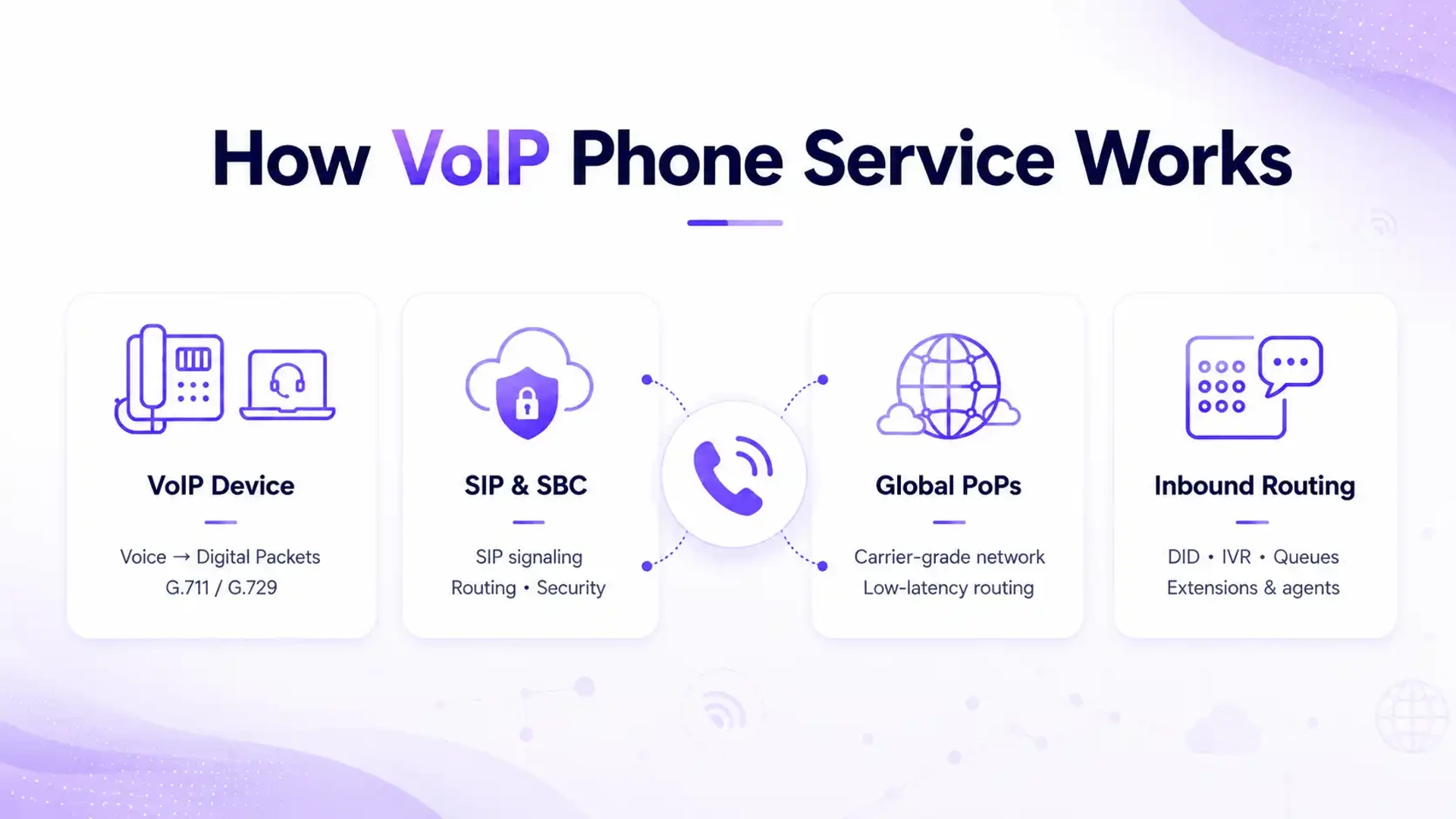
The SBC routes the call through the provider's network — over carrier-grade infrastructure with Points of Presence (PoPs) distributed globally — until it reaches the destination carrier via voice termination.
Inbound calls reverse this path. A DID (Direct Inward Dialing) number assigned to your business accepts the incoming call, routes it through the provider's network, and delivers it to the right extension, queue, or IVR menu based on your routing rules.
Bandwidth: minimum 100 kbps per concurrent call for G.711. Jitter: under 30 ms. Packet loss: under 1% to maintain voice clarity.
6 Features That Separate Good VoIP from Great in 2026
The feature gap between providers has narrowed on basics — voicemail, call forwarding, conferencing. The gap has widened on the features that affect revenue.
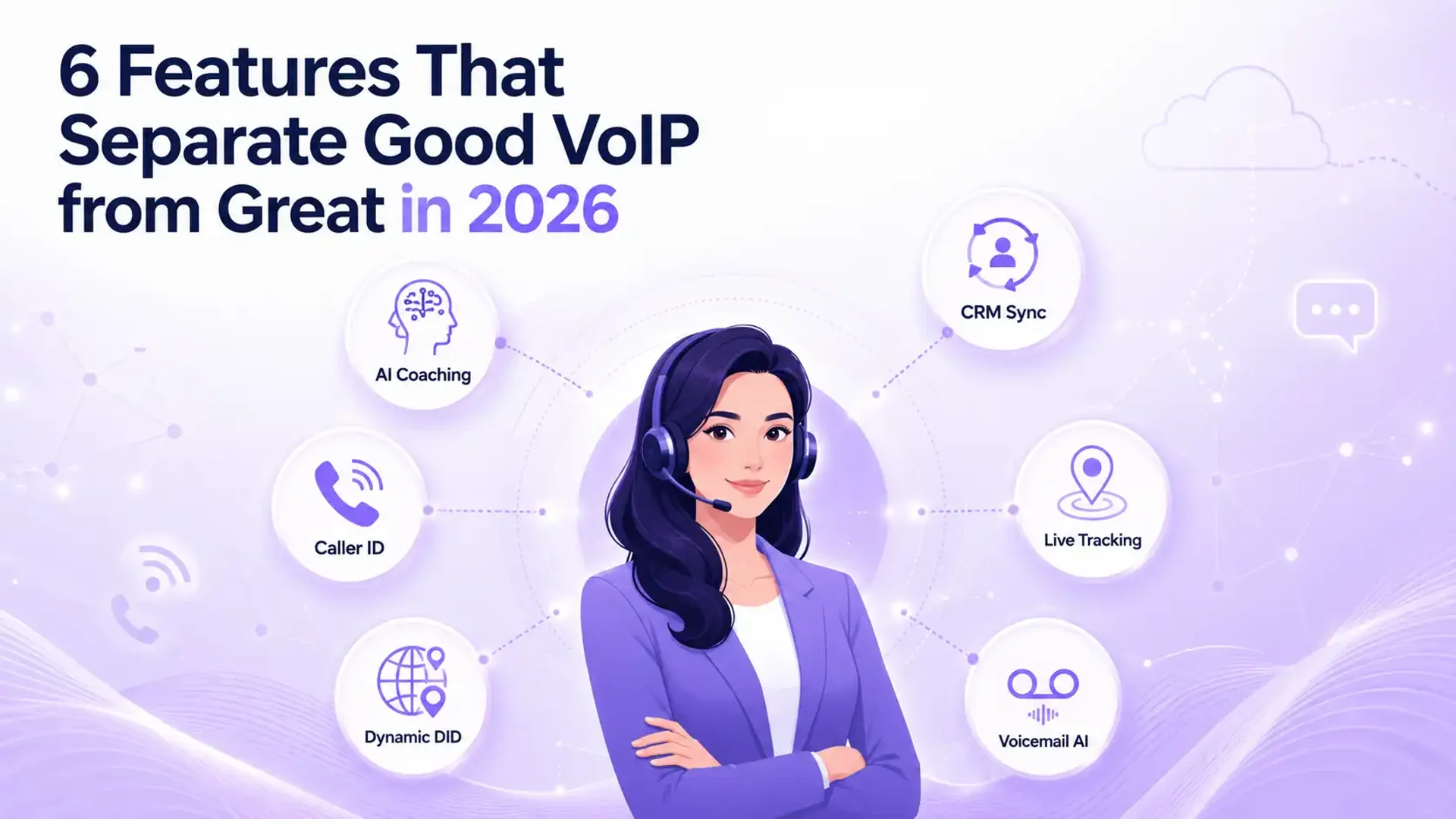
- 1AI Sales Coaching during live calls — Post-call analysis is useful. Real-time guidance during the conversation is where the revenue impact lands. Ringflow's AI Sales Coaching surfaces talk-track prompts and objection responses to reps while the call is active — not in a debrief an hour later.
- 2Rotating Caller ID for outbound teams — Carrier algorithms flag numbers that dial high volumes from a single ID as potential spam. Rotating Caller ID cycles the outbound number automatically, keeping connect rates from eroding on active campaigns. This is a contact-center-level feature that most standalone VoIP services don't offer.
- 3Dynamic DID Handling — Dynamic DID Handling assigns separate virtual numbers per campaign or traffic stream. A healthcare follow-up campaign uses a different number from a retail upsell campaign — caller ID reputation stays clean across all outbound activity.
- 4CRM-native call logging — Every call logged automatically to HubSpot or Zoho eliminates the manual entry that consumes 10–15 minutes per rep per day. More importantly, it ties call duration, outcome, and recording to the right contact record without depending on agent discipline.
- 5Live Call Tracking and real-time monitoring — Live Call Tracking gives supervisors a real-time view of active calls — who is on a call, how long it has been running, which queue it came from. Combined with VoIP number analytics, it turns operational insight from a weekly report into a live dashboard.
- 6Auto Voicemail Detection (AMD) — Auto Voicemail Detection identifies answering machines before connecting the agent, dropping a pre-recorded message instead of burning live agent time on a voicemail. On a power dialer running 500 dials per day, AMD meaningfully increases agent talk time.
VoIP Phone Service by Business Size
Needs differ sharply by scale. The right configuration for a 5-person startup is not the right one for a 200-seat contact center. High-volume teams often run on wholesale VoIP capacity at the infrastructure layer.
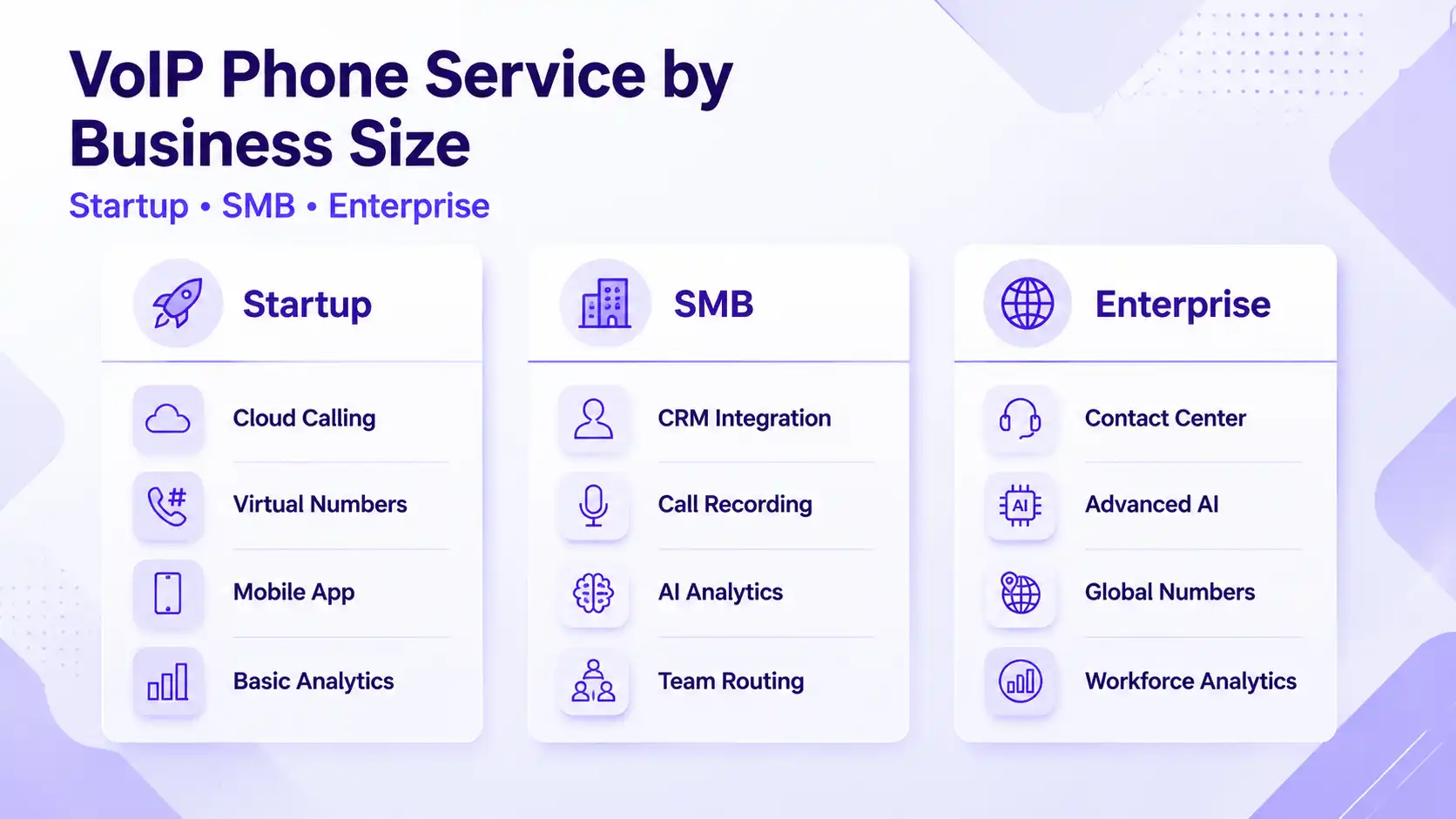
- Startups — need fast deployment, low per-seat cost, and mobile-first access. A cloud phone service with a softphone app and basic call routing covers the requirement. Ringflow's startup tier is built for this — no hardware, no PBX setup, active from day one.
- Small and mid-size businesses — typically need call queuing, IVR menus, multi-extension management, and CRM integration. The call management layer and integrated CRM communications handle these without custom development.
- Enterprises and contact centers — require the full stack: inbound ACD routing, outbound dialing infrastructure, agent performance monitoring, compliance recording, and AI-assisted coaching at scale. Ringflow's enterprise contact center combines all of these under one platform — inbound and outbound management, AI Team Performance monitoring, and analytics that span the entire operation.
How to Choose a VoIP Phone Service: 5 Questions
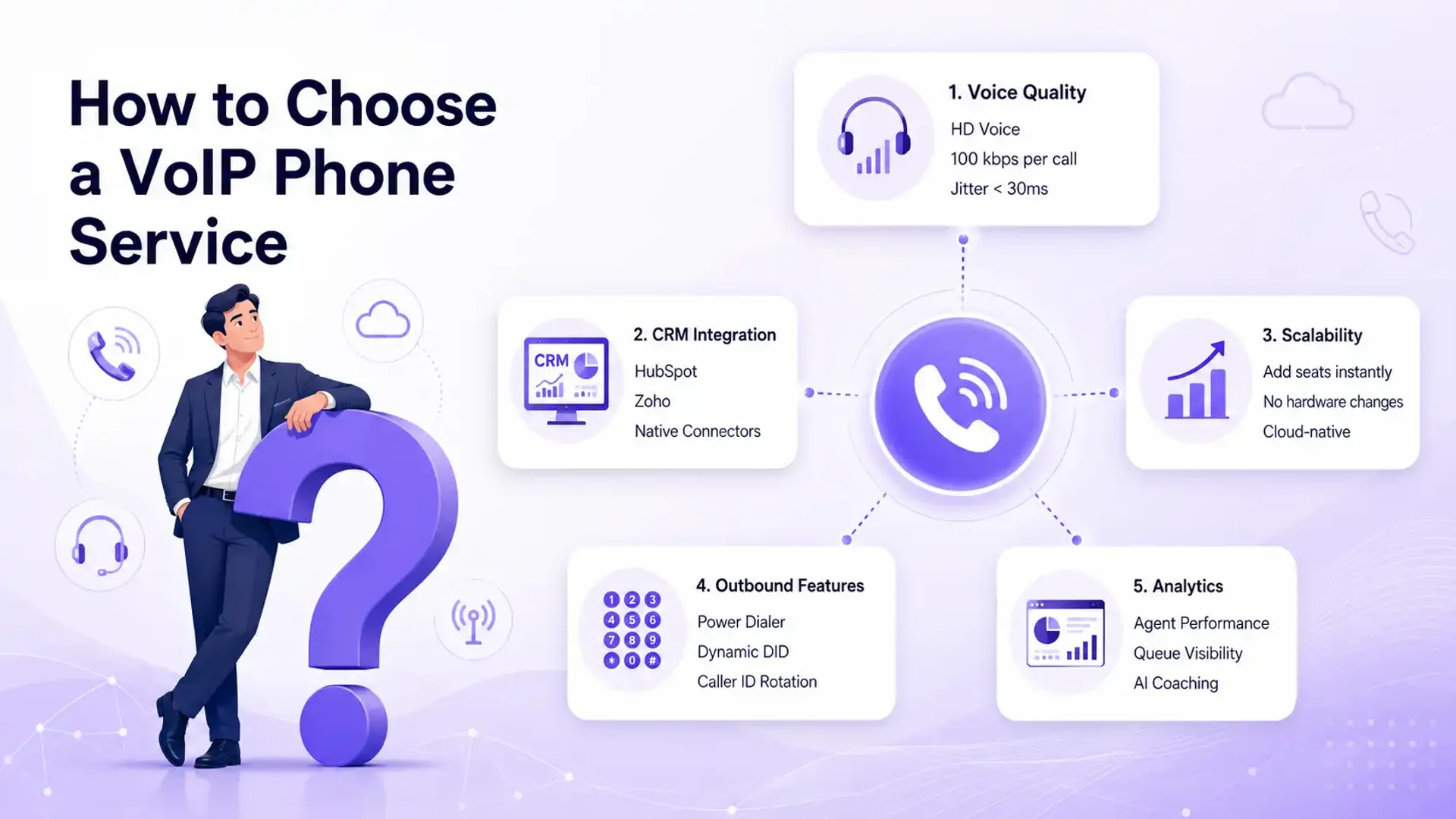
- 1Does the voice quality hold under your bandwidth conditions? Request a trial during peak hours. HD voice under load, not in a demo environment, is the real test. Minimum 100 kbps per concurrent call; jitter under 30 ms.
- 2Does it integrate with your CRM without middleware? Native HubSpot and Zoho connectors mean zero configuration after setup. API-only integrations require engineering time and break when APIs update.
- 3Does it scale without hardware changes? Adding 20 seats should take minutes, not a hardware order. Cloud-native platforms scale through a portal. Hybrid systems with on-premise components don't.
- 4Does it include outbound features if you run campaigns? Rotating Caller ID, Dynamic DID, Auto Voicemail Detection, and power dialing are not standard in most business VoIP plans. If your team dials outbound volume, confirm these before committing.
- 5What does the analytics layer actually show? Call duration and volume are table stakes. Agent-level performance, campaign ASR, real-time queue visibility, and AI coaching data are the metrics that drive decisions.
Also verify compliance before committing to any provider. Per FCC guidelines, all VoIP deployments must maintain compliance with call authentication standards including STIR/SHAKEN.
Conclusion
VoIP phone service stopped being a cost story in 2026. Every provider delivers on the basics at a comparable price. The decision now is about the intelligence layer — whether the platform turns every call into actionable data, whether AI coaching reaches reps during live conversations rather than after, and whether the phone system connects tightly enough to your CRM and contact center stack that it adds to your pipeline rather than just enabling it.
Ringflow's cloud contact center and AI Sales Platform delivers that full stack — from the SIP layer through to AI-driven coaching, analytics, and CRM integration — built for businesses that treat every call as a revenue event.
HD voice, AI coaching, Rotating Caller ID, live tracking, and CRM logging — one platform. No hardware. No long contracts. Active from day one.
Ready when you are
See What AI-Powered VoIP Can Do for Your Business
HD voice, AI coaching, rotating caller ID, live tracking & CRM logging — one platform. No hardware. No long contracts. Active from day one.
FAQ
VoIP phone service routes calls over the internet as digital data packets, while traditional phone lines use analog copper circuits through the PSTN. VoIP eliminates per-minute charges on most domestic routes, reduces international call costs significantly, and allows any internet-connected device to function as a business phone. It also enables software features — call analytics, CRM logging, AI coaching — that analog lines cannot support.
Business VoIP typically costs $10 to $50 per user per month depending on the provider, plan tier, and features included. Basic plans cover voice, voicemail, and call forwarding. Mid-tier plans add CRM integration, call analytics, and team collaboration tools. Enterprise plans include contact center features, AI coaching, and advanced outbound dialing. Most providers offer per-seat pricing that scales with headcount.
Each concurrent VoIP call requires approximately 100 kbps of bandwidth using the G.711 codec, or around 32 kbps with G.729 compression. A 10-person team with 4 concurrent calls at peak needs roughly 400 kbps dedicated to voice traffic. Beyond bandwidth, low network jitter (under 30 ms) and packet loss below 1% are the two factors that most directly affect call clarity.
Yes. Most cloud VoIP providers offer iOS and Android apps that use the same business phone number as desk phones or desktop softphones. Calls made from the mobile app display the business number — not a personal mobile number — maintaining professional caller ID. This lets remote and field teams make and receive business calls from any location with internet access.
Reputable VoIP providers encrypt calls using TLS (Transport Layer Security) for signaling and SRTP (Secure Real-time Transport Protocol) for voice data. Session Border Controllers enforce access policy and block unauthorized traffic. For businesses in regulated industries — healthcare, legal, finance — confirm HIPAA-compatible infrastructure and data residency options before selecting a provider.