
Introduction
Choosing between SIP trunk providers affects more than your monthly phone bill. The right service helps your business maintain reliable calls, connect existing phone systems, and expand without installing additional physical lines.
However, SIP trunk providers differ in pricing, coverage, security, compatibility, and technical support. Some offer pay-as-you-go calling, while others specialize in enterprise networks or high-volume traffic.
This Ringflow guide explains how SIP trunking works, compares established providers, and answers common questions about costs, channels, number portability, and security.
What Are SIP Trunk Providers?
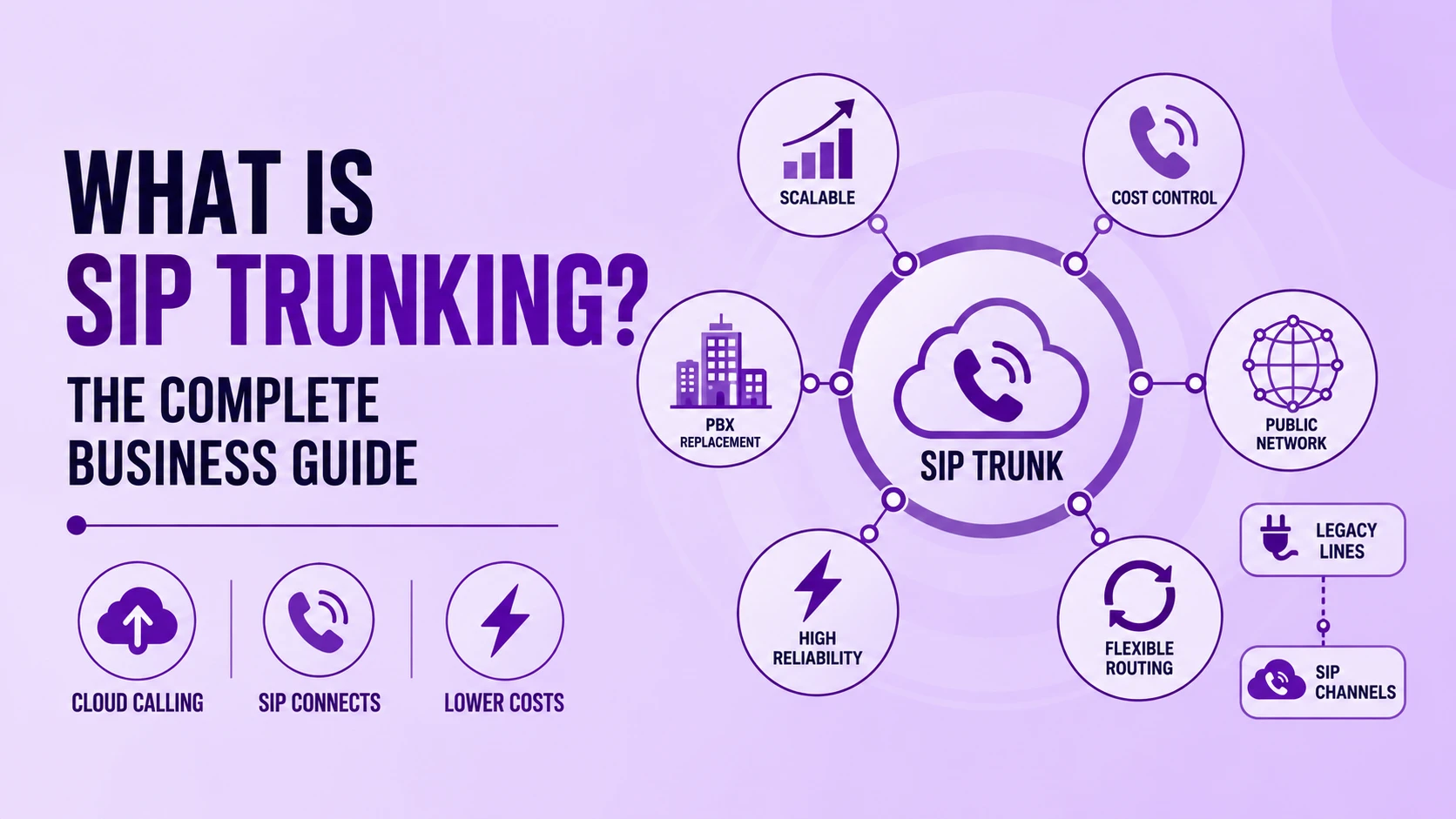
SIP trunk providers are telecommunications companies that connect business phone systems to the public switched telephone network (PSTN) using internet-based technology.
SIP stands for Session Initiation Protocol, which establishes, manages, and ends communication sessions. Instead of relying on traditional telephone circuits, businesses use SIP trunks to make and receive calls through an IP-enabled phone system.
A SIP trunk is a logical connection, while a SIP channel generally represents capacity for one simultaneous call. Some SIP trunk providers charge for fixed channel allocations, while others offer elastic capacity subject to account and network limits.
Businesses use SIP trunking to:
- Connect existing PBX systems to external telephone networks.
- Manage local, national, and international calling.
- Increase calling capacity as requirements change.
- Maintain business numbers through supported porting arrangements.
For a deeper explanation, read our guide to SIP trunking.
How Do SIP Trunk Providers Work?
SIP trunking connects your business phone system to a provider's network, which routes calls to their destinations. When an employee makes a call, the process generally follows these steps:
- 1Call initiation: Your PBX sends a SIP request to the provider.
- 2Authentication: The provider verifies that the connection is authorized.
- 3Call routing: The provider determines how to reach the destination network.
- 4Media connection: Audio travels using an agreed codec and media path.
- 5Call completion: The provider records relevant usage and billing information.
Incoming calls follow a corresponding process in reverse. Although SIP is defined by the RFC 3261 standard, SIP trunk providers can differ significantly in routing, security configuration, reliability, and interoperability.
SIP Trunk Providers to Compare in 2026
There is no single best SIP trunk provider for every business. The right choice depends on geography, call volume, existing infrastructure, and required technical control.
The following established SIP trunk providers offer different approaches to SIP connectivity.
| Provider | Main focus | Worth evaluating for |
|---|---|---|
| Twilio | Elastic SIP trunking and programmable communications | Developers and flexible integrations |
| Telnyx | Elastic SIP connectivity and carrier network services | Usage-based calling and network control |
| Bandwidth | Enterprise voice connectivity and telecom APIs | Enterprise communications infrastructure |
| Flowroute | Metered SIP trunking and self-service tools | PBX connectivity and usage-based billing |
- Twilio provides Elastic SIP Trunking for connecting business communications infrastructure to telephone networks. Its documentation covers configuration, security, and scaling requirements.
- Telnyx offers elastic SIP trunks with usage-based pricing. Businesses can review its published rates and technical documentation when evaluating connectivity options.
- Bandwidth focuses on enterprise communications infrastructure, offering SIP connectivity alongside voice, numbering, and related services.
- Flowroute provides metered SIP trunking that can appeal to businesses seeking pay-as-you-go billing and control over their existing phone systems.
These are comparison candidates, not a performance ranking. Verify current coverage, rates, availability, and platform compatibility directly before purchasing.
Types of SIP Trunk Providers
Understanding the categories of SIP trunk providers helps narrow your shortlist, and Ringflow recommends starting here.
- Facilities-based carriers: Operate substantial network infrastructure, potentially providing greater control over routing and service management.
- SIP trunk resellers: Purchase connectivity from upstream carriers and package it with additional billing, support, or managed services.
- Cloud communications providers: Offer SIP connectivity alongside services such as virtual numbers, communications APIs, and hosted phone systems.
- Wholesale voice providers: Serve carriers, service providers, and organizations with substantial calling requirements.
Network ownership alone does not guarantee superior service. Evaluate actual performance, redundancy, customer support, and commercial terms.
Key Features to Compare Before Choosing
A reliable SIP trunk provider should support your operational requirements without introducing unnecessary complexity.
Coverage and Number Portability
Confirm that the provider supports your calling destinations, required number types, and geographic markets. If you already have business numbers, ask whether they can be transferred. Portability depends on local regulations, number eligibility, and carrier arrangements.
Call Quality and Reliability
Review provider monitoring, route diversity, uptime commitments, and failover arrangements. Important quality indicators include latency, jitter, packet loss, and post-dial delay. Where relevant, assess Answer Seizure Ratio (ASR) and Average Call Duration (ACD) across representative traffic.
Security and Fraud Prevention
Look for supported TLS signaling encryption, SRTP media encryption, IP access restrictions, authentication controls, and fraud monitoring. Confirm which protections are enabled by default and whether encryption extends across the relevant connection.
Compatibility and Support
Verify interoperability with your PBX, session border controller, or communications platform. Request configuration documentation, service-level commitments, escalation procedures, and access to technical support.
How Much Do SIP Trunk Providers Cost?
SIP trunk pricing depends on the billing model, destination, usage, and service configuration. Three common pricing approaches are:
- Per-channel pricing: Monthly charges for allocated simultaneous-call capacity.
- Metered pricing: Charges based on calling minutes, sometimes combined with other fees.
- Bundled pricing: A recurring charge with included calling allowances and usage restrictions.
Additional expenses may include telephone numbers, emergency calling, setup, porting, and international termination.
Consider a hypothetical business making 10,000 outbound minutes monthly at an illustrative rate of $0.01 per minute. Its outbound usage would cost $100 before numbers, taxes, channel charges, and other fees. This is a calculation example, not a current provider quote.
Ringflow recommends asking each of the SIP trunk providers on your shortlist to estimate your complete monthly bill using the same calling destinations, minutes, peak concurrency, and number requirements. For additional background, see our VoIP termination guide.
SIP Trunking vs VoIP: What's the Difference?
VoIP refers broadly to transmitting voice communications over IP networks. SIP trunking is one way to connect a compatible phone system to telephone networks using VoIP technology.
| SIP trunking | Hosted VoIP phone service |
|---|---|
| Connects an existing PBX to carrier networks | Typically includes a provider-managed phone platform |
| Business manages its PBX configuration | Provider manages much of the infrastructure |
| Pricing commonly depends on channels or usage | Pricing commonly depends on users and features |
| Suits organizations retaining compatible PBX systems | Suits businesses wanting a managed phone solution |
SIP trunking is often appropriate when a business already operates a PBX. Hosted VoIP may be easier when an organization wants to replace its phone infrastructure entirely.
How Many SIP Channels Does Your Business Need?
Channel requirements depend on the maximum number of simultaneous calls, not simply employee count. For example, a company with 50 employees might have only 12 active calls during its busiest period.
If the provider uses channel-based capacity, the business could begin planning around that measured peak and add appropriate headroom. Review historical call records, seasonal peaks, expected growth, and tolerance for blocked calls before deciding.
Elastic services may not require purchasing fixed channels, but concurrency, calls-per-second, and infrastructure limits still matter.
How to Choose the Right SIP Trunk Provider
Follow a structured evaluation when comparing SIP trunk providers instead of looking at advertised rates alone.
- 1Identify requirements: Record calling destinations, monthly minutes, peak simultaneous calls, and existing equipment.
- 2Shortlist providers: Confirm number availability, coverage, compatibility, and required features.
- 3Compare total costs: Evaluate billing increments, channel fees, destination rates, and contract terms.
- 4Review security and resilience: Check encryption, authentication, redundancy, emergency calling, and fraud controls.
- 5Conduct test calls: Evaluate audio quality, call setup, routing reliability, and support responsiveness.
- 6Plan deployment: Test inbound and outbound calling, number porting, failover, and rollback procedures before migration.
For business-critical communications, Ringflow advises requesting documented service commitments and establishing an escalation contact before going live.
Conclusion
Selecting SIP trunk providers requires balancing price, reliability, coverage, security, and technical compatibility.
Start by understanding your calling requirements, comparing suitable services, and testing real traffic before committing. Transparent pricing and dependable support are often more valuable than the lowest advertised rate.
Ringflow encourages businesses to evaluate their connectivity requirements carefully and confirm technical and commercial details before choosing a SIP trunking solution. A well-matched provider can support reliable communications today while providing room for future growth.
Ready when you are
Need a SIP Trunk You Can Trust?
Talk to Ringflow about SIP trunking, clear per-minute rates and a short test before you scale. Get a custom quote today.
Frequently Asked Questions
The best option depends on your existing phone system, budget, calling patterns, and support needs. Small businesses should prioritize straightforward configuration, predictable costs, and responsive assistance.
Often, yes. Many SIP trunk providers support number porting, subject to eligibility and local regulations. Confirm coverage, expected timelines, and fees before canceling your current service.
SIP trunking can be secured using TLS, SRTP, authentication, network restrictions, and fraud controls. Security depends on correct configuration and the protections supported by your provider.
Many IP PBX systems support SIP trunk connections. Compatibility depends on software versions, codecs, authentication, network configuration, and provider requirements. Older systems may need a gateway.
Calls may fail unless alternative connectivity or routing is configured. Ask about network redundancy, backup destinations, automatic failover, and disaster recovery procedures.