
Introduction
The India phone number format is simpler than it first looks: a regular Indian number, mobile or landline, has 10 digits. What changes is how those digits are grouped, whether a 0 goes in front, and whether the number is written for someone in India or for a reader abroad with +91.
This guide follows the Department of Telecommunications (DoT) numbering plan and papers from the Telecom Regulatory Authority of India (TRAI), covering mobiles, landlines, the +91 form, special series and clean storage. Every example uses X in place of real digits.
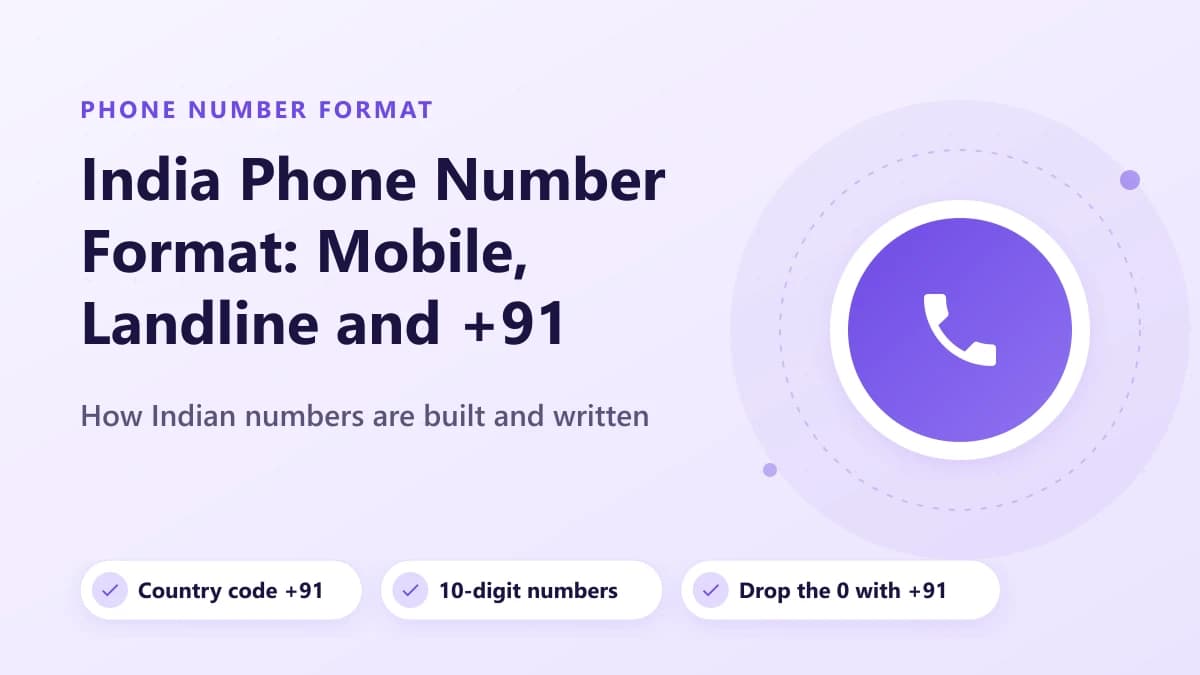
- Mobile and landline numbers are both 10 digits long under India's National Numbering Plan.
- Mobile numbers come from series starting with 9, 8, 7 and 6; a landline is an STD code plus a subscriber number.
- The leading 0 is a trunk prefix for dialing inside India. It is dropped when you write +91.
- 1800 numbers are toll-free for the caller, 140 numbers belong to telemarketers and 160 numbers are reserved for service calls.
India Phone Number Format: How Numbers Are Structured
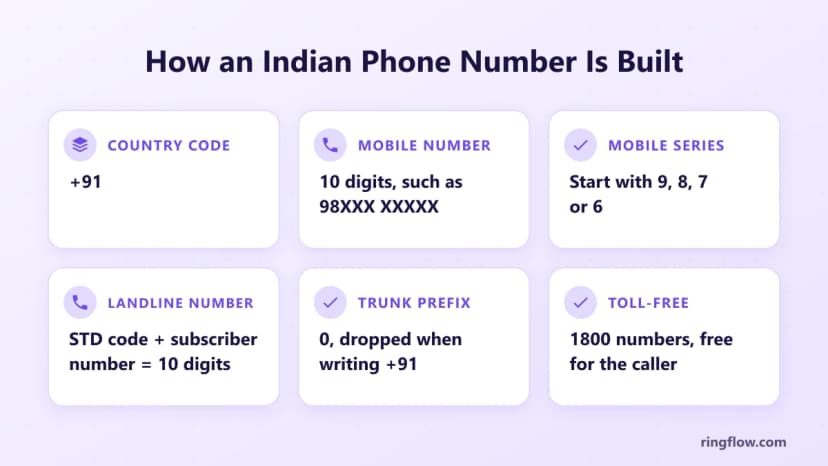
India's rules come from the National Numbering Plan 2003. It set a 10-digit national number for both fixed-line and mobile services. That core stays the same wherever the call comes from; only the prefix in front of it changes.
The first digit has a job. 0 is the trunk prefix and 1 is kept for special services such as 1800 toll-free numbers. The 2003 plan reserved level 9 for mobiles; TRAI papers from 2019 and 2024 show mobile numbers in levels 8, 7 and 6 as well.
| Number type | Written in India | Digits (without 0) | Written with +91 |
|---|---|---|---|
| Mobile | 98XXX XXXXX | 10 | +91 98XXX XXXXX |
| Landline, 2-digit STD code | 011-XXXX XXXX | 10 | +91 11 XXXX XXXX |
| Landline, 3-digit STD code | 0XXX-XXX XXXX | 10 | +91 XXX XXX XXXX |
| Landline, 4-digit STD code | 0XXXX-XX XXXX | 10 | +91 XXXX XX XXXX |
Indian Mobile Number Format (10 Digits)
An Indian mobile number always has 10 digits. TRAI describes mobile service as a closed numbering system, meaning all 10 digits are dialed for calls within India, whether the other phone is next door or in another state. There is no area code to add or remove.
The first five digits are what TRAI calls the MSC code, allocated to operators in blocks, and the last five identify the subscriber, hence the written form 98XXX XXXXX.
Nationwide mobile number portability means the prefix doesn't reliably reveal the network. Calling a mobile from a landline needs a 0 in front: the DoT accepted TRAI's May 2020 recommendation, and the 0 has been mandatory for fixed-to-mobile calls since 15 January 2021.
Today's mobile series start with 9, 8, 7 and 6. TRAI also recommended that, once surrendered numbers run out, codes in levels 2, 3, 4 and 6 can be used for mobile numbers, and the DoT accepted that. A form that only accepts 6 to 9 could reject valid numbers later.
Indian Landline Number Format and STD Codes
A landline number in India has two parts: an STD code for the local charging area (the numbering plan calls it an SDCA or trunk code) and a subscriber number. STD codes are 2, 3 or 4 digits and subscriber numbers are 8, 7 or 6 digits, so the pair always totals 10. The largest cities have the shortest codes.
Within the same area, a landline caller dials only the 6 to 8 digit subscriber number. From a landline in another area, or from any mobile, you dial 0, the STD code and the subscriber number. That is why landlines are written with the 0 in front, as in 011-XXXX XXXX for New Delhi.
| City | STD code | Written in India | Written with +91 |
|---|---|---|---|
| New Delhi | 11 | 011-XXXX XXXX | +91 11 XXXX XXXX |
| Mumbai | 22 | 022-XXXX XXXX | +91 22 XXXX XXXX |
| Kolkata | 33 | 033-XXXX XXXX | +91 33 XXXX XXXX |
| Chennai | 44 | 044-XXXX XXXX | +91 44 XXXX XXXX |
| Hyderabad | 40 | 040-XXXX XXXX | +91 40 XXXX XXXX |
| Bengaluru | 80 | 080-XXXX XXXX | +91 80 XXXX XXXX |
In February 2025, TRAI recommended moving landlines to a 10-digit closed scheme based on licensed service areas, with every fixed-to-fixed call dialed as 0, STD code and subscriber number. It said existing subscriber numbers would stay the same and dialing to and from mobiles would not change. Check the DoT's current notices before changing a dialing rule.
Writing an Indian Number With +91 (International Format)
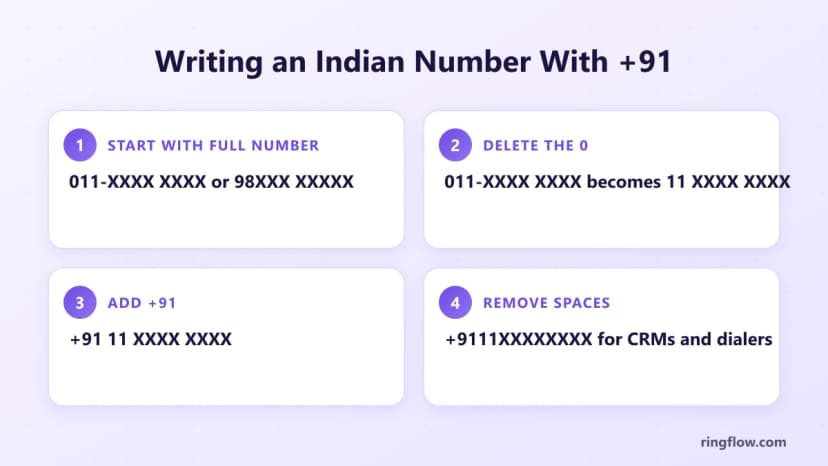
The international version is +91 followed by the 10-digit number, with any domestic 0 removed. The ITU assigns country code 91 to India, and India's numbering plan follows the ITU's E.164 layout of country code plus national number.
- 1Start with the complete number. For a landline, include the STD code: 011-XXXX XXXX.
- 2Delete the leading 0. The landline becomes 11 XXXX XXXX. A mobile such as 98XXX XXXXX has no 0 to delete unless it was saved as 098XXX XXXXX.
- 3Put +91 in front: +91 11 XXXX XXXX or +91 98XXX XXXXX.
- 4Remove spaces and dashes for software: +9111XXXXXXXX or +9198XXXXXXXX, 13 characters including the plus sign.
To dial the number from another country, replace the plus sign with that country's exit code. The India country code +91 page walks through calling India from the US and elsewhere.
Indian Mobile and Landline Number Examples
Each sample shows one number in three contexts. X stands in for real digits, so none of these is a working line; keep the grouping and put in the digits you actually have.
| Example | Written in India | International | Stored (E.164) |
|---|---|---|---|
| Mobile, 9 series | 98XXX XXXXX | +91 98XXX XXXXX | +9198XXXXXXXX |
| Mobile, 6 series | 6XXXX XXXXX | +91 6XXXX XXXXX | +916XXXXXXXXX |
| Mumbai landline | 022-XXXX XXXX | +91 22 XXXX XXXX | +9122XXXXXXXX |
| Bengaluru landline | 080-XXXX XXXX | +91 80 XXXX XXXX | +9180XXXXXXXX |
For readers in India, 98XXX XXXXX is enough. Anywhere seen abroad, such as a website or email signature, use +91 98XXX XXXXX, and always keep a landline's STD code.
Toll-Free and Special Numbers in India
Special numbers sit in level 1 and don't follow the 10-digit subscriber pattern. The best known is 1800. TRAI describes it as a free phone service: the caller pays nothing and the called party bears all charges. These numbers run from 8 to 13 digits, written as 1800, a service code and the number, for example 1800 XXX XXXX.
- 1800: toll-free. The organization receiving the call pays.
- 1860: Universal Access Service. Calls are charged to the caller or split between caller and receiver.
- 140: 10-digit numbers (140XXXXXXX) allocated to telemarketers.
- 160: a series the DoT created in May 2024 only for service and transactional calls. Calls from financial entities such as those under the RBI, SEBI, PFRDA and IRDA start with 1601.
The DoT says operators must verify each entity before assigning a 160 number, and it asks people to report suspected fraud through the Chakshu facility on the Sanchar Saathi portal.
Formatting Indian Numbers in Forms, CRMs and Spreadsheets
One badly stored number can break a dialer import or a text campaign. Keep a single format for storage and add spacing only for display.
- Store +91 and 10 digits: no spaces, dashes or brackets, giving +9198XXXXXXXX for a mobile.
- Validate by length: require exactly 10 digits after +91. A rule that insists on 6 to 9 as the first digit rejects every landline.
- Strip the trunk 0 on import: an 11-digit entry that begins with 0 loses the 0 before +91 is added.
- Give toll-free numbers their own type: 1800 and 1860 numbers vary in length, so a mobile rule will misread them.
- Format spreadsheet columns as text: otherwise the software may drop a plus sign or leading 0, or turn a long number into scientific notation.
The same habits carry over to other countries. The US phone number format guide covers +1 numbers, the Canada phone number format guide explains the shared +1 layout, and the UK phone number format guide shows +44 replacing the 0.
Common Formatting Mistakes
- 1Keeping the 0 after +91. +91 011-XXXX XXXX has one digit too many. The trunk prefix belongs only to dialing inside India.
- 2Dropping the STD code. A landline saved as XXXX XXXX works only for a landline call within the same area.
- 3Saving mobiles with a 0. The 0 is dialed from a landline, but it isn't part of the number. Store the 10 digits or +91 and the 10 digits.
- 4Saving 0091 instead of +91. 00 is the international prefix used in India, and other countries use different exit codes. The plus sign lets each phone supply its own.
- 5Reading the prefix as the operator. With portability, the first digits show which operator received the block, not who serves the subscriber now.
Conclusion
The India phone number format comes down to a fixed length and two prefixes. Mobile and landline numbers have 10 digits, a 0 goes in front where domestic dialing rules call for it, and +91 replaces that 0 for anyone abroad. Landlines carry a 2 to 4 digit STD code, mobiles are written as two groups of five, and 1800 numbers cost the caller nothing.
Indian numbering keeps evolving, and TRAI made further landline recommendations in 2025, so check the DoT's current notices before changing a validation rule. If your team works with contacts in India from the United States, Ringflow offers US local and toll-free numbers that ring on its mobile and desktop apps, with number porting and a free trial.
Ready when you are
Work With Contacts in India From a US Business Line
Ringflow gives your team US local and toll-free numbers that ring on its mobile and desktop apps. Start a free trial, or port the number you already use.
FAQ
An Indian mobile number has 10 digits, usually written as two groups of five, such as 98XXX XXXXX. Mobile numbers come from series starting with 9, 8, 7 and 6. From outside India, the same number is written +91 98XXX XXXXX.
Regular Indian mobile and landline numbers both have 10 digits under the National Numbering Plan. For a landline, the 10 digits include the STD code but not the 0 dialed in front of it. Toll-free 1800 numbers are an exception and can be 8 to 13 digits.
Write the 0, the STD code and the subscriber number, for example 011-XXXX XXXX for New Delhi, where 11 is the STD code. The code and subscriber number always add up to 10 digits. For readers outside India, drop the 0 and write +91 11 XXXX XXXX.
Take the 10-digit number, remove any leading 0 and put +91 in front, as in +91 98XXX XXXXX or +91 11 XXXX XXXX. For a CRM or other software, remove the spaces too, giving +9198XXXXXXXX.
No. The 0 is a trunk prefix used only when dialing within India, so it disappears once +91 is added. Writing +91 0 before the number adds an extra digit, and calls or messages to it can fail.
A sample Indian mobile number looks like 98XXX XXXXX in India and +91 98XXX XXXXX internationally, with X standing in for real digits. Use a placeholder like this in forms and guides, because a made-up 10-digit number could belong to a real person.