
Introduction
An international phone number is a number written so anyone in any country can dial it: a plus sign, a country code and the national number. Every foreign telephone number you come across, on a hotel booking, an invoice or a missed call, can be written that way, and calling one from the US comes down to 011, the country code and the rest of the digits.
This guide explains the E.164 format, how exit codes and country codes fit together, the steps for dialing abroad from a landline or mobile, and how to keep the cost down.
- E.164 is the ITU's international numbering plan: a country code of one to three digits, then the national number, 15 digits at most.
- The plus sign stands for the caller's exit code. It's 011 in the US and other NANP countries, and 00 in most of the world.
- From a US landline, dial 011, the country code and the number without its domestic leading 0. On a mobile, enter + instead of 011.
- Ask about discount plans, consider VoIP, and be careful calling back unknown numbers.
What Makes a Foreign Telephone Number International
Every number belongs to a national numbering plan, and inside its own country it's usually written in a shorter domestic form. What makes it international is the country code, which lets someone elsewhere reach the same line.
An international call crosses from one country's network to another's, and you signal it by dialing an international call prefix (the exit code), then the destination's country code and national number.
Americans meet one wrinkle. Country code 1 belongs to the whole North American Numbering Plan (NANP), which spans 20 countries, including the US, Canada and many Caribbean islands. Calls between them don't use 011, but they aren't typically billed at domestic rates, and a Caribbean area code such as 809 for the Dominican Republic looks just like a US one.
The International Format (E.164) Explained
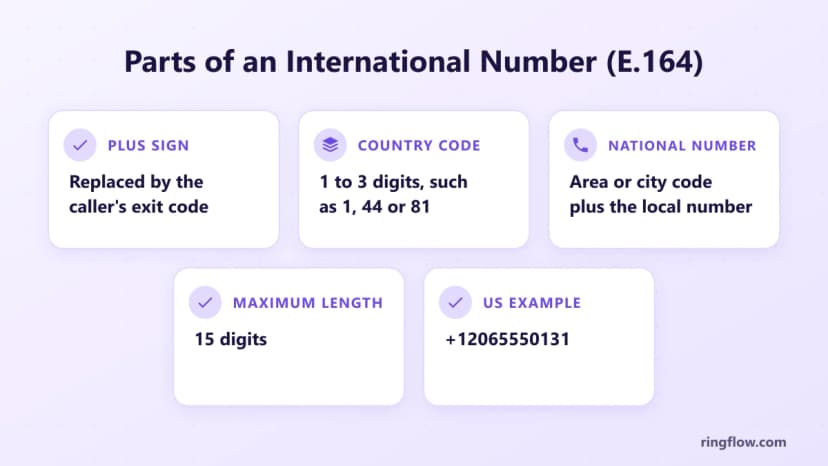
ITU-T Recommendation E.164 is titled "The international public telecommunication numbering plan." Numbers that follow it contain digits only, 15 at most, split into a country code of one to three digits and the subscriber number that follows.
| Part | What it does | US example | Brazil example |
|---|---|---|---|
| + | Replaced by the caller's exit code | + | + |
| Country code | Identifies the country or shared plan | 1 | 55 |
| National number | Area or city code plus the local number | 206 555 0131 | 21 XXXX XXXX |
| E.164 form | Digits only, no spaces | +12065550131 | +5521XXXXXXXX |
The plus isn't a digit you dial on a landline. It tells the reader to swap in the international prefix used where they are, which is why one written number works for callers in every country.
Exit Codes and Country Codes
The exit code tells your own network the call is leaving the country; the country code says where it's going.
| Code | Also called | Depends on | Examples |
|---|---|---|---|
| Exit code | International call prefix, IDD code | The country you call from | 011 in NANP countries; 00 in most others |
| Country code | Country calling code | The country you're calling | 44 United Kingdom, 52 Mexico, 61 Australia, 81 Japan, 91 India |
E.164 names 00 as the standard exit code, and most countries use it. NANP members use 011, some post-Soviet states still use 810, and a small number of countries use others such as 0011 or 119.
Country codes are grouped into world zones by their first digit, with zone 1 for the NANP and zones 3 and 4 mostly in Europe, and a few are shared, such as +7 for Russia and Kazakhstan. For every code, see our country code directory.
Many countries also add a trunk prefix, often 0, for domestic calls. Drop it after the country code, as a UK caller does when dialing an Australian number.
How to Call an International Number From the US
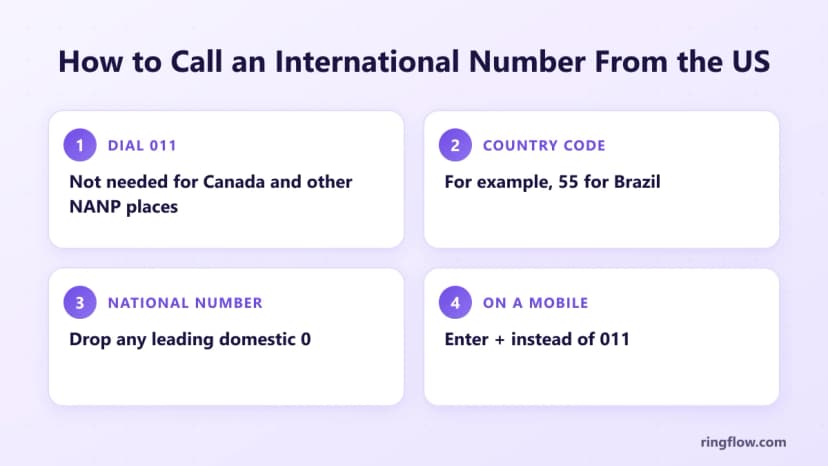
The FCC's international calling tip sheet puts it simply: dial 011, then the country code, the area or city code, and the phone number. Its own example is Rio de Janeiro, Brazil: 011 55 21 XXXX-XXXX.
- 1Dial 011. Skip it for Canada and other NANP destinations, which share country code 1.
- 2Enter the country code, such as 55 for Brazil or 81 for Japan.
- 3Add the national number, including the area or city code but without any leading domestic 0.
- 4On a mobile, start with + instead of 011. The FCC's Mexico guidance, for instance, tells mobile callers to enter +, then 52, then the 10-digit number.
Details can change: since August 3, 2020, callers reaching a Mexican mobile no longer add a 1 after 52, so the call is 011 52 XX XXXX XXXX from a landline or +52 XX XXXX XXXX from a mobile.
The FCC warns about "one ring" scams: a call rings once and hangs up, hoping you'll call back a number outside the US and pay connection and per-minute charges. Some use codes that resemble US area codes, such as 809 for the Dominican Republic or 232 for Sierra Leone, so be cautious with numbers you don't recognize.
International Calling Costs and Cheaper Options
Rates vary by provider and destination. The FCC's tips suggest a few ways to pay less:
- Ask about a discount plan if you call certain countries regularly, and look at the total cost, which will likely include more than the advertised per-minute rate.
- Consider VoIP. The FCC notes that Voice over Internet Protocol calling may be cheaper than traditional telephone providers, and our guide to VoIP phone service explains how it works.
- Use calling apps over Wi-Fi when traveling. They can help you avoid or reduce voice roaming charges, though the FCC warns about security risks on public wireless networks.
- Check roaming before a trip. Most US domestic plans don't cover use abroad, and rates on foreign networks can be much higher.
Many toll-free numbers can't be reached from abroad, so try a company's regular number instead. If an unexpected charge appears, raise it with your phone company first; the FCC accepts complaints at no cost if the issue isn't resolved, and the FCC's one-ring scam guide covers what to do.
Getting a Number in Another Country
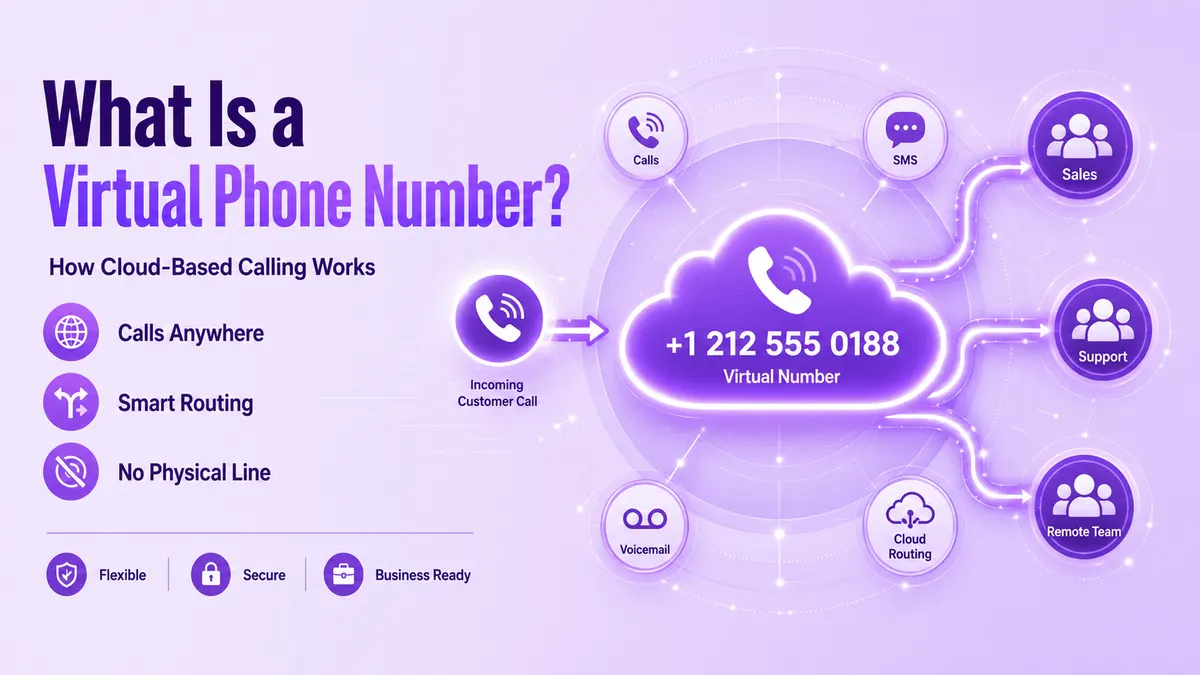
Sometimes you want the reverse: a number with another country's code so people there can call you at local rates. The usual routes are a SIM or plan from a carrier in that country, or a virtual number from a VoIP provider that rings an app wherever you are. Requirements differ by country.
Our explainer on virtual phone numbers shows how app-based numbers route calls. Going the other way, people and businesses abroad that want US callers to reach them can use a US number. Ringflow can provide US local numbers, chosen by area code, or a toll-free number, answered through its mobile and desktop apps, and can take over an existing US number by porting.
Conclusion
An international phone number is a national number with its country code attached, written in E.164 form as a plus sign and up to 15 digits. The plus replaces your exit code, which is 011 from the US and 00 in most other countries.
To call abroad, dial 011 or +, the country code and the number without its domestic 0, and be wary of returning unexpected international calls. If you need a US business line, Ringflow lets you start on a free trial and port a number you already have.
Ready when you are
Need a US Number for Your Business?
Get local numbers in US area codes or a toll-free line that rings on mobile and desktop apps. Try Ringflow free, or port a US number you already use.
FAQ
An international call connects a phone in one country to a phone in another. From the US you place one by dialing 011, the destination's country code and the national number. Calls to Canada and other NANP members share country code 1 and don't use 011.
In international form it starts with a plus sign and a country code of one to three digits, followed by the national number, up to 15 digits in total. A number in Rio de Janeiro, Brazil, for example, is written +55 21 XXXX XXXX.
From a US landline, dial 011, then the country code, then the area or city code and number, leaving out any leading domestic 0. On a mobile phone, enter + in place of 011. From another country, use that country's exit code instead, which is 00 in most places.
It's an informal term for a number people can call from many countries. Any number written in E.164 form, with a plus sign and its country code, can be dialed internationally, although many toll-free numbers can't be reached from abroad.
Ask your provider about a discount plan if you call certain countries often, and compare the total cost rather than the advertised rate. The FCC notes that VoIP calling may be cheaper than traditional phone service, and calling apps over Wi-Fi can reduce roaming charges when you travel.