
Introduction
A Chinese phone number carries a leading 0 when it is dialed domestically as a long-distance call, and +86 takes over from that 0 when the number is written for callers abroad. Landline numbers pair a city area code with a local number, while mobile numbers are 11 digits and always start with 1.
Below you'll find how Chinese phone numbers are structured, which digits identify a mobile number, which area codes serve Beijing, Shanghai and other major cities, and how to dial in from the US. The later sections cover what getting a Chinese number as a foreign business involves and how to time calls across the time difference.
- China's country code is +86. Drop the domestic trunk prefix 0 in international format, so 010-XXXXXXXX becomes +86 10-XXXXXXXX.
- Mobile numbers are 11 digits and start with 1. The next two digits (13x-19x) point to China Mobile, China Unicom or China Telecom.
- Major cities use a 2-digit area code and an 8-digit local number, such as Beijing's 10 or Shanghai's 21. Smaller areas use a 3-digit code.
- China has required real-name registration for every phone number since a 2013 regulation, which makes a Chinese SIM difficult for a foreign individual to get without a local ID.
- China spans 5 geographic time zones but uses a single official time, China Standard Time (UTC+8), nationwide.
China Phone Number Format (+86)
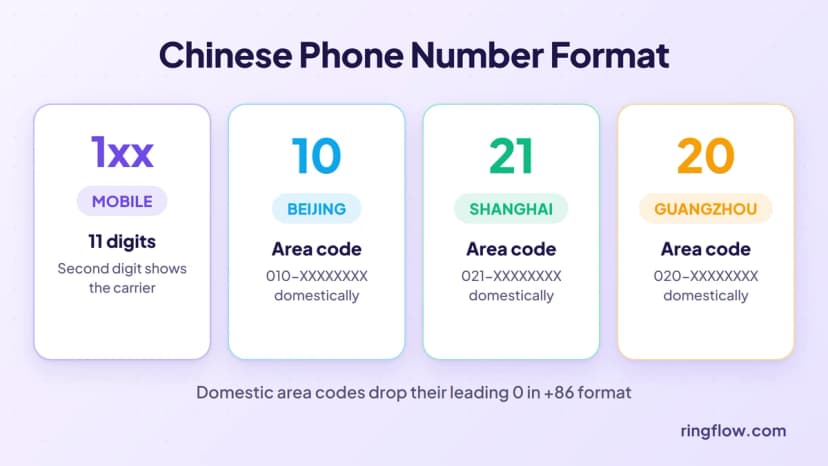
A Chinese landline number is built from a city area code plus a local number. Major cities use a 2-digit area code and an 8-digit local number, while smaller areas use a 3-digit area code with a 7- or 8-digit local number. Domestically, that area code is dialed with a leading 0, as in Beijing's 010-XXXXXXXX.
That leading 0 only applies to calls placed within China. For an international audience, replace it with +86: Beijing's 010-XXXXXXXX becomes +86 10-XXXXXXXX, and Shanghai's 021-XXXXXXXX becomes +86 21-XXXXXXXX. Mobile numbers carry no leading 0 to drop, since the trunk prefix only applies to area codes.
| Number type | Starts with | Length (without leading 0) |
|---|---|---|
| Mobile | 1 (13x-19x) | 11 digits |
| Landline, major city | 2-digit area code | 10 digits total |
| Landline, other areas | 3-digit area code | 10 or 11 digits total |
| IoT / data numbers | 140-144 | 13 digits |
Chinese Mobile Numbers
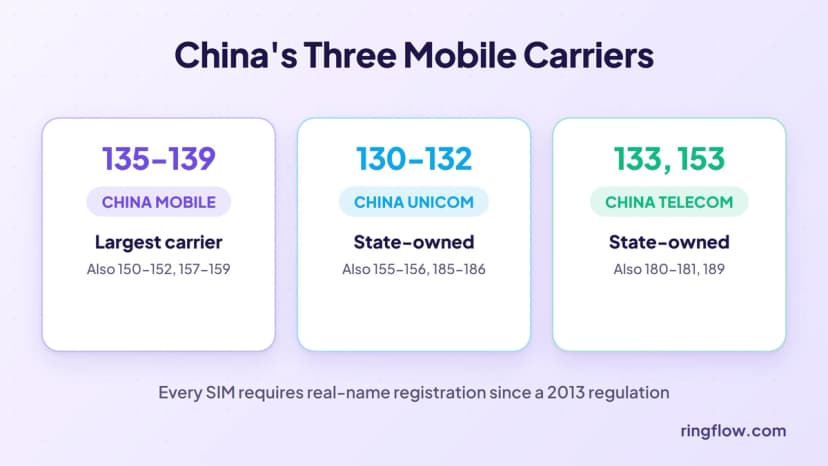
A Chinese mobile number is 11 digits and always starts with 1. The next two digits identify which of the three state-owned carriers issued it, under a numbering plan administered by China's Ministry of Industry and Information Technology (MIIT).
| Carrier | Common prefixes |
|---|---|
| China Mobile | 135, 136, 137, 138, 139, 150, 151, 152, 157, 158, 159 |
| China Unicom | 130, 131, 132, 155, 156, 185, 186 |
| China Telecom | 133, 153, 180, 181, 189 |
These ranges were opened up over time as demand grew: the 15x range arrived in 2006, 18x and the 14x data/IoT range followed in late 2008, 17x arrived in late 2013, and 16x and 19x were added in 2017. The prefix identifies the issuing carrier, not a region, since Chinese mobile numbers work the same way nationwide.
Landline Area Codes
The largest cities were assigned the shortest area codes, which leaves more digits for local numbers. Beijing, Shanghai, Guangzhou and Chongqing each use a 2-digit area code paired with an 8-digit local number.
| City | Area code (dialed in China) | Pattern |
|---|---|---|
| Beijing | 010 | 010-XXXXXXXX |
| Shanghai | 021 | 021-XXXXXXXX |
| Guangzhou | 020 | 020-XXXXXXXX |
| Chongqing | 023 | 023-XXXXXXXX |
Chinese Phone Number Examples
These samples keep the subscriber digits as X, so none of them points to a real line. Put in real digits only when the owner of the number has given it to you.
| Example | Dialed in China | International format |
|---|---|---|
| Beijing office line | 010-XXXXXXXX | +86 10-XXXXXXXX |
| Shanghai office line | 021-XXXXXXXX | +86 21-XXXXXXXX |
| Mobile (China Mobile) | 138-XXXX-XXXX | +86 138-XXXX-XXXX |
| Mobile (China Unicom) | 130-XXXX-XXXX | +86 130-XXXX-XXXX |
Ringflow gives your team a business number that rings on mobile and desktop apps, so international calls go through one shared line instead of someone's personal plan. Start a free trial and test it on your own calls.
How to Dial a China Phone Number From the US
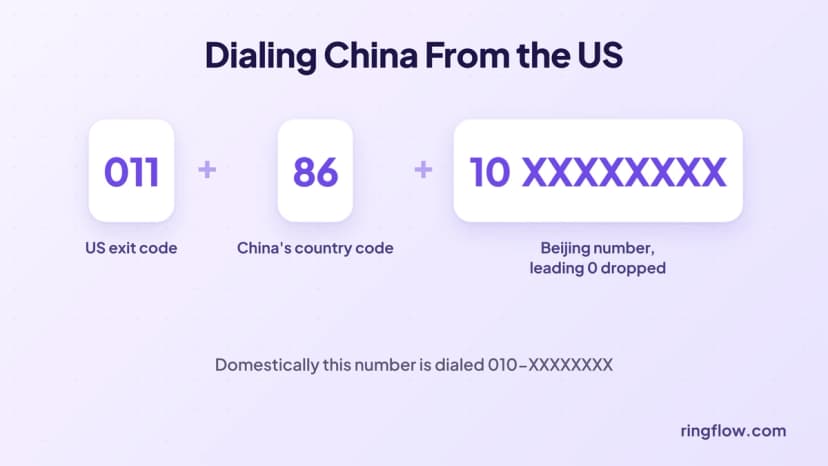
Start with 011, the code for leaving the North American Numbering Plan, add 86, and finish with the Chinese number minus its leading 0 if it has one. A Beijing office line becomes 011 86 10 XXXXXXXX, and a mobile number becomes 011 86 138 XXXX XXXX. Mobile users can press + at the start and skip the 011.
The mistake to watch for is keeping the 0, as in 011 86 010, which leaves the domestic trunk prefix where it no longer belongs. For exit codes from other countries and more dialing detail, see our China country code guide.
Getting a Chinese Phone Number as a Foreign Business
China has required real-name registration for every phone number since a Ministry of Industry and Information Technology regulation took effect on 1 September 2013, and MIIT pushed carriers to 100% compliance among existing subscribers by the end of 2016. In practice, a new SIM or number needs a valid form of identification, and carriers generally require a Chinese national ID or a foreign passport presented in person at a carrier store, which is not something a business outside China can complete remotely.
Businesses that need a presence reachable from China typically work through a licensed local partner or telecom reseller that can complete this registration on their behalf, or rely on a Chinese platform account (such as a WeChat official account) rather than a traditional phone number. Requirements and available routes change, so confirm current rules with a provider or partner in China before committing to a specific option.
New to numbers that live in the cloud instead of on a SIM? Our virtual phone number explainer covers the basics, and our Japan numbering guide walks through a market with a comparable area-code system.
Time Zone and Call Timing
China spans five geographic time zones but has used a single official time nationwide, China Standard Time (UTC+8), since 1949. Beijing, Shanghai, Chengdu and Urumqi all share the same clock time even though the sun does not.
- US Eastern Time: China is 12 hours ahead during US daylight saving time and 13 hours ahead during US standard time.
- US Pacific Time: China is 15 hours ahead during US daylight saving time and 16 hours ahead during US standard time.
In practice, a weekday morning in China lines up with the previous evening in the US. A 9 a.m. call from Beijing on a Tuesday reaches New York around 9 p.m. Monday in summer. Our best time to call China page suggests calling windows.
Conclusion
Chinese phone numbers follow a consistent logic. A 0 opens a domestic long-distance call and turns into +86 abroad, landlines pair a short area code with a long local number in major cities, and mobile numbers total 11 digits starting with 1. With that pattern in mind, you can format a number correctly and avoid the extra 0 that trips up international calls.
US teams with customers or partners in China can make those calls from a Ringflow business line, answering and dialing from mobile and desktop apps. You can pick a local number in a US area code or a toll-free number for American callers, move your current number over through number porting, and test it with a free trial.
Ready when you are
Call China From Your US Business Line
Pick a number in a US area code or a toll-free line on Ringflow, bring your current number over with porting, and try the apps free before you commit.
FAQ
A landline number pairs a city area code (2 digits in major cities, 3 elsewhere) with a local number, written with a leading 0 for domestic long distance, such as 010-XXXXXXXX in Beijing. Mobile numbers are 11 digits and always start with 1.
It is 11 digits starting with 1, such as 138-XXXX-XXXX. The second and third digits point to the issuing carrier: China Mobile, China Unicom or China Telecom.
Drop the leading 0 from an area code and put +86 in front. Beijing's 010-XXXXXXXX becomes +86 10-XXXXXXXX. Mobile numbers have no leading 0 to drop, so 138-XXXX-XXXX becomes +86 138-XXXX-XXXX.
Dial 011, then 86, then the Chinese number with any leading 0 removed. A Beijing landline becomes 011 86 10 XXXXXXXX. From a mobile phone you can dial + instead of 011.
It's difficult to do remotely. China has required real-name registration with a government-issued ID since 2013, and carriers generally require that ID in person. Most foreign businesses work through a local partner or reseller, or use a platform account such as WeChat instead.
China Mobile, China Unicom and China Telecom are the three state-owned, MIIT-regulated carriers that issue mobile numbers nationwide.
All of China uses China Standard Time (UTC+8) nationwide, even though the country spans five geographic time zones. This has been the case since 1949.
A safe sample keeps the subscriber digits as placeholders, such as 010-XXXXXXXX for a Beijing landline or 138-XXXX-XXXX for a mobile number. In international format those become +86 10-XXXXXXXX and +86 138-XXXX-XXXX.