
Introduction
A business phone number is the number customers use to reach a company, kept apart from anyone's personal line. Any business phone number example could pass for a home number, such as (602) 555-0114, because what makes it a business line is who controls it and how calls are handled, not the digits.
Below are examples of each type, formatting tips and the main ways to set one up and share it.
- Business numbers come in four common forms: local, toll-free, vanity and mobile.
- Local and mobile numbers share one US format; toll-free numbers start with codes such as 800, 888 or 833.
- Use one format everywhere, and add the +1 international form where readers abroad will see it.
- A number held on a business account can be ported to a new provider, so it stays with the company.
What Is a Business Phone Number?
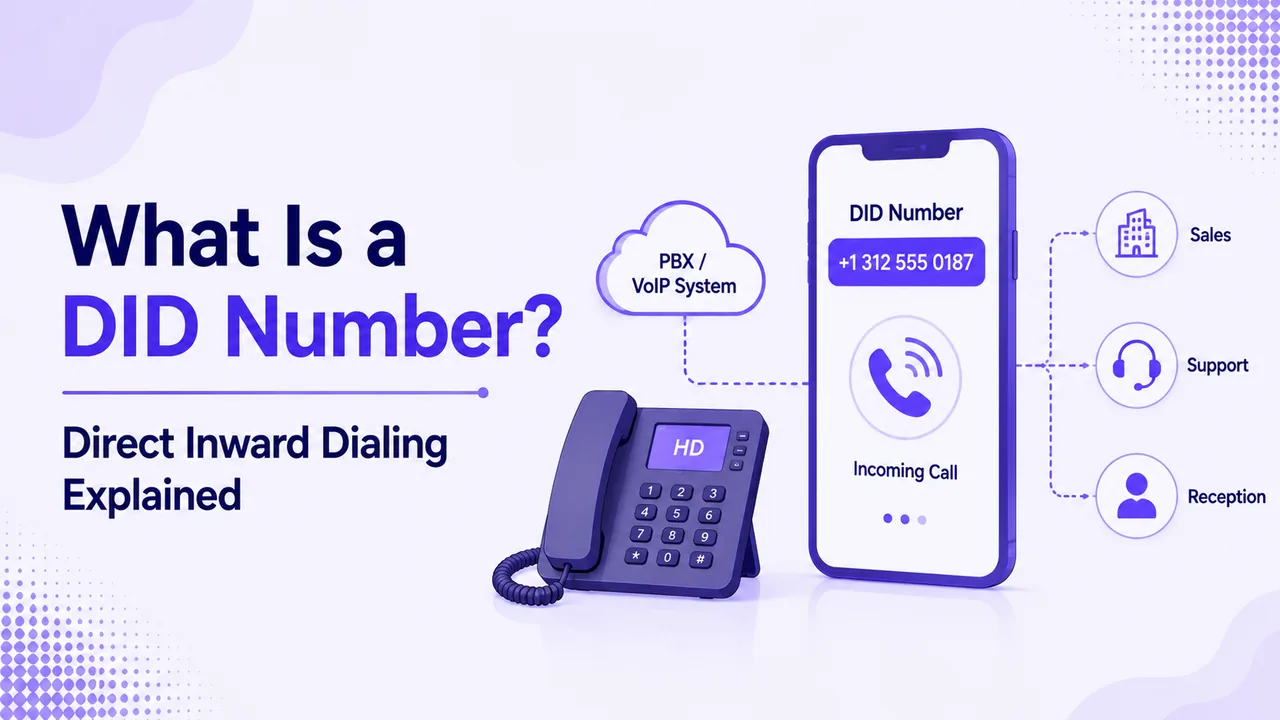
It's the number a company publishes on its website, invoices, signs and search listings. It might ring a desk phone, a mobile app or a whole team, but callers only need to remember one number.
In the US it follows the same North American Numbering Plan layout as any other line: ten digits made up of an area code, an exchange code and a line number, under country code 1. No area codes are set aside for cell phones, so the digits won't show whether a business number rings a landline, a mobile or an internet-based phone system.
What really sets a business line apart is ownership. Google's Business Profile guidelines say the number must be under the direct control of the business, which is simpler when it sits on a company account rather than an employee's personal plan.
Business Phone Number Examples: Local, Toll-Free and Vanity
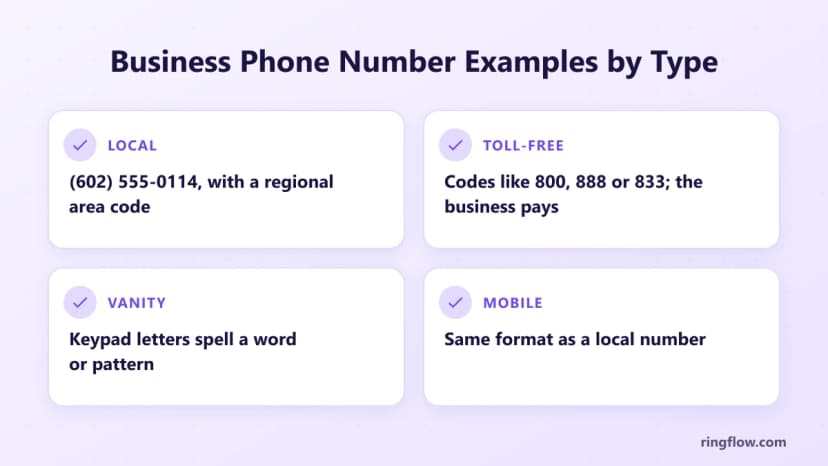
Local and mobile examples use the 555-0100 to 555-0199 range reserved for fictional use. Toll-free examples use X placeholders, since real subscribers hold those digits.
| Type | Example | What it tells callers |
|---|---|---|
| Local | (602) 555-0114 | The area code points to a region |
| Toll-free | 1-800-XXX-XXXX or 1-833-XXX-XXXX | The caller doesn't pay; the business is billed |
| Vanity | 1-8XX-XXX-HELP | Keypad letters spell a word or form a pattern |
| Mobile | (720) 555-0172 | Nothing extra: it looks like a local landline number |
North American toll-free numbers use the codes 800, 833, 844, 855, 866, 877 and 888, and any of them can be pointed at any regular number, so they aren't tied to a place. Vanity numbers, most familiar on toll-free lines, spell a word or contain an easy pattern, and our guide to vanity phone numbers covers choosing one.
Writing a Business Number on Cards, Websites and Google
Pick one format and stick to it. The business card phone number format US readers know best is (602) 555-0114 or 602-555-0114; the ITU's E.123 notation puts parentheses around digits that aren't always dialed, such as an area code. Where people abroad will see it, add +1 602 555 0114, the international form with spaces and no parentheses. Our US phone number format guide lists other styles.
- Cards and websites: label the line "Office" or "Main" if a mobile appears too, and show it on your site as text, not an image, so phones can tap it.
- Google Business Profile: Google prefers a local number to a central call center helpline where possible, wants a number that connects to that location, and rejects numbers that send callers anywhere other than the actual business, as well as premium-rate numbers.
Why Use a Separate Business Number
A separate phone number for business keeps customer calls apart from family calls, lets you keep business hours with a proper voicemail greeting, and keeps your personal number off listings and ads.
- Continuity: the number belongs to the company, so it stays when staff change roles or leave.
- Portability: the FCC's number porting guide explains that you can keep a number when you switch providers in the same area, including moves between wireline, wireless and internet-based providers. Toll-free numbers are portable too.
If you only need a work line on your existing mobile, our guide to adding a second phone number for business covers that route.
How to Set Up a Business Phone Number
There are three main ways of creating a business phone number:
| Option | How it works | Good fit |
|---|---|---|
| Phone company business line | A landline installed at your premises | One fixed location with desk phones |
| Mobile carrier line | A separate line or plan on a mobile phone | A sole trader working from one phone |
| Cloud or VoIP phone service | The number rings apps and desk phones over the internet | Remote staff, several sites or a shared line |
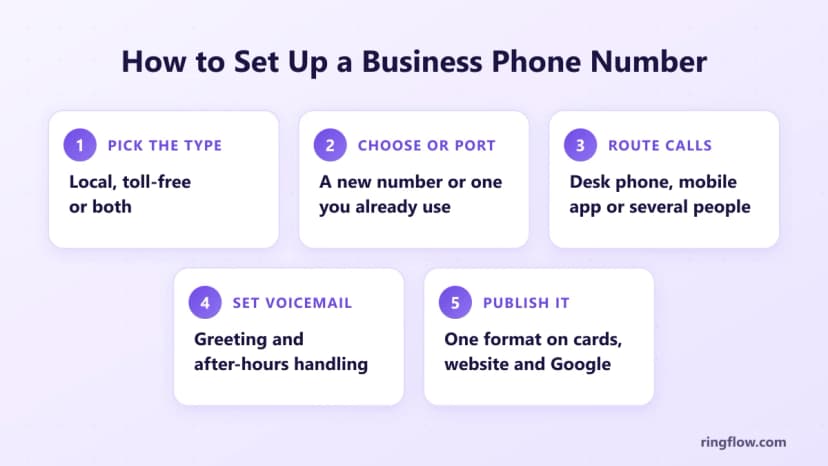
Whichever route you take, the steps to set up a business phone number look much the same:
- 1Pick the type: local, toll-free or both. For a local number, find an area code in our area code directory.
- 2Choose or port the number. The FCC says to contact the new provider first, which then starts the port with your current one, and its rules require simple ports to be processed in one business day.
- 3Decide where calls ring: a desk phone, a mobile app, a computer or several people.
- 4Set hours and voicemail, including what happens after hours.
- 5Publish it in the same format on cards, your website and your Business Profile.
For a cloud setup, Ringflow's business phone service gives you a local number in a US area code or a toll-free line, rings your team through mobile and desktop apps, and includes an auto attendant and business texting. Port your current number or begin on a free trial.
Local vs Toll-Free: Which to Choose
A local number carries an area code linked to a region, which suits a business serving one city or state. A toll-free number isn't linked to a place, and the business is billed for incoming calls, although a mobile caller's plan may still charge airtime.
| Factor | Local number | Toll-free number |
|---|---|---|
| Tied to a place | Yes, through the area code | No |
| Who pays for the call | The caller, under their usual plan | The business |
| Reachable from abroad | Yes, dialed with +1 | Often not |
Many businesses use both: a local number for each branch and a toll-free line for support. Our comparison of toll-free and local numbers covers the trade-offs, and the toll-free number page shows the codes available.
Sharing One Business Number Across a Team
A shared phone number for business lets several people answer one line. Phone systems have long done this with hunt groups, which distribute calls to one number across several lines:
- Linear hunting: each call goes to the first available line in a fixed order.
- Circular hunting: calls rotate round-robin through the group.
- Most-idle hunting: each call goes to whoever has been idle the longest.
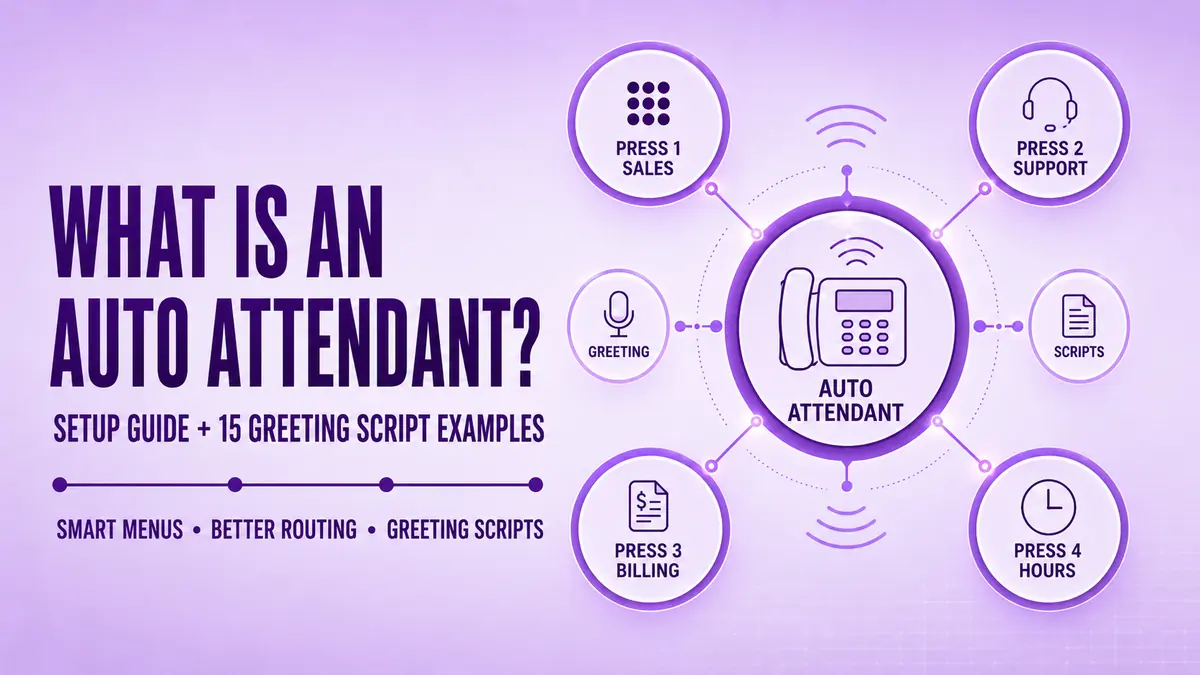
An auto attendant puts a menu in front of the team: callers press a digit for sales or service, dial an extension, or press 0 for a person, with no receptionist needed.
Conclusion
A business phone number is the line a company controls and publishes, whether it's local, toll-free, vanity or mobile. Write it the same way everywhere, add the +1 form for international readers, and follow Google's rules for your Business Profile.
Getting one means choosing a type, picking or porting the number and deciding where calls ring. Ringflow's local and toll-free lines work through its mobile and desktop apps, and a free trial lets you test one before porting your existing number.
Ready when you are
Get a Business Number Customers Can Reach
Choose a local number in a US area code or a toll-free line that rings on your mobile and desktop apps. Start a free Ringflow trial, or port the number you already have.
FAQ
A local business number looks like any US number, such as (602) 555-0114, from the 555-0100 to 555-0199 range set aside for fictional examples. A toll-free business number starts with a code such as 800, 888 or 833 instead of a regional area code.
Decide between local and toll-free, then get the number from a phone company, a mobile carrier or a cloud phone provider. Pick a new number or port one you already use, choose which phones or apps it rings, and set up voicemail.
Yes. You can add a business line from a phone company or mobile carrier, or get a number from a cloud phone service that rings an app on your current phone. Keeping it on a business account means the number stays with the company and can be ported later.
For US readers, use a familiar style such as (602) 555-0114 or 602-555-0114 and keep it consistent. If people abroad will see the card, add +1 602 555 0114, the international form under the ITU's E.123 notation, with spaces and no parentheses.
Yes. A phone system can spread calls to one number across several people, in a fixed order, in rotation or to whoever has been idle longest.