
Introduction
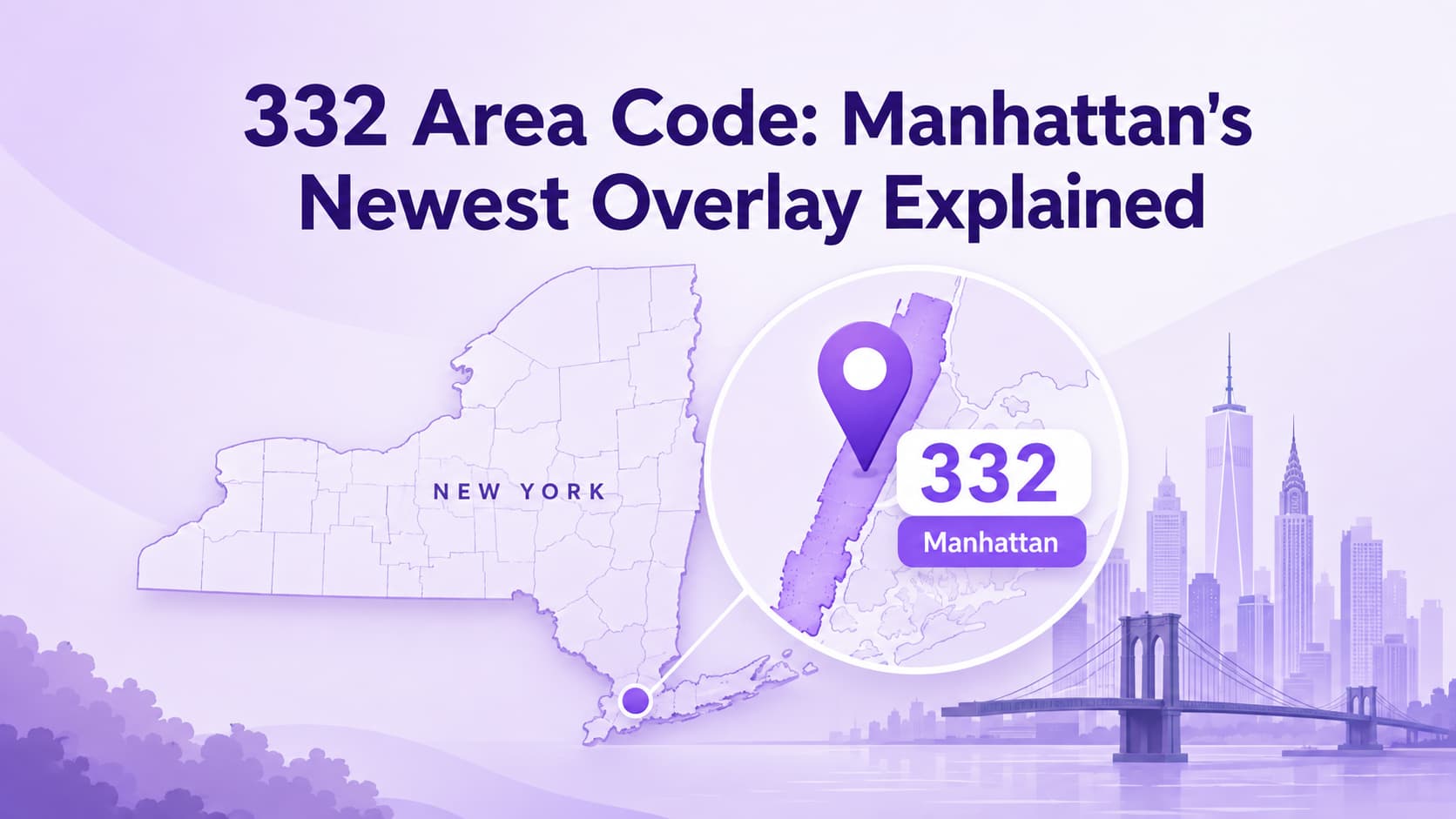
The 332 area code identifies Manhattan phone numbers — the newest of four overlapping codes now sharing the same small island, added once the older ones ran low on fresh digits.
This guide covers where 332 actually reaches, how Manhattan ended up sharing one footprint across four area codes, what drives the borough's economy, and how a business claims a 332 number of its own.
What Is the 332 Area Code?
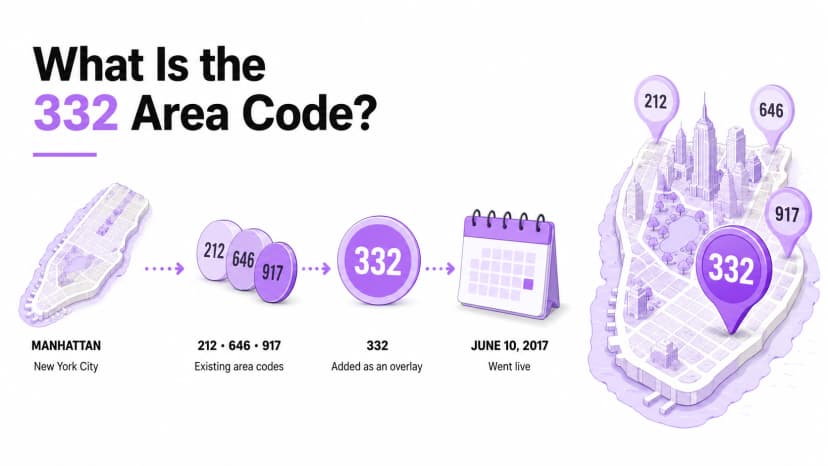
On the North American Numbering Plan, 332 marks Manhattan phone numbers. The overlay went live June 10, 2017, layered directly on top of 212, 646, and the Manhattan portion of 917 — the fourth area code assigned to the same small island.
New York's Public Service Commission approved 332 back in November 2015, well ahead of activation, after regulators projected that 212 itself — Manhattan's original code — would run out of fresh numbers by the third quarter of 2017.
Unlike a split, an overlay never reassigns anyone's existing number. Every 212, 646, and 917 line kept dialing exactly as before; 332 simply gave new lines somewhere left to go once the other three ran dry.
Neighborhoods the 332 Area Code Covers
332 covers the entirety of Manhattan — every neighborhood, right down to the same blocks already served by 212, 646, and 917. There's no separate territory to map; all four codes describe the identical 22.7-square-mile island.
- Midtown — the commercial core, home to most of Manhattan's office towers and corporate headquarters
- Financial District — Wall Street and Lower Manhattan's banking and fintech hub
- Upper East Side and Upper West Side — dense residential neighborhoods anchoring both sides of Central Park
- Harlem — a historic cultural center now also home to a fast-growing business district
- Chelsea and the Meatpacking District — a mix of tech offices, galleries, and retail
Because 332 shares its territory with three older codes, a Manhattan business's area code alone says nothing about how long it's operated there. A 332 number can belong to a company that's been on the same block for decades, simply issued its line more recently than a neighbor still dialing on 212.
Manhattan's business districts sit close enough together that a courier can cross several of them on foot inside an hour, yet each one runs its own distinct economy: finance downtown, media and advertising in Midtown, and a growing cluster of startups spread across Chelsea and the Flatiron District.
Wall Street itself sits at the southern tip of that footprint, inside a Financial District that packs the New York Stock Exchange, Nasdaq's MarketSite, and dozens of global bank headquarters into a few square blocks — a level of business density most metro areas spread across an entire downtown core.
From 212 to 332: A Numbering History
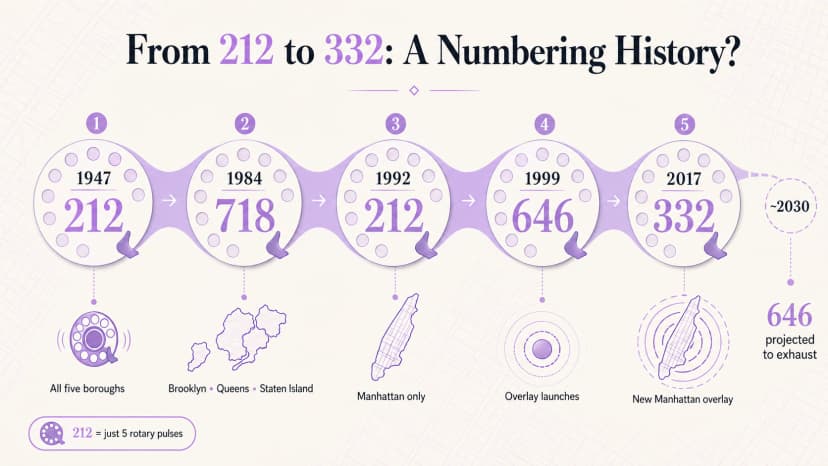
Manhattan's numbering story goes back to 1947, when 212 launched as one of the original area codes and covered all five boroughs at once.
New York didn't just get an area code that year — it got the fastest one possible to dial. A rotary phone sent each digit as a burst of clicks proportional to its value, so a 9 took nearly five times longer to dial than a 1, and 212 adds up to just five pulses total, the lowest of any area code ever assigned in the country.
That single-code arrangement didn't last. Manhattan's numbers kept tightening decade after decade, each squeeze forcing regulators back to the drawing board for another split or overlay.
- 1984 — New York regulators carve out 718 for Brooklyn, Queens, and Staten Island, splitting roughly three million numbers down the middle; the change becomes mandatory the following January.
- 1992 — The Bronx moves to 718 on July 1, leaving 212 exclusively to Manhattan.
- 1999 — Area code 646 launches July 1 as an overlay once 917, the citywide mobile code, starts running short.
- 2017 — 332 activates June 10 as an overlay once 212 itself neared exhaustion.
- ~2030 — Regulators project 646 will run out next, meaning Manhattan likely isn't done adding area codes.
Manhattan's Global Financial Economy
Manhattan generates roughly 73% of New York City's entire economic output — about $939 billion of the five boroughs' combined $1.286 trillion gross product — packed into an island of barely 23 square miles.
The Financial District anchors that scale. Wall Street and Lower Manhattan still function as the world's leading fintech and banking hub, and eight of New York City's ten largest Fortune 500 companies are banks, insurers, or financial-services firms.
- 43 Fortune 500 headquarters and 66 Fortune 1000 companies call New York City home — more than any other American city — generating close to $2 trillion in combined annual revenue and employing over two million people.
- Roughly 66,940 people per square mile live in Manhattan, one of the densest populations in the country, packing an enormous concentration of businesses into a handful of shared area codes.
- The New York Stock Exchange and Nasdaq both trace back to trading floors a few blocks apart in Lower Manhattan, together listing companies worth trillions of dollars in combined market value.
Why Businesses Choose a 332 Number
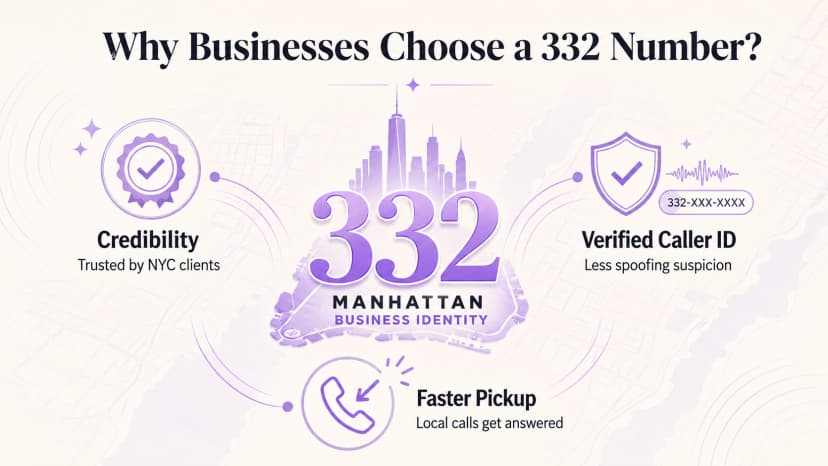
A 332 number signals that a business has staked out real ground in Manhattan, not routed calls in from a satellite office somewhere else — and in a market this dense with competitors, that distinction shapes whether a first-time caller even picks up.
For companies running hybrid or fully remote teams, a virtual phone number from a platform like Ringflow keeps that Manhattan identity intact even when nobody on staff is actually sitting in a Midtown office that day.
- Credibility with finance, media, and real estate clients — a recognizable New York City code reads as a baseline trust signal before a conversation even starts.
- Protection against spoofing suspicion — a verified number paired with a registered caller ID name cuts through the spam noise NYC callers field constantly.
- Faster pickup on cold outreach — a prospective client is far more likely to answer a number that matches the city they already do business in.
How to Get a 332 Area Code Number
Claiming a 332 number today doesn't require setting foot in Manhattan, and cloud providers like Ringflow handle the entire process from signup to first ring. Here's roughly how it goes:
- 1Narrow the search to a provider that genuinely stocks 332 numbers instead of pulling from one generic national pool.
- 2Browse available numbers and settle on one a client can recall after hearing it just once.
- 3Complete the account basics — business name, email, and a payment method usually covers it.
- 4Wire the new number into a desk phone, a shared inbox, or an auto-attendant, and run an inbound test before it ever reaches a real customer.
A business already holding a Manhattan number can usually keep it — phone number porting moves an existing 212, 646, or 917 line onto a new provider without changing the digits customers already know.
Porting typically takes a few business days rather than the same-day activation of a brand-new number, since the losing carrier has to release the line before the new provider can accept it — worth planning around if a launch date is already set.
Pricing tends to hinge on the feature set attached to a Manhattan number rather than which of the four overlapping codes it carries. Call recording, CRM integrations, and multi-line routing — the kind Ringflow bundles in by default — move the monthly bill far more than whether the number happens to start with 212, 332, 646, or 917.
Dialing Rules and Common Mistakes
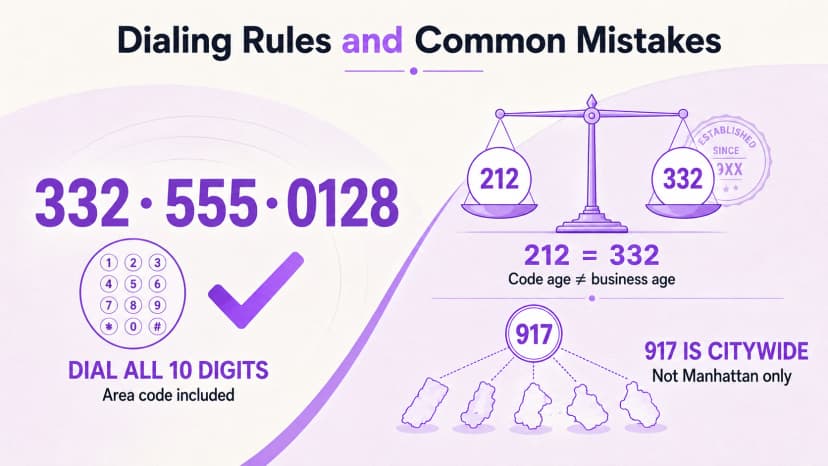
With four overlapping codes on one island, ten-digit dialing is mandatory for every Manhattan call, area code included, even between two desks on the same floor.
The most common slip-up is assuming a 332 number means a business is somehow newer or less established than one on 212. In an overlay system, the code only reflects when the line was issued, not how long the company itself has operated.
A second, quieter mistake is assuming every 917 number belongs to a Manhattan business specifically. Because 917 overlays all five boroughs rather than just the island, a 917 caller ID could just as easily be dialing in from Staten Island or the Bronx as from a desk two blocks from Wall Street.
Conclusion
332 is the newest of four area codes stacked on the same island, a reminder of just how much demand Manhattan's phone numbers have absorbed since 212 first launched in 1947 as the fastest code on the entire dial.
A provider like Ringflow that genuinely stocks 332 inventory can get a number running the same day, whether it's a new venture's first line or an added line for a business that's called Manhattan home for years.
Ready when you are
Claim Your Slice of Manhattan
Build instant Manhattan credibility with a 332 number from Ringflow. Set up in minutes — free trial, no card required.
FAQ
The 332 area code identifies Manhattan phone numbers. It's an overlay that's been active since June 10, 2017, sharing the same territory as 212, 646, and 917.
332 covers all of Manhattan, the same footprint already served by 212, 646, and 917. There's no separate territory unique to any one of the four codes.
212 is Manhattan's original 1947 area code. 646 was added as an overlay in 1999, and 332 followed in 2017 once 212 ran low on numbers. 917 is a separate citywide overlay covering all five boroughs, not just Manhattan.
Choose a cloud phone provider that genuinely stocks 332 numbers, browse what's available, and finish the entire signup from a browser. No Manhattan address is required, and most numbers activate the same day.
Yes. Because four area codes overlap the same Manhattan territory, every local call requires all ten digits, including calls between two numbers in the same building.