
Introduction
Few phone numbers carry as much instant recognition as a Manhattan one. The 646 area code sits alongside 212 and 332 on the island, and all three are equally local. If you have ever wondered why two neighbors can have different prefixes, or which code to pick for a new business line, the answers are simpler than they look. That recognition is exactly why the code remains so popular today.
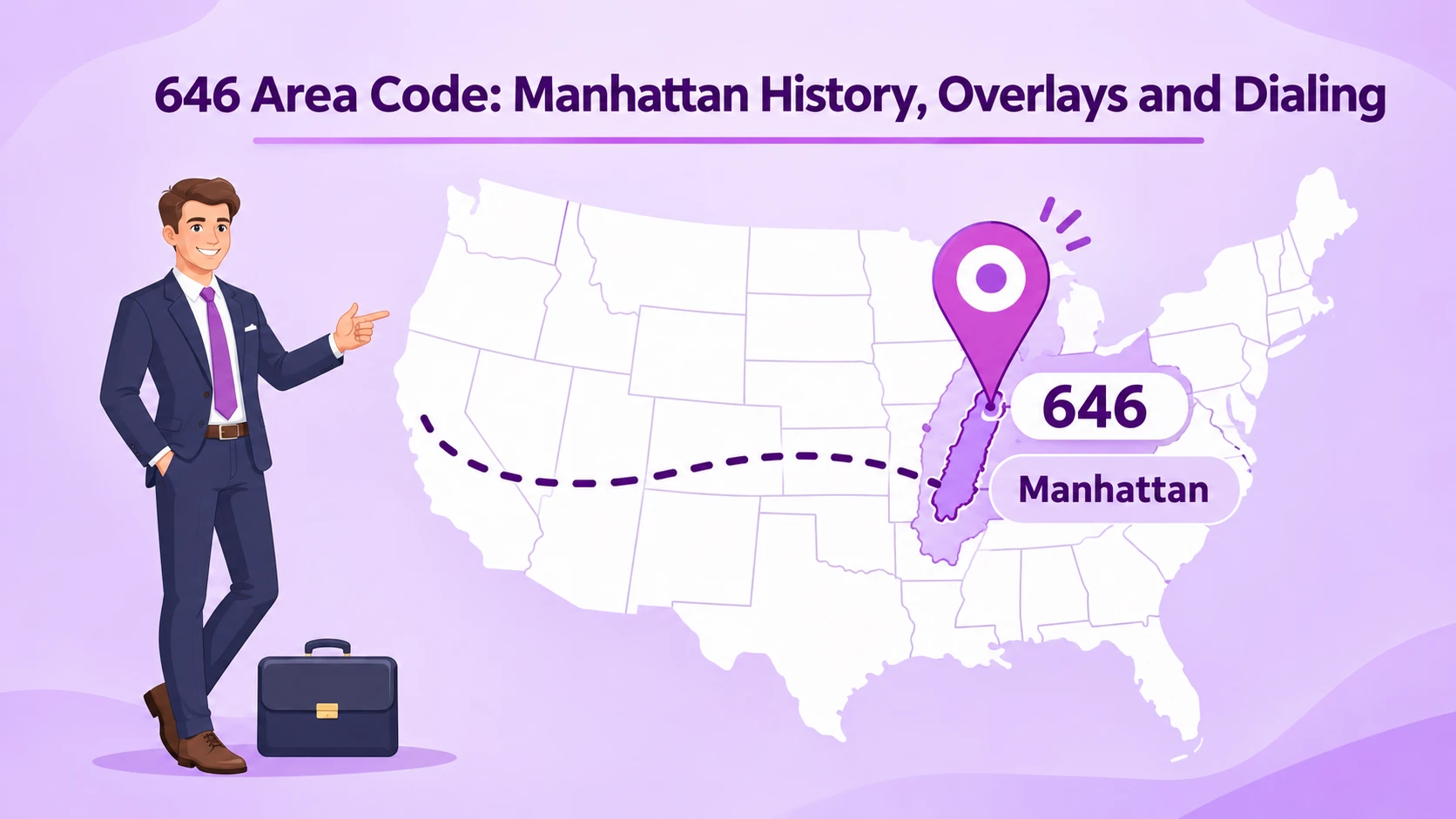
The 646 area code was added in 1999 as an overlay, which means it shares territory with an older code rather than splitting it. That choice kept existing numbers working and gave the city room to grow. The 646 area code also reshaped dialing habits, which still surprise visitors and some older phone systems. Understanding that background makes the current rules easier to remember.
This guide explains what the code covers, why it was created, how it relates to 212, 332, and 917, and how ten-digit dialing works. You will also see why companies want a 646 number and how to get one. At Ringflow, we keep each section short, so you can jump straight to what you need.
What Is the 646 Area Code?
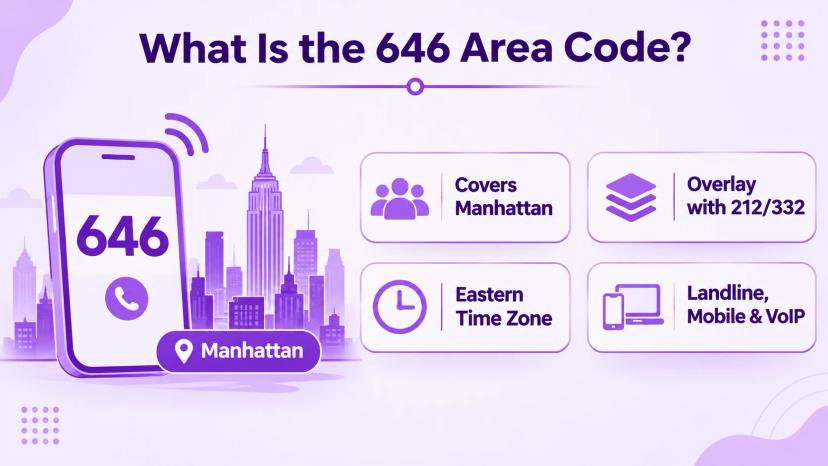
The 646 area code is a geographic telephone prefix assigned to Manhattan, one of the most densely populated places in the United States. It covers most of the borough, from the Financial District and Midtown to Harlem and Washington Heights. Callers dial it before a seven-digit number, like any other US area code. Those neighborhoods hold a huge mix of residents, workers, and visitors who rely on phones every day.
What sets it apart is that it has no territory of its own. The 646 area code overlays 212, so both codes cover the same streets, and 332 joins them as a third. A restaurant in Chelsea and a law firm in Midtown can hold different codes while both remain equally local to a Manhattan customer. Neither code is better, and the choice rarely changes how a call is placed or answered.
Manhattan sits in the Eastern Time Zone, and the code behaves like any other domestic prefix. Whether a call counts as local depends on the carrier and the plan, not on which Manhattan code it carries. Landlines, mobile phones, and internet-based lines all use 646 numbers, so treat each call as you would any other. As always, be careful with unexpected requests for money or personal details, whichever prefix appears.
When and Why the 646 Area Code Was Created
For decades, a single code served the whole city. The 212 area code was assigned in 1947 to all of New York City, and it became one of the best-known prefixes in America. As the city grew, that one code could not hold enough numbers, so planners began dividing and layering the map. Each change aimed to protect existing numbers while making more combinations available.
The first fix was a split in 1984, when 718 took over Brooklyn, Queens, and Staten Island. Another overlay followed in 1992 with 917. By 1999, available 917 numbers were becoming scarce, so 646 was added over Manhattan on July 1, 1999. Our 212 area code guide covers the original code in more detail.
- 1947: the 212 area code is assigned to all of New York City.
- 1984: 718 is created for Brooklyn, Queens, and Staten Island, leaving 212 for Manhattan and the Bronx.
- 1992: 718 expands to the Bronx, and 917 is layered over the entire city.
- July 1, 1999: the 646 area code is implemented as an overlay for Manhattan as 917 numbers run scarce.
- November 2015: 332 is assigned as a third overlay for Manhattan.
- June 10, 2017: 332 becomes active alongside 212 and 646.
How 646 Relates to 212, 332, and 917
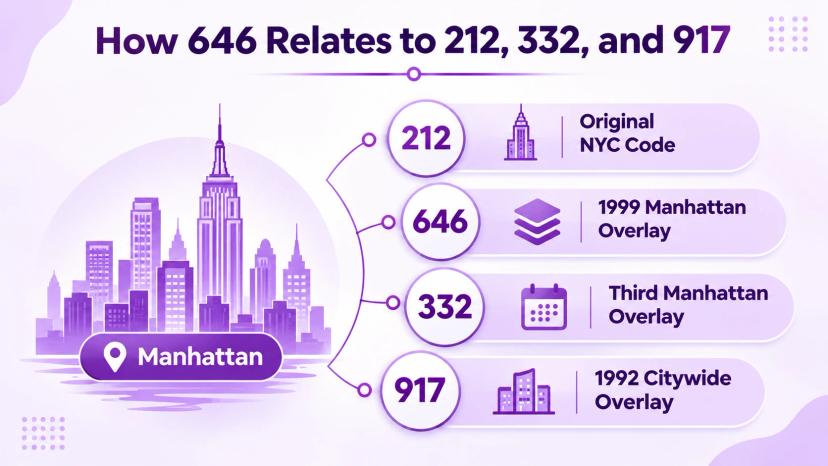
The codes around Manhattan can look tangled, but each has a clear role. The 646 area code, 212, and 332 all serve most of Manhattan, and they are interchangeable for local calling. The 917 code is different because it was layered over the entire city in 1992, so it can appear on numbers in any borough. Knowing which is which helps when you read a caller ID or choose a new line.
Outside Manhattan, the other boroughs use their own family of codes, led by 718 with 347 and 929 layered on top. A person holding a 718 number and a person holding a 646 number are both in New York City, but they are not necessarily in the same borough. The code is a clue, not a guarantee. That is why businesses often ask for a Manhattan code when they want a Manhattan identity.
- 212: the original New York City code, now associated mainly with Manhattan and prized for its long history.
- 646: the 1999 Manhattan overlay that added room when 917 numbers grew scarce.
- 332: the third Manhattan overlay, active since June 10, 2017, adding room for new lines.
- 917: the 1992 citywide overlay that can appear on numbers in any of the five boroughs, including Manhattan.
- 718, 347, and 929: the family of codes used for Brooklyn, Queens, Staten Island, and the Bronx, with 917 mixed in across all of them.
Ten-Digit Dialing in the 646 Area Code
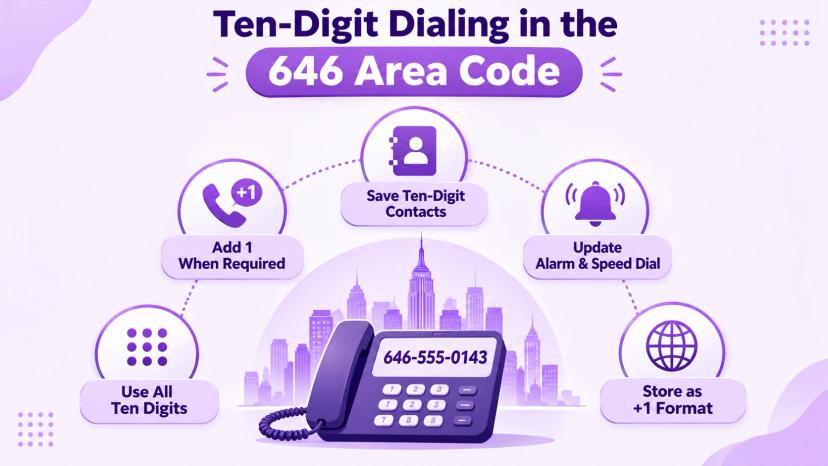
Because the 646 area code, 212, and 332 share one territory, every call placed inside Manhattan needs all ten digits. That means the area code plus the seven-digit number, even when you are calling the shop across the street. Leaving the code off usually produces an error message from your carrier instead of connecting the call. The rule applies to landlines, mobile phones, and cloud phone apps alike.
The rule also affects the equipment around you. Alarm panels, fax machines, speed-dial lists, and older office phone systems may still store seven-digit entries from before the overlay. Updating those entries once saves confusion later, and it keeps automated dialers from quietly failing when a call cannot be placed.
- Dial the area code plus all seven digits for every call inside Manhattan, local or not, even to a neighbor.
- Add a 1 first only when your carrier asks for it on long-distance calls, which varies by provider.
- Save every contact in full ten-digit format so your mobile phone dials it correctly from any location.
- Check that alarm systems, door entry panels, and speed-dial lists all use ten digits, including older entries.
- Store numbers as +1 followed by the area code so they work from any country, which also helps cloud phone apps.
Why Businesses Want a 646 Number
A Manhattan area code like the 646 area code tells customers you belong to the city's business world. For lawyers, creative agencies, restaurants, and startups, a familiar prefix can build trust before the first hello. People often answer a call that looks local more readily than one from an unknown out-of-state number, which helps first conversations start. A matching number on a website and business card reinforces that first impression.
You do not need an office on the island to benefit. Our business phone system guide explains how a cloud line can carry a 646 prefix while ringing a laptop, a mobile phone, or a whole support team anywhere. That lets remote companies look local without paying Manhattan rent.
- A local Manhattan presence for agencies, clinics, and professional firms that serve city clients and nearby boroughs.
- Separate lines for each office, campaign, or department so every call reaches the right team.
- Call routing to a mobile phone, desk phone, or app, based on business hours or availability.
- Business texting from the same number, subject to the carrier registration steps that apply before messages go out.
- Easy tracking of which ads, listings, and referrals produce calls, so marketing spend becomes measurable.
How to Get a 646 Number
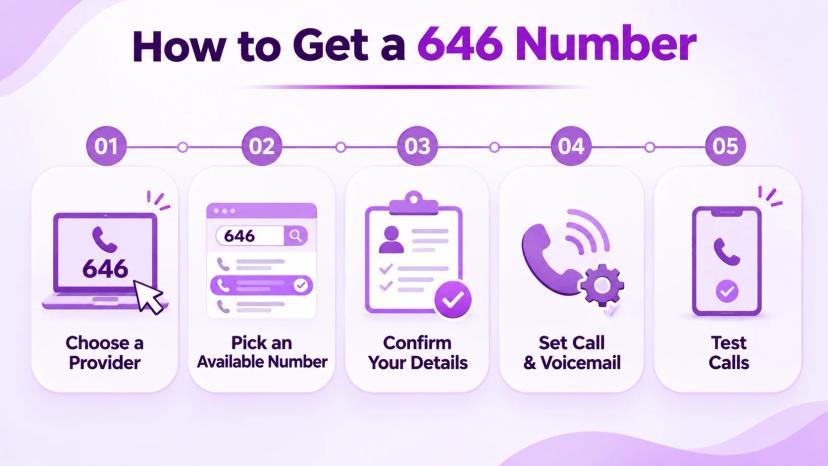
Getting a 646 number is simpler than most people expect, because providers such as Ringflow search and assign numbers online in minutes. You pick a prefix, choose from the available combinations, and connect the line to the devices you already use. No physical landline or Manhattan address is required for a cloud number, and most setups take less than an hour from the first search to the first test call.
Before you commit, check pricing, call quality, and number portability. The 646 code is projected to run low on numbers by 2030, so popular combinations may not last. If you plan to move a line later, the FCC number porting guide explains your right to keep a number when you switch carriers.
- 1Choose a provider that offers 646 numbers, clear pricing, and reliable call quality.
- 2Search the available 646 numbers and pick one that is easy to say and remember.
- 3Confirm your business details and reserve the number on your account.
- 4Set call forwarding, business hours, and a voicemail greeting for after hours.
- 5Test inbound and outbound calls from a mobile phone and a landline before you publish the number.
Conclusion
The 646 area code is a practical answer to the demands of a crowded city. Added as an overlay on July 1, 1999, it kept existing Manhattan numbers working while 917 ran short, and it now sits alongside 212 and 332 as part of the island's identity. The only real cost was the shift to ten-digit dialing. That balance of continuity and growth is why the overlay approach has lasted.
Today the 646 area code works as a local identity as much as a technical fix. Residents use it every day, and businesses use it to look familiar to nearby customers. If you want a presence in Manhattan, a 646 number from Ringflow is a simple, low-friction way to get one, and it works as well for a single owner as for a growing team.
Whatever your reason for researching the code, the key points are simple. The 646 area code overlays 212 across most of Manhattan, it shares the island with 332, and every call inside the borough needs ten digits. If you are choosing a number, pick one that is easy to remember and test calls from several phones before you publish it.
Ready when you are
Ready to get your own 646 area code number?
Build instant Manhattan credibility in New York City. Spin up a 646 number in minutes — free trial, no card, and free number porting if you already own a number.
Frequently Asked Questions
The 646 area code serves Manhattan in New York City. It shares the island with 212 and 332, and the region follows the Eastern Time Zone.
Both cover the same Manhattan streets and are equally local. The 646 area code was added on July 1, 1999 as an overlay for 212, which is why neighbors can hold different codes.
The 332 code is a third Manhattan overlay, active since June 10, 2017. The 917 code is different because it was layered over all five boroughs in 1992 and appears on numbers across the whole city.
Yes. Every call inside Manhattan needs the area code plus the seven-digit number, even to a neighbor. Add a 1 only when your carrier asks for it on long-distance calls.
Yes. A cloud provider such as Ringflow can assign a 646 number online, and you can forward calls to any phone or app. Popular combinations may not last, since the code is projected to run low on numbers by 2030.