
Introduction
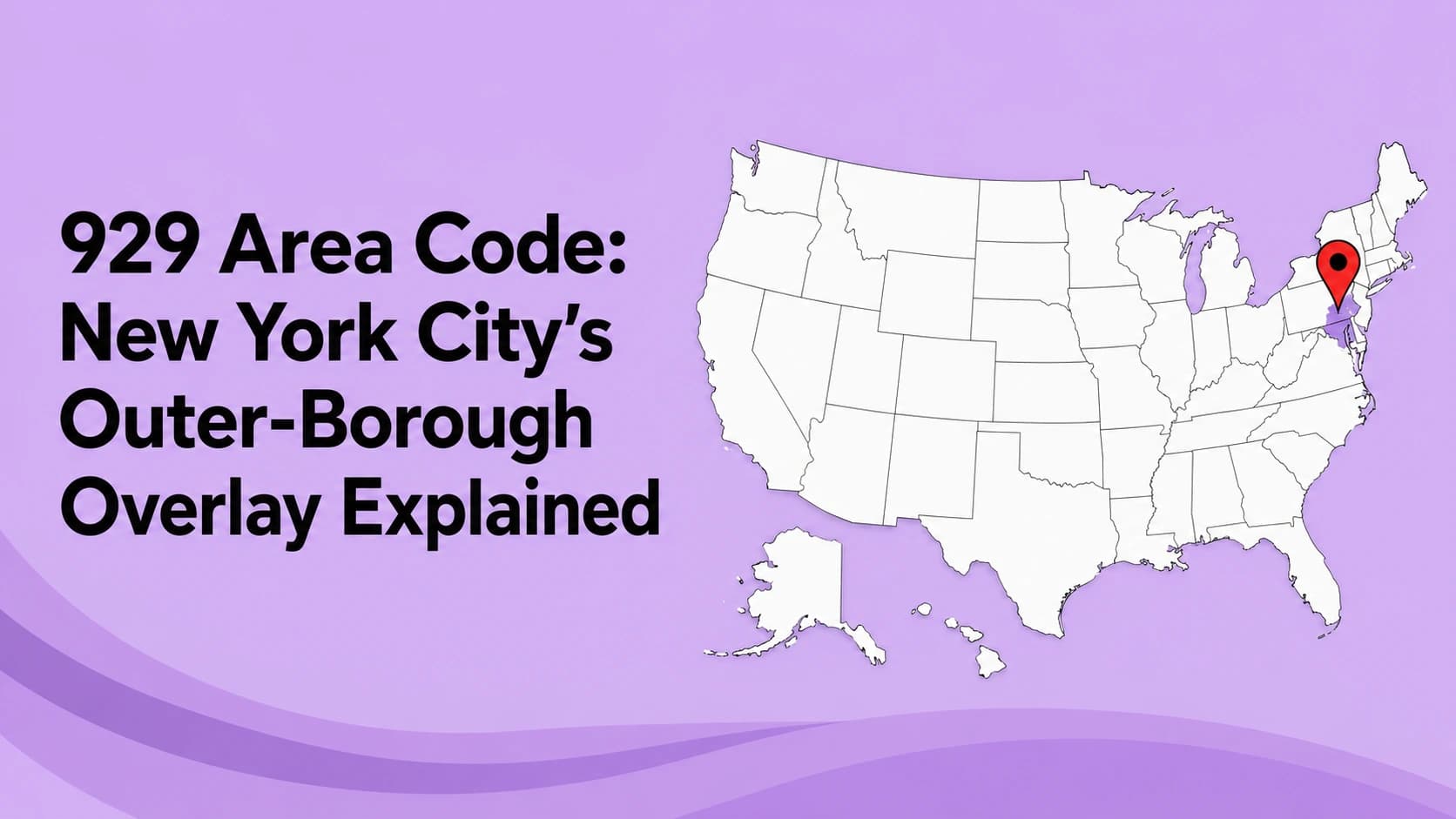
The 929 area code identifies phone numbers across four of New York City's five boroughs — Brooklyn, Queens, the Bronx, and Staten Island — layered on top of two older codes that were already running low on room by the time it launched in 2011.
This guide covers where 929 actually reaches, how it ended up sharing ground with 718 and 347, what the outer boroughs' economy looks like today, the process for claiming a number of your own, and a few dialing habits worth knowing before that first call goes out.
How 929 Joined New York City's Numbering Plan
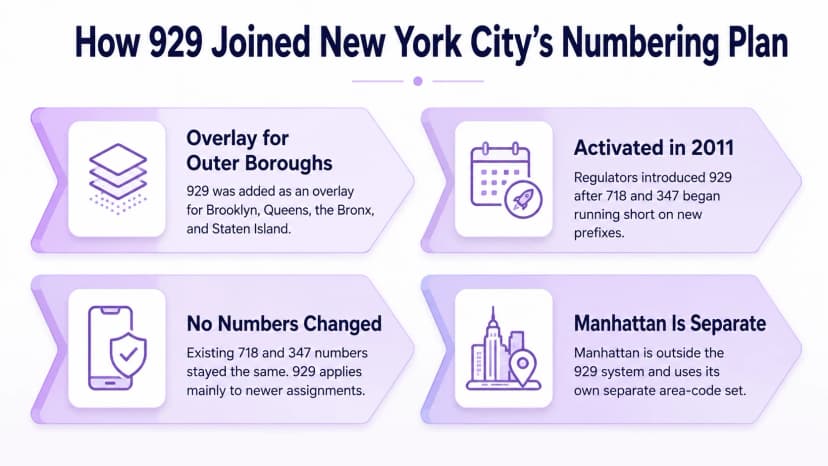
The North American Numbering Plan assigns 929 to New York City's outer boroughs, an overlay layered onto that same four-borough footprint rather than a fresh geographic split. Regulators activated it in 2011 once the two codes already covering that territory, 718 and 347, started running short on prefixes for new lines.
An overlay solves a capacity problem without moving anyone's number. Every existing 718 or 347 line stayed exactly where it was; the new code only applies to numbers assigned after the rollout date. Manhattan sits outside this system entirely, running its own separate set of codes that never touch 929 at all.
That separation catches people off guard more often than you'd expect. A 929 number signals the outer boroughs specifically, not the borough most visitors picture when they hear "New York City," and getting that distinction right matters for any business choosing a number to represent where it actually operates.
Every Borough the 929 Code Reaches
929 covers close to seven million residents spread across four boroughs, more people than most entire states hold. Brooklyn alone approaches three million on its own, a population that would rank among the four largest cities in the country if it stood apart from the rest of the five-borough system. Queens isn't far behind it, and together the two boroughs account for the majority of everyone this overlay reaches.
- Brooklyn — Williamsburg, Park Slope, Bushwick, and a creative and tech corridor anchored around DUMBO and Industry City
- Queens — Long Island City, Astoria, Flushing, and one of the most linguistically diverse counties in the entire country
- The Bronx — Fordham, Riverdale, Mott Haven, and a growing healthcare and food-distribution footprint
- Staten Island — the ferry terminal, St. George, and a warehousing corridor built around easy highway access
One quirk worth knowing: Marble Hill technically sits inside Manhattan's official borough lines but is physically attached to the Bronx, and it dials on the outer-borough codes rather than Manhattan's. It's a small exception, but it occasionally confuses anyone mapping numbers to neighborhoods by feel.
Growth in these four boroughs hasn't slowed the way older city projections assumed it would. New residential towers keep rising around Long Island City and Downtown Brooklyn specifically, both neighborhoods sitting squarely inside 929's territory rather than pulling from Manhattan's shrinking supply of ground-floor retail and office space.
The Road From 718 to a Second Overlay
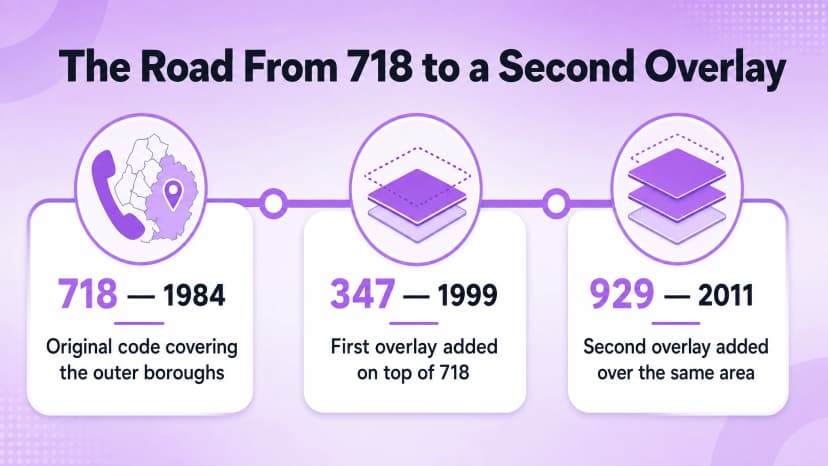
718 has covered the outer boroughs since 1984, when regulators split it away from Manhattan's original 212 code as the city's population and business-line demand both kept climbing. It held that entire territory alone for fifteen years before New York needed room again.
347 arrived in 1999 as the first overlay, layered directly on top of 718 without touching a single number already in service. That bought roughly a decade before demand caught up again, pushed along by pagers and early cell phones as much as new landlines, and regulators returned with 929 in 2011 as the second overlay over the same four boroughs.
All three codes now carry identical standing across the territory. Nothing about a 929 prefix marks a number as newer or somehow lesser than a 718 line — the difference only reflects which pool happened to have room left on the day that particular number got assigned.
Approving a new overlay isn't an overnight decision, either. Regulators track remaining number capacity years ahead of an actual shortage and run a public comment period before a new code goes live, which is part of why 929 didn't arrive until 2011 even though the shortage had been building for years before that.
The Outer Boroughs' Business Landscape
Brooklyn and Queens alone would each rank among the country's largest cities if they stood apart from the rest of New York, and the business mix behind 929's territory reflects that scale. Long Island City and DUMBO have pulled in tech and media companies for over a decade, while Industry City has turned a stretch of Brooklyn's waterfront into a hub for manufacturers and food producers.
- Hunts Point in the Bronx houses the largest wholesale produce market in the country, moving food through the region every night before most of the city is even awake
- Queens hosts two of the region's busiest airports, JFK and LaGuardia, anchoring a logistics and hospitality economy that reaches well beyond the terminals themselves
- Flushing and Jackson Heights support dense immigrant-owned retail corridors that run largely on foot traffic and phone orders rather than delivery apps
- Staten Island's highway access and ferry terminal make it a natural base for warehousing and last-mile distribution serving the rest of the city
None of that activity depends on a Manhattan address. A restaurant in Astoria, a contractor in Riverdale, and a clinic in Bay Ridge all compete for the same outer-borough customers, and increasingly none of them need an office south of the East River to do it.
That diversification changes how a business actually measures competition. A logistics contractor near JFK, a bakery in Bushwick, and a home health agency in Riverdale are all drawing from the same outer-borough customer base, and none of them are chasing the same crowd a Manhattan storefront would.
What a Local 929 Number Signals to Callers
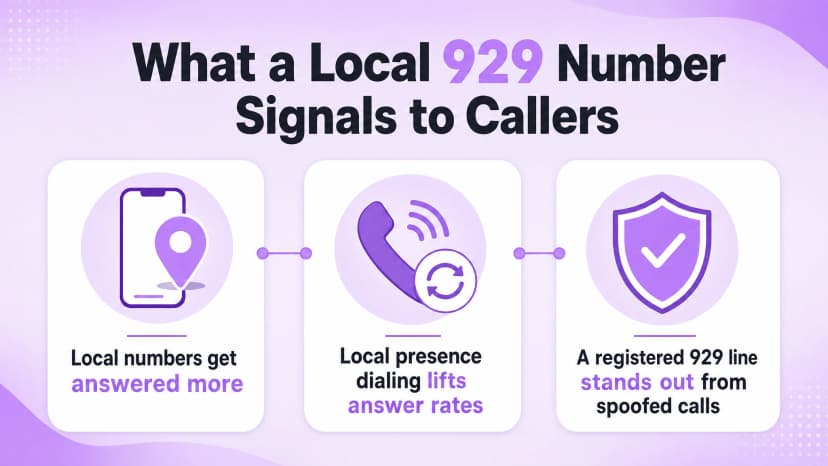
Local numbers get answered more than unfamiliar ones, and that pattern holds across every one of these outer-borough neighborhoods. A 929 line signals a business genuinely rooted in Brooklyn, Queens, the Bronx, or Staten Island, not a call center phoning in from a state the customer has never heard of.
That advantage extends to outbound calls too, through local presence dialing, a system that swaps the outgoing caller ID to match a 929 prefix automatically whenever the person on the receiving end sits inside that same territory. Answer rates on cold outreach and appointment reminders both tend to climb once that switch flips.
Robocalls and spoofed caller IDs hit New York particularly hard, and outer-borough numbers are a frequent target for scammers posing as local businesses. Keeping a 929 line tied to a properly registered caller name is one of the simplest ways a legitimate business separates itself from that background noise.
Claiming a 929 Number, Step by Step
None of this needs a physical presence anywhere in the outer boroughs — signing up happens entirely online, wherever the business happens to be based. The typical process breaks down into four steps:
- 1Check that the provider has real 929 numbers available right now, not just a form that promises to follow up later.
- 2Scroll through what's on offer and settle on a number that sounds clean read aloud — something nobody has to ask you to repeat.
- 3Enter whatever the signup asks for, usually just a business name, an email address, and a payment method.
- 4Point the number at whatever should answer it — a phone, a queue, an auto-attendant — and test it with an outside call before handing it out to anyone.
Pricing rarely hinges on the number itself; it's the plan attached to it that sets the bill. Features like call forwarding, transcribed voicemail, and a starter auto-attendant are typically bundled into the entry-level tier rather than sold as separate add-ons.
Technically speaking, what you're setting up is a DID phone number — a direct inward-dial line a provider routes to a specific person, queue, or device instead of funneling it through a shared front desk, which is how most small outer-borough operations end up running their phones.
Switching who manages an existing 929, 718, or 347 number usually doesn't mean losing it. The transfer happens on the back end — the number keeps working the same way for anyone calling it while the account underneath moves to a new provider.
Dialing Habits Worth Getting Right
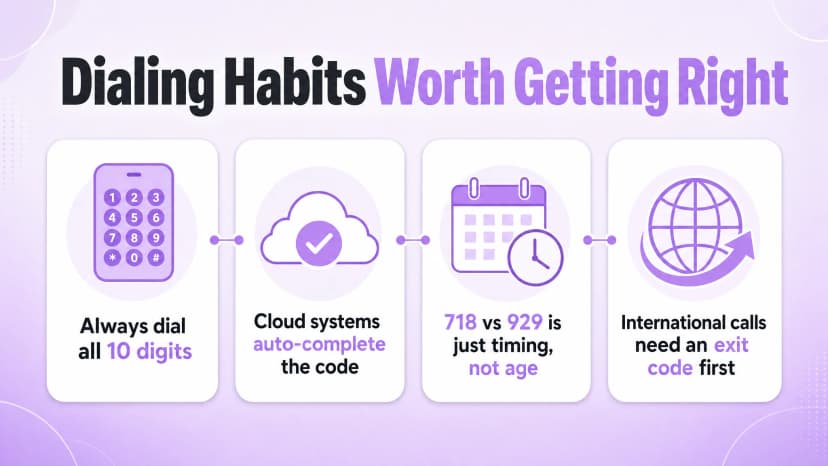
Overlay territory means dialing all ten digits on absolutely everything, including a call between two phones sitting in the same room. Drop the area code and the call just won't go through — a rule that's been standard since 347 joined the mix back in 1999.
For the full breakdown of why that rule exists, the FCC maintains a public ten-digit dialing guide covering every US region running more than one area code over the same footprint, outer-borough New York among them.
- Most cloud phone systems auto-complete the missing digits without anyone noticing — the actual failures tend to trace back to a printed flyer or an old spreadsheet nobody bothered updating
- Treating 718 as somehow more legitimate than 929 is a common assumption, but the code stamped on a number only reflects timing, never how long a business has actually been open
- International callers need their own exit code ahead of the US country code and the full number, a step that locals dialing from inside the country never have to think about
- Some caller ID databases still lag behind and show 718 for a line that was only ever issued as 929 or 347, and that resolves itself as those records eventually get updated
Conclusion
The outer boroughs outgrew what 718 and 347 could handle on their own, and 929 filled that gap the same way overlays always do — quietly, without moving a single number anyone already had. It sits on equal footing with the two codes it shares space with, not a step below either one.
Dial the full ten digits, expect the same call quality as any other New York City line, and treat 929 as exactly what it is: a full member of the outer boroughs' phone system, not a placeholder waiting to be replaced by something better.
Between Hunts Point's produce trade, two international airports, and a dense mix of independent businesses spread across four boroughs, this part of New York fields plenty of calls from people it hasn't met yet. Getting a working 929 number set up rarely takes more than a few minutes once you're with a provider that actually stocks them.
Ready when you are
Ready to get your own 929 area code number?
Build a real New York City presence across Brooklyn, Queens, the Bronx, and Staten Island. Spin up a 929 number in minutes — free trial, no card, and free number porting if you already own a number.
FAQ
The 929 area code covers Brooklyn, Queens, the Bronx, and Staten Island as an overlay on top of the 718 and 347 codes. It has served that territory since 2011 and does not extend into Manhattan.
No. Manhattan runs on its own separate set of codes — 212, 646, and 332 — that never overlap with 929. The one exception is Marble Hill, which sits inside Manhattan's borough lines but dials on the outer-borough codes.
Because three area codes now share the same outer-borough territory. With more than one code covering identical ground, the network needs the full ten digits, area code included, to know which line you actually mean.
Yes. Both read as genuine New York City numbers to local customers. 718 is simply the older code, so a few businesses lean toward it out of habit, but there is no functional difference in how either one routes or rings.
Yes. Cloud phone providers issue 929 numbers regardless of where a team is physically based, and calls forward to whatever device answers. This is how remote and hybrid teams maintain a real outer-borough presence without leasing space there.
Yes. Number portability is a legal right in the US, so a 929 number can move to a new provider without changing what customers dial. Confirm the porting timeline and any fees before you commit to switching.