
Introduction
Answer a business line enough times and you eventually see it happen: a call that should reach a real customer shows up as "Spam Likely" before anyone picks up. STIR/SHAKEN explained in plain terms is the reason that label appears at all, and understanding it is the first step to keeping your own calls off that list before customers ever notice.
This guide breaks down what STIR/SHAKEN actually does, what the A, B, and C attestation levels mean, and how a call gets checked before it rings. It also covers why full attestation alone does not stop blocked calls, what actually triggers a spam label, and how to check and improve your own score. By the end, you will know exactly where to look first and what to fix.
What Is STIR/SHAKEN?
STIR/SHAKEN is a pair of technical standards that confirm a caller ID is real before a call ever reaches the person being called. STIR, short for Secure Telephone Identity Revisited, defines how a call gets cryptographically signed at the source. SHAKEN, short for Signature-based Handling of Asserted information using toKENs, sets the rules for how carriers apply that signature consistently.
Before this system existed, any provider could stamp almost any number on an outbound call, which made spoofing trivially easy. A caller in another country could show up looking exactly like a neighbor's phone number, with no way for the recipient to tell. Cryptographic signing closes that gap, since a spoofed number cannot carry a valid signature from a carrier that never actually issued it.
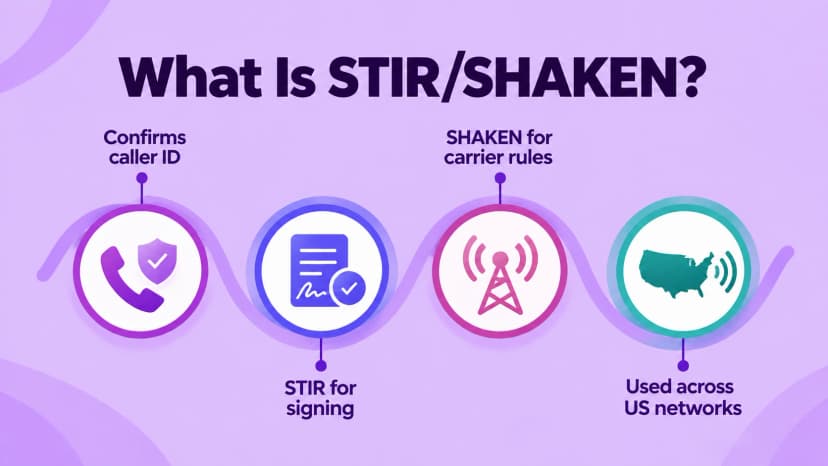
- Confirms a caller ID is genuine before the receiving phone even rings
- Combines two standards: STIR for signing, SHAKEN for carrier-wide rules
- Runs automatically on every call, with no manual steps for the caller
- Applies to calls carried across telecom networks in the United States
- Covers both mobile and landline carriers handling the call
- Makes spoofed numbers far harder to disguise as a trusted contact
- Was built specifically to cut down on illegal and nuisance robocalls
- Works in the background regardless of which phone or carrier answers
- Does not require the caller to install anything or change how they dial
What Are the Attestation Levels?
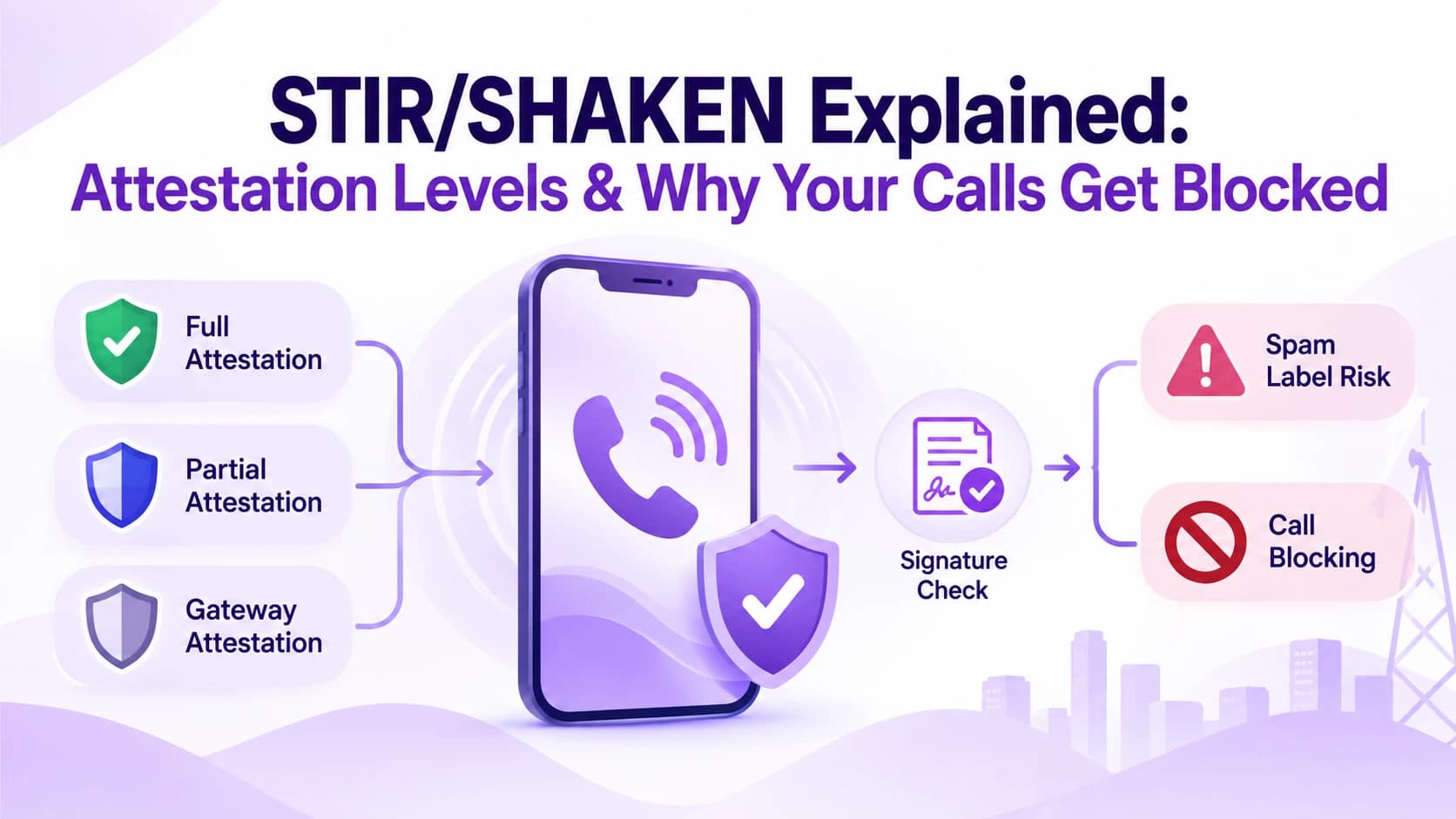
Every outbound call gets tagged with an attestation level before it leaves your provider's network, and that tag tells the receiving carrier how confident your provider is in your identity. Level A, or full attestation, means your provider has confirmed you are authorized to use that exact caller ID. Most phones show this as a checkmark or a verified tag right on the call screen, which builds trust before the call even connects.
Level B, or partial attestation, means your provider knows your account but has not confirmed the specific number, which often happens on a shared trunk without per-number verification. Level C, or gateway attestation, means your provider has no real relationship with you at all, usually because the call passed through as an international gateway connection.
- Level A means full attestation, with your identity and number both confirmed
- Level B means partial attestation, with the account known but not the number
- Level C means gateway attestation, with little or no relationship confirmed
- Level A is the target every legitimate business should be aiming for
- Level C is the label most likely to trigger a block or spam flag
- A shared trunk without per-number checks often lands at Level B
- International gateway traffic is the most common source of Level C
- Ask your provider directly which level most of your traffic actually carries
- Ringflow ties every outbound number to a verified account to keep it at Level A
How Caller ID Authentication Works
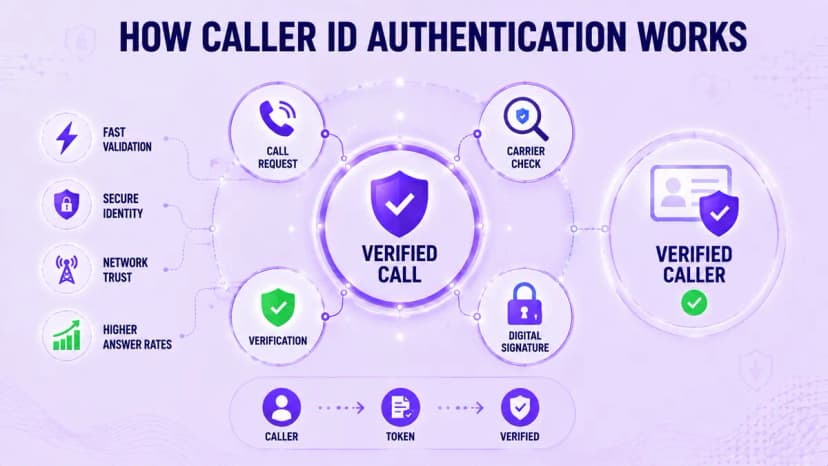
This process happens automatically in the background on every single outbound call your business makes, in just a handful of quick steps. Your phone system or SIP trunking provider sends the call request, your carrier checks its own records for that number and account, and the carrier signs the call with an attestation level and a digital token before it ever leaves that carrier's own network.
The receiving carrier then verifies that token before the phone even rings, deciding in that instant whether to show a verified badge, pass the call through untouched, or flag it. None of this requires manual work on a call-by-call basis, but it only works correctly when your provider actually supports it. A provider that skips this step leaves every one of your calls unsigned, which almost always reads as higher risk on the receiving end.
- Your phone system sends the outbound call request to your provider
- Your carrier checks its own records for that number and account
- The carrier signs the call with an attestation level and a digital token
- The receiving carrier verifies that token before the phone rings
- A verified badge, a plain pass-through, or a flag follows from that check
- An unsigned call almost always reads as higher risk to the receiver
- Testing across more than one carrier catches gaps a single test can miss
- Keep a simple log of test results so patterns are easy to spot later
- Ringflow signs every outbound call correctly by default, so none go out unsigned
Why Calls Get Blocked Even With Full Attestation
Most explanations stop at get Level A and you are fine, but that is not the whole story. Full attestation is only one signal among several that carriers weigh when judging a call, and a brand-new number making thousands of short calls a day can still get flagged even while carrying a clean Level A tag from its very first day in service, long before it earns any real calling history.
Volume spikes are the biggest trigger, followed by calling the same numbers repeatedly and high abandon rates on a fresh number with no history. A 30-agent sales team dialing 2,000 calls a day from ten fully verified lines can still see half those numbers flagged as spam within two weeks. Spreading the load and watching call center metrics usually fixes this faster than any single technical setting.
- STIR/SHAKEN full attestation is one signal among several, not a guaranteed pass
- Sudden volume spikes are the single biggest trigger for a spam label
- Calling the same numbers repeatedly raises risk regardless of attestation
- Short call durations and high abandon rates add risk on top
- A brand-new number with no history is treated with extra suspicion
- Insurance, real estate, and collections teams feel this pressure hardest
- Rotating across a wider pool of verified numbers reduces the strain
- Healthcare reminder lines see the same spike during busy appointment seasons
How to Check and Improve Your Attestation Level
Start by calling your own cell phone from your business line, since most carriers now show the attestation result directly on the screen. If you see a spam warning or no verified badge, ask your provider for your current level in writing, and repeat this test from every number your business actively dials from, not only the one main line customers already know.
Improving your level usually comes down to one main thing: giving your provider more proof that you genuinely own the number you are calling from. Verify ownership directly through your provider's own account portal, avoid third-party number leasing that quietly breaks the ownership chain, and check whether your setup still meets today's 10DLC business registration requirements for business texting on the same lines.
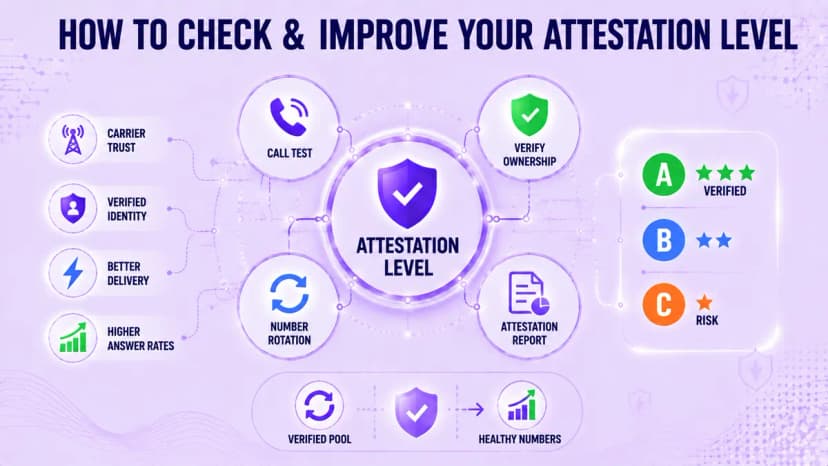
- Call your own cell phone from every business line you actively dial from
- Ask your provider for your current STIR/SHAKEN attestation level in writing
- Verify number ownership directly through your provider's own portal
- Avoid third-party number leasing that breaks the ownership chain
- Keep account details current whenever a number changes hands internally
- Rotate a pool of verified numbers instead of relying on just one
- Review that pool monthly, since a healthy number can still burn out
- Document every verification step in case a carrier asks for proof later
STIR/SHAKEN Compliance: What the Rules Require
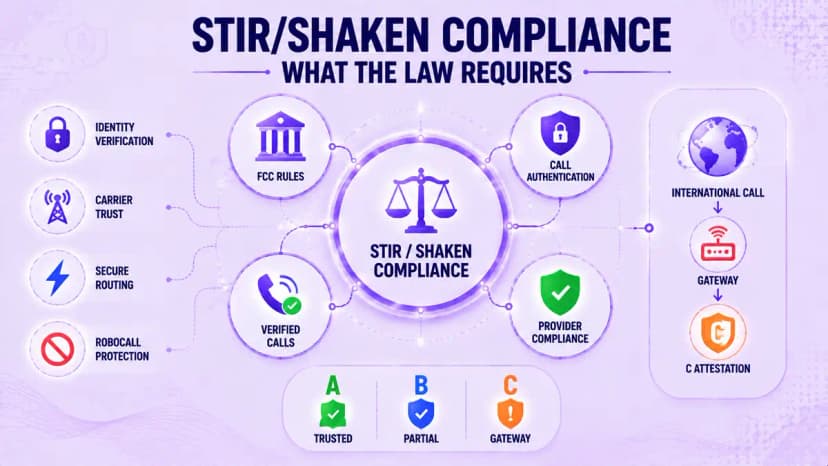
The FCC requires STIR/SHAKEN implementation from major voice providers across the United States, and it is federal policy rather than optional infrastructure. Providers that skip it risk real financial penalties, not just angry customer complaints. The FCC call authentication rules set the floor every provider must meet, though meeting that floor does not guarantee every call reaches Level A.
Smaller providers had extended deadlines, but most of the industry is compliant today, even though compliant and effective are not quite the same thing. International calls add another wrinkle, since a call originating overseas and terminating in the US often cannot carry the same signature a domestic call gets. Gateway providers bridging that international traffic are exactly where Level C shows up most often in practice.
- Major US voice providers are required to implement STIR/SHAKEN today
- Smaller providers followed on extended compliance deadlines
- Compliance sets a floor, not a guarantee of full attestation
- International calls often cannot carry the same signature a domestic call gets
- Gateway providers bridging international traffic often show Level C
- Ask any provider for written proof of compliance, not just a claim
- A compliant provider can still implement the standard poorly in practice
- Revisit compliance yearly, since carrier rules and thresholds do shift over time
- Ringflow builds STIR/SHAKEN compliance directly into its contact center platform
Conclusion
STIR/SHAKEN quietly decides how trustworthy your caller ID looks before anyone on the other end even answers, and the A, B, and C attestation levels set the baseline for how much of it exists. Full attestation helps enormously, but it will not fix bad calling patterns on its own, and checking your level is only the first step, not the last one.
Blocked calls cost real conversations every day they go unresolved. Check your current attestation level this week, then work through your calling patterns before assuming the technical box is fully checked. Ringflow ties every outbound number to a verified account by default and pairs that with smarter routing, so attestation stays clean without any extra manual paperwork on your side.
Curious how this looks from the receiving end? Our guide to restricted and blocked calls covers *67, *82, and how STIR/SHAKEN factors into the caller ID a phone actually shows.
Ready when you are
A Blocked Call Never Gets the Chance to Be a Good Conversation
Ringflow keeps your STIR/SHAKEN attestation clean and your outbound calls connecting.
Frequently Asked Questions
It is a caller ID authentication system that confirms a call is coming from who it claims to be, using cryptographic signing so spoofed numbers cannot carry a valid signature.
Level A means your provider fully confirmed your identity and number. Level B confirms the account but not the number. Level C means little or no relationship was confirmed.
No. Full attestation helps, but carriers also weigh calling volume, complaint history, and how new a number is before deciding whether to flag a call.
Call your own cell phone from your business line and look at the screen. Most carriers display a verified badge or a spam warning based on the result.
Verify number ownership directly through your provider's portal and avoid third-party number leasing, which is the most common reason attestation stays low.