
Introduction
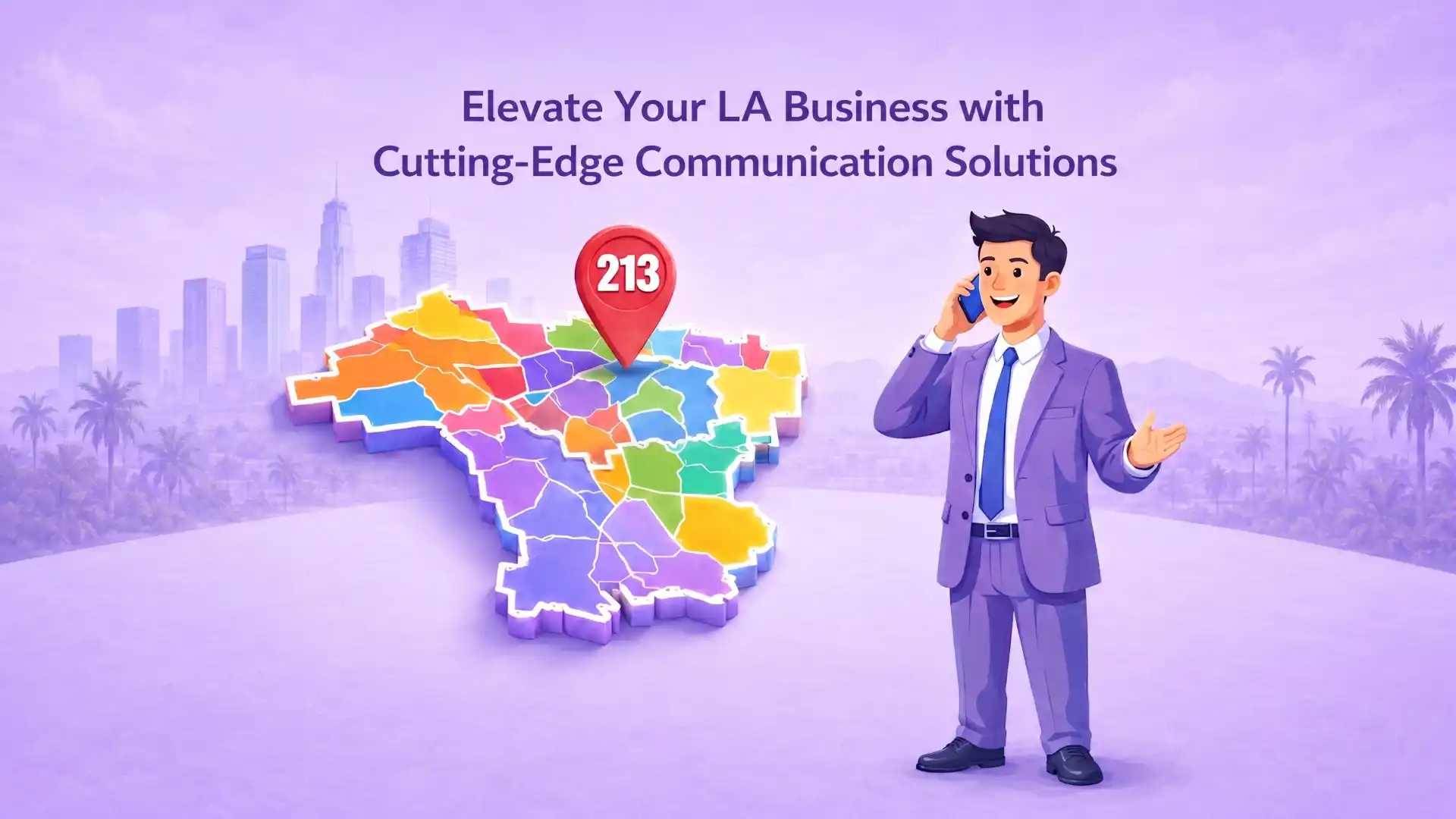
The 213 area code is downtown Los Angeles's original telephone prefix — one of only three area codes California received in 1947, alongside 415 for the Bay Area and 916 for the northern half of the state. Nearly eighty years and five territorial splits later, it still anchors the city's commercial core, from the Financial District's towers to the Arts District's converted warehouses.
This guide covers where the code actually reaches today, the unusual regulatory decision that folded two split-apart codes back into one shared overlay, the newer 738 layer added on top of that, and who actually relies on a 213 number and why. The setup steps at the end take a few minutes, whether the line is going on a business card or a personal phone.
- The 213 area code was created in 1947 as one of California's original three area codes, alongside 415 and 916.
- 213 was split five times between 1951 and 1998 (spinning off 714, 805, 818, 310, and 323), shrinking it down to just downtown LA.
- In 2017, regulators took the unusual step of eliminating the boundary between 213 and 323, merging them into a shared overlay — then added 738 as a third layer in 2024.
- Entertainment, finance, fashion, and Arts District tech all lean on a 213 number for downtown credibility.
What Is the 213 Area Code?
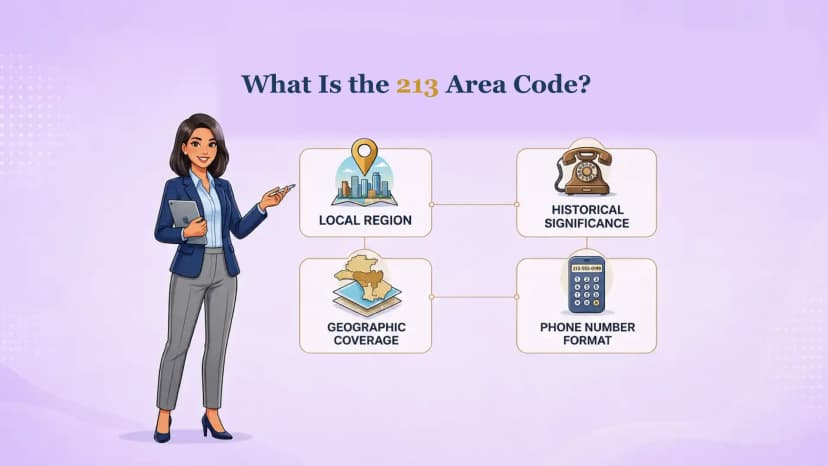
213 is one of California's original three 1947 area codes, issued in the same batch as 415 for the Bay Area and 916 for the north when the state's numbering plan first launched. Back then it stretched across nearly the entire southern half of California — from the Mexican border up through the Central Coast and inland toward the desert.
Decades of explosive population growth shrank that footprint dramatically, as regional planners carved out new codes every time demand for phone lines outpaced the numbers still available under the old one. Today, after five separate splits, 213 covers just downtown LA and its immediately surrounding neighborhoods — a fraction of its original territory, but by far the most commercially dense part of it.
That contraction mirrors what happened across most of urban America during the same decades: a single area code built for a mid-century population simply ran out of headroom once fax lines, pagers, and eventually cell phones multiplied the number of lines a single household or business needed.
A Brief History: Five Splits and a Reunion
213 has changed shape more than almost any other California area code, shrinking through five separate splits before an unusual regulatory move brought part of that territory back together:
- 1951-1998: five splits. 714 broke off in 1951 to cover Orange County, 805 followed in 1957 for the Central Coast, 818 split away in 1984 for the San Fernando Valley, 310 carved out the Westside and South Bay in 1991, and 323 arrived in 1998, finally reducing 213 to just downtown LA.
- 2017: an unusual reunion. Instead of splitting the shrunken 213 territory again, the California PUC eliminated the boundary between 213 and 323 altogether, merging two already-separate codes back into one shared overlay covering the exact same footprint.
- 2024: a third overlay. That reunited 213/323 territory needed more capacity by the early 2020s, so regulators approved 738 as a third layer, which went live in November 2024.
- A nationwide pattern. Layering multiple codes onto identical geography instead of redrawing boundaries has become the standard fix once regulators realized repeated splits force people to change numbers just to stay reachable.
Where the 213/323/738 Overlay Reaches
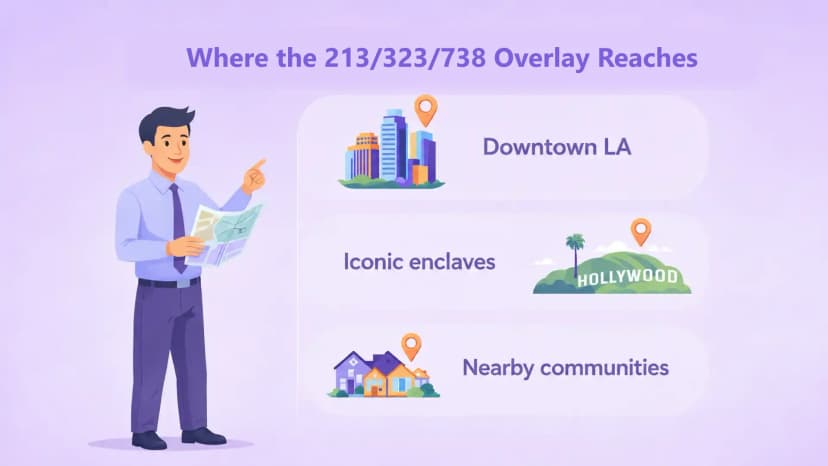
The overlay covers downtown LA's Financial District, the Arts District, Chinatown, Koreatown, and Little Tokyo, plus West Hollywood, Beverly Hills, Glendale, and Pasadena. It stretches further out to Bell, Huntington Park, Vernon, Montebello, and a number of other central Los Angeles County communities that sit just outside the urban core but still fall inside the same numbering boundary.
A number from any of the three codes signals the same thing to anyone who sees it on a caller ID or a business card: a genuine downtown-and-central-LA presence, not the Westside, not the San Fernando Valley, and not greater Los Angeles County in the broader sense that outsiders often assume.
That distinction matters more in Los Angeles than in most metro areas, since the city's sprawl means a phone number is one of the few quick signals locals actually use to place a business geographically before they've even looked at an address.
213 vs. 323 vs. 738 vs. Neighboring LA Codes
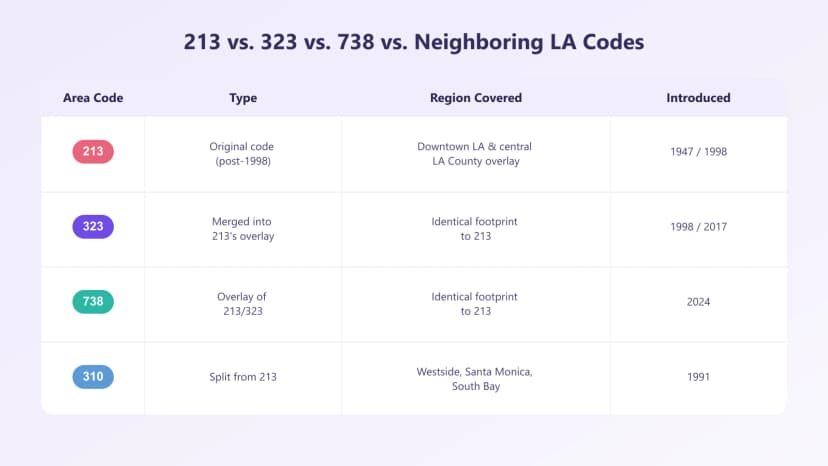
LA's numbering map is easy to mix up. Here's how the codes relevant to downtown actually relate:
| Area Code | Type | Region Covered | Introduced |
|---|---|---|---|
| 213 | Original code (post-1998) | Downtown LA & central LA County overlay | 1947 / 1998 |
| 323 | Merged into 213's overlay | Identical footprint to 213 | 1998 / 2017 |
| 738 | Overlay of 213/323 | Identical footprint to 213 | 2024 |
| 310 | Split from 213 | Westside, Santa Monica, South Bay | 1991 |
An overlay works differently from a split: instead of drawing a new line on the map, regulators simply allow more than one code to serve the same addresses, and new numbers get assigned to whichever code still has blocks available at the time.
The short version: 213, 323, and 738 are three names for the exact same downtown footprint, so picking one is purely a question of what's available, never geography. Businesses after a coastal identity instead should look at the 310 area code, which covers Beverly Hills, Malibu, and Santa Monica — a completely different slice of the LA numbering map.
Who Actually Uses a 213 Number
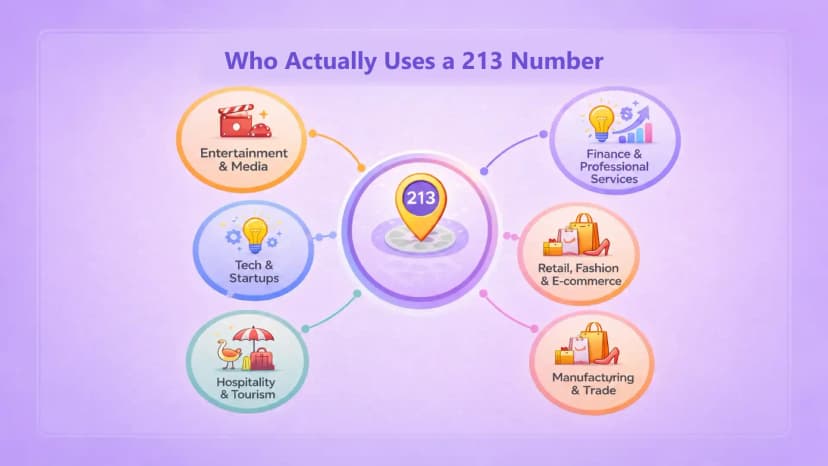
There's a practical reason a 213 number gets picked over any other prefix: it signals proximity to the specific industries clustered around downtown's commercial core, and those industries tend to judge an unfamiliar caller by exactly that kind of detail:
- Entertainment and media. Agencies, production companies, and streaming platforms cluster around downtown and want a number that matches.
- Finance and professional services. Banks, law offices, and consulting firms in the Financial District lean on 213 for institutional credibility.
- Arts District tech and startups. DTLA's innovation hubs use a local number to signal roots even while hiring remotely.
- Fashion, retail, and hospitality. The Fashion District's wholesale ecosystem and downtown's hotels and venues both depend on high call volume.
None of that requires an actual downtown office lease. Plenty of the businesses that lean hardest on a 213 identity run distributed or fully remote teams, and simply forward the virtual number to wherever staff happen to be working that day, from a home office in Pasadena to a co-working space three states away.
How to Get a 213 Area Code Number
No Financial District office is needed to claim a number here — the whole thing happens online, start to finish:
- 1Pick a provider. Choose a cloud phone service that lists downtown LA numbers as available inventory.
- 2Search for your number. Browse combinations across 213, 323, or 738 — all three are equally local.
- 3Set up billing. Providers typically just need a name, email address, and a card on file.
- 4Route the line. Point calls to a person, a shared queue, or an auto-attendant menu.
- 5Place a test call. Dial and text the new number before handing it out to anyone.
The old number stays live throughout a port, and the switch itself usually clears in a few business days once the previous carrier signs off on the transfer. What actually moves the price needle is feature set — call recording, multi-line routing — not which area code is attached; see our business phone system cost breakdown for real numbers.
Common Mistakes to Avoid
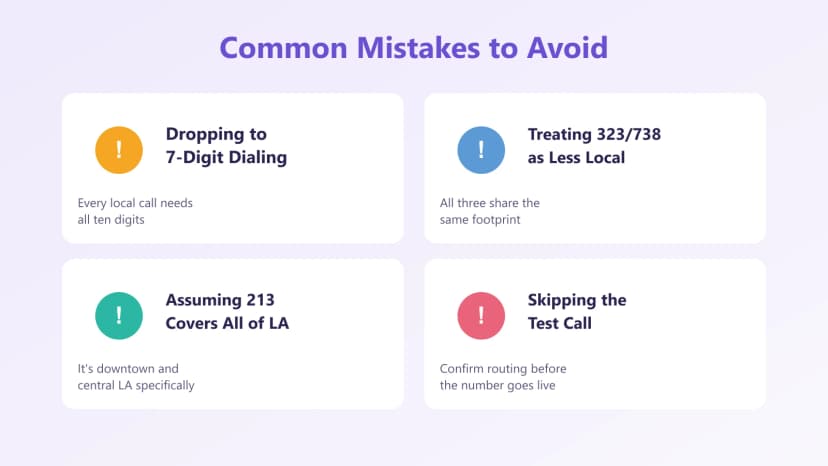
Sharing one footprint across three area codes opens the door to a handful of predictable slip-ups — all avoidable once someone knows to look out for them:
- Dropping to 7-digit dialing. Since 213, 323, and 738 share one footprint, every local call needs all ten digits, even between two 213 numbers.
- Treating 323 or 738 as less local than 213. All three draw from the same shared pool for the same downtown territory.
- Assuming 213 covers all of LA. It's downtown and central LA specifically — the Westside uses 310, the Valley uses 818.
- Skipping a test call after activation. Confirm routing works correctly before the number reaches customers.
The 2017 boundary elimination that merged 213 and 323 was approved by the California PUC, the state regulatory body that oversees every area code change in California, from routine splits to rarer overlay mergers like this one.
Conclusion
Downtown Los Angeles has carried the 213 prefix since 1947, and getting here took a genuinely unusual path: five splits shrank it to a compact footprint, an equally rare boundary elimination stitched it back together with 323, and 738 layered on top of both to add room without redrawing the map a sixth time.
Any of the three codes activates fast — often the same day it's requested — regardless of whether it's going on a personal line or a business number fielding downtown LA calls, and an existing number ports over in the background without dropping service.
Ready when you are
Ready to Get Your Own 213 Area Code Number?
Claim instant downtown LA credibility with a 213 number from Ringflow. Set one up in minutes — free trial, no card required, and free number porting if you already own a number.
FAQ
The 213 area code is downtown Los Angeles's original telephone prefix, created in 1947 as one of California's first three area codes. It's now part of a three-way overlay with 323 and 738.
There isn't a geographic difference — all three share the exact same downtown LA footprint. 323 was originally a separate split-off code until regulators merged it back with 213 in 2017; 738 was added as a third overlay in 2024.
The 213/323/738 overlay is bordered by 310 (Westside LA) and 818 (San Fernando Valley), both of which originally split off from 213 itself.
Sign up with a cloud phone provider like Ringflow, search available numbers across 213, 323, or 738, and activate the line online. Most providers only need a name, email, and payment method.
Yes — it's one of California's three original 1947 area codes, and remains a legitimate, historic prefix for downtown Los Angeles.
Always, since 213, 323, and 738 share the same region and require 10-digit dialing for every local call, even between two numbers with the same code.