
Introduction
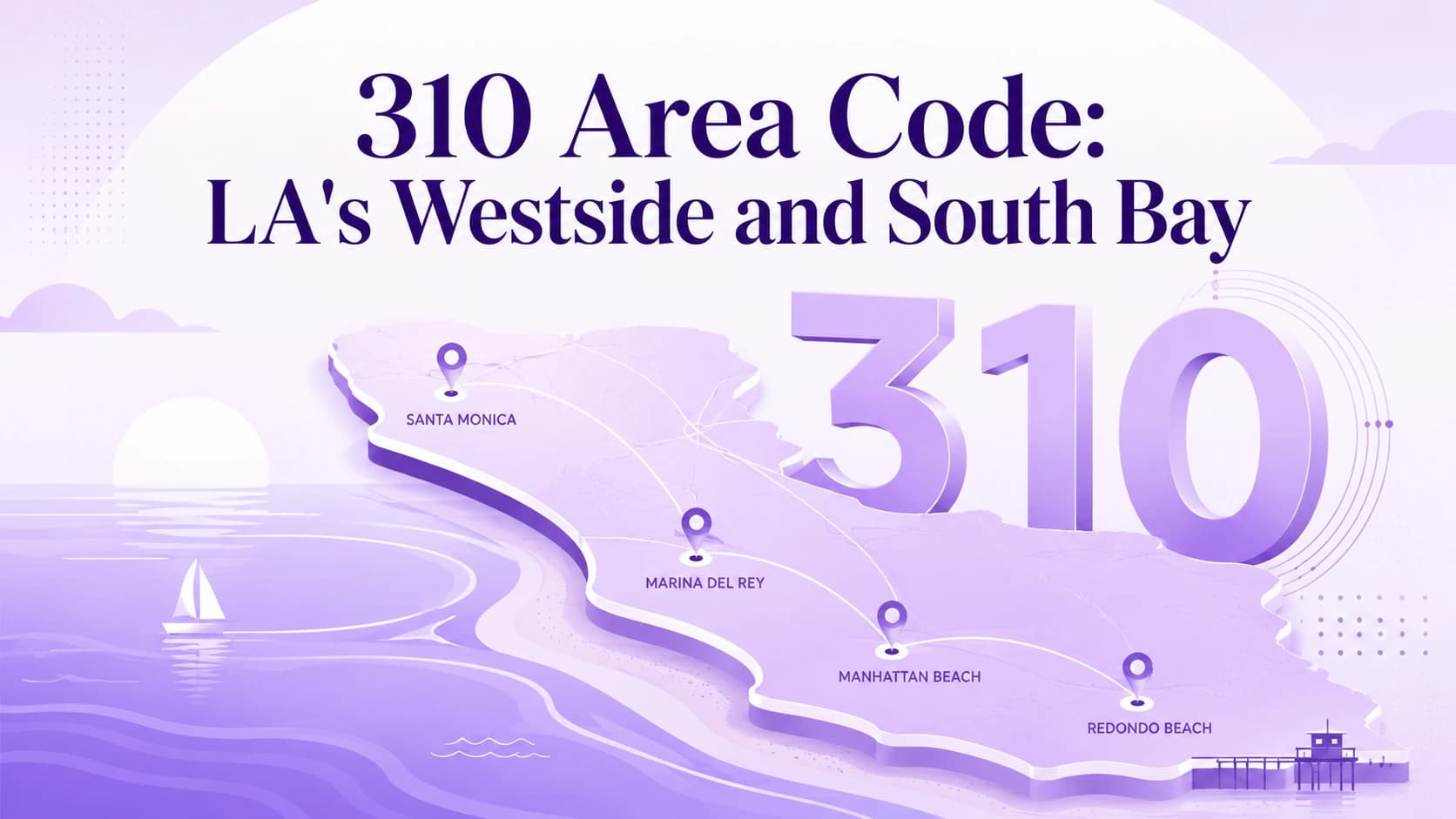
The 310 area code covers the Westside and South Bay of Los Angeles County, from Beverly Hills and Santa Monica down to Torrance and San Pedro. Spotting this prefix on a missed call, shopping for a Westside line, or just wondering why a second area code shares this exact same territory today are all good reasons to want the full picture.
Below you'll find exactly where it reaches, how it split away from Los Angeles's original area code, why a newer overlay shares its exact same footprint today, and the steps to set up a working line here for a growing team of any size. Once through, it'll be clear why a 310 number still signals genuine Westside or South Bay roots, not a distant out-of-state call center.
- The 310 area code covers the Westside and South Bay of Los Angeles County, including Beverly Hills, Santa Monica, Torrance, and San Pedro, plus Catalina Island offshore.
- It split off from Los Angeles's original area code, 213, on November 2, 1991, then lost its own southeastern edge, including Long Beach, to area code 562 just six years later in 1997.
- Area code 424 has overlaid that same footprint since 2006, the first all-services overlay ever approved in California, so every local call needs all 10 digits.
- Silicon Beach tech offices, LAX, UCLA, and Sony Pictures Studios all sit inside this same coverage area, alongside Beverly Hills's talent agencies.
Where the 310 Area Code Reaches: Westside to South Bay
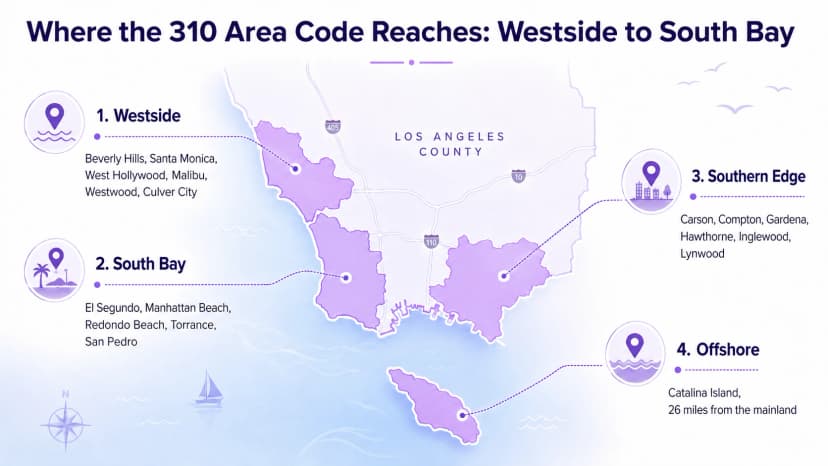
Area code 310 covers the Westside of Los Angeles County, including Beverly Hills, Santa Monica, West Hollywood, Malibu, Westwood, Brentwood, Pacific Palisades, Venice, Marina del Rey, and Culver City, along with the South Bay cities of El Segundo, Manhattan Beach, Hermosa Beach, Redondo Beach, Torrance, and San Pedro. Catalina Island, roughly 26 miles offshore, carries this same prefix too, despite sitting entirely apart from the mainland coast.
Carson, Compton, Gardena, Hawthorne, Inglewood, and Lynwood round out the footprint's southern edge. That's a coastal, densely populated stretch of Los Angeles County rather than the sprawling inland valleys most people picture when they think of the wider LA area, and it stays that way regardless of which direction a business happens to be calling from.
- Westside: Beverly Hills, Santa Monica, West Hollywood, Malibu, Westwood, and Culver City
- South Bay: El Segundo, Manhattan Beach, Redondo Beach, Torrance, and San Pedro
- Southern edge: Carson, Compton, Gardena, Hawthorne, Inglewood, and Lynwood
- Offshore: Catalina Island, roughly 26 miles from the mainland coast
Two Splits: From 213 to Today's Footprint
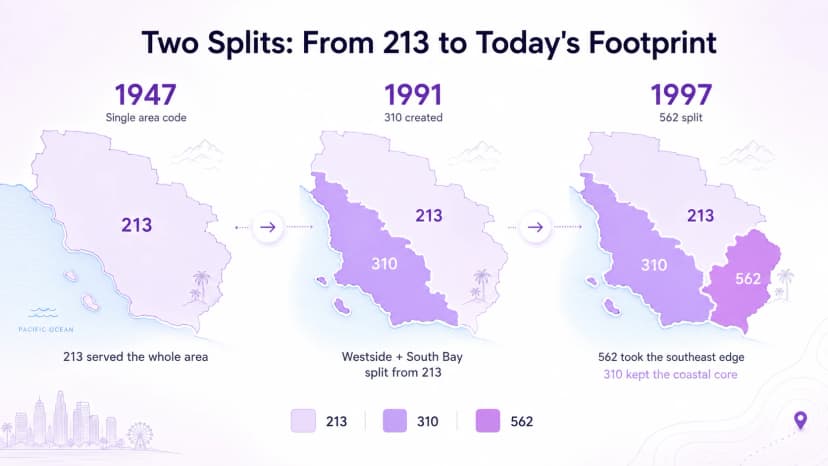
Area code 310 didn't exist before 1991. Los Angeles ran on a single area code, 213, one of the original 86 assigned nationwide in 1947, until regulators split off the Westside and South Bay as their own area code on November 2, 1991, once the original footprint ran short on available numbers to hand out to new customers.
That new 310 footprint didn't stay intact for long either. On January 25, 1997, its own southeastern edge split away again, taking Long Beach, the Gateway Cities, and a slice of Orange County into a brand-new area code, 562, and leaving 310 with the coastal core it still covers today, just six years after it was first carved out of 213.
310 Next to 213, 562, and the Valley
Four area codes border this coastal footprint today. To the east, 213 and its 323 overlay cover central and east Los Angeles, the very territory 310 split away from back in 1991 when the two prefixes first went their separate ways for good and never looked back.
The 213 area code guide covers that shared split from the other side of the border. To the southeast, 562 picks up Long Beach and the Gateway Cities, while 805 and 818 cover Ventura County and the San Fernando Valley across the Santa Monica Mountains to the north.
- East: 213 and its 323 overlay, covering central and east Los Angeles
- Southeast: 562, covering Long Beach and the Gateway Cities
- North: 805, covering Ventura County
- North: 818 and its 747 overlay, covering the San Fernando Valley
Silicon Beach, Studios, and LAX: The 310 Economy
Santa Monica and Venice anchor Silicon Beach, home to tech offices for Google, Snap, and YouTube, while Hulu keeps its headquarters in Santa Monica. Beverly Hills remains a historic hub for talent agencies and entertainment deal-making, and Sony Pictures Studios operates out of Culver City, keeping the region tied closely to the entertainment industry it helped build over the decades.
UCLA sits in Westwood, and Los Angeles International Airport falls inside this same footprint. San Pedro is home to the Port of Los Angeles, distinct from the Port of Long Beach just across the 562 border, and plenty of these businesses lean on a virtual phone number to keep a local presence without renting a downtown office anywhere near these coastal neighborhoods at all.
- Silicon Beach: Google, Snap, and YouTube offices, plus Hulu's Santa Monica headquarters
- Entertainment: Beverly Hills talent agencies and Sony Pictures Studios in Culver City
- Education: UCLA, in Westwood
- Transportation: Los Angeles International Airport and the Port of Los Angeles in San Pedro
424: California's First All-Services Overlay
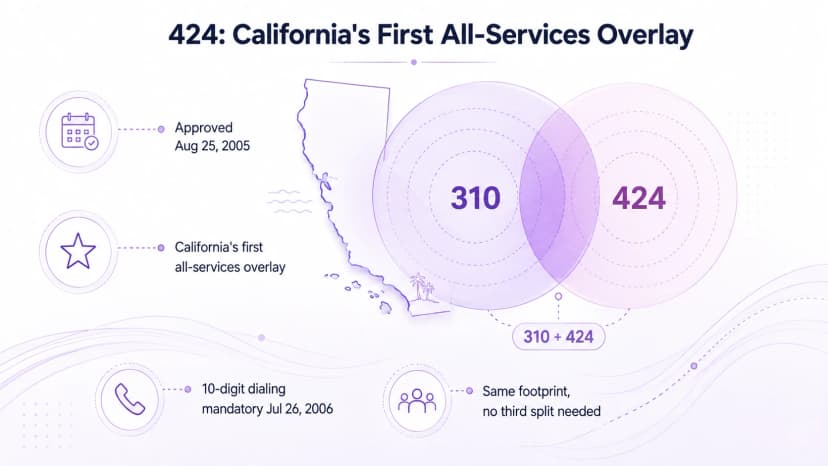
By the early 2000s, this coastal footprint was running low on available numbers as pagers, fax lines, and early cell phones ate into the remaining supply faster than expected. Regulators approved a new overlay, area code 424, on August 25, 2005, rather than splitting the map a third time, making it the first all-services area code overlay ever approved anywhere in the state of California.
Permissive 10-digit dialing began that December, and by July 26, 2006, it became mandatory alongside the first new 424 numbers issued. The overlay history traces the full regulatory record behind that decision, and no third code has been needed on this same footprint since that overlay first went live.
Why a Local 310 Number Still Signals Real Roots
A number from this prefix tells Westside and South Bay customers that a business is genuinely local, not a national brand routing calls through a distant call center somewhere else. That signal matters most for real estate agents, entertainment-adjacent businesses, and service companies whose customers expect a name they recognize before they even pick up the phone to answer.
The number itself only gets a call answered, though. What happens after that, whether a live rep picks up or a properly configured call flow routes it, determines whether that answered call actually turns into a paying customer instead of a missed opportunity that never calls back a second time, no matter how good the first impression was.
Picking Up a 310 Number in a Few Steps
A new number in this area code activates within minutes once a provider is chosen, whether the plan is a single line for a Santa Monica startup, a full call center for a South Bay retailer, or anything spanning multiple offices in between.
- 1Search available prefixes by city, whether Beverly Hills, Torrance, or San Pedro, and compare the 310 and 424 options side by side before choosing one.
- 2Assign the number to a team, a device, or an automated call flow that keeps routing calls even outside business hours and on weekends.
- 3Set up voicemail and forwarding, or port an existing number over if there's already one worth keeping instead of starting over.
Ringflow lets teams preview available prefixes before committing, so a growing business finds a number matching the exact Westside or South Bay neighborhood it wants to represent, all without a lengthy contract or a drawn-out onboarding call.
What to Watch for When a 310 Number Calls
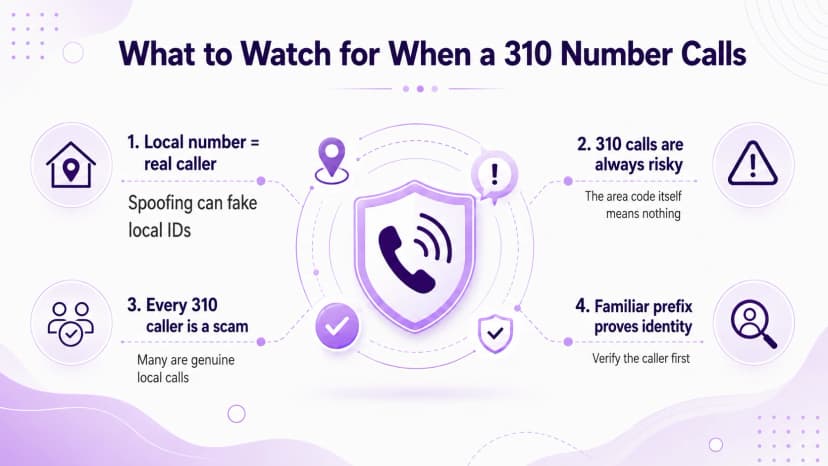
This prefix isn't immune to caller ID spoofing, where scammers display a local-looking number to boost the odds someone actually picks up. That's a nationwide tactic tied to spoofing broadly, not something specific to Los Angeles or this coastal footprint, no matter what a random caller-lookup site might try to claim.
Picking up a call from this area code carries no special risk on its own. Most of these calls come from genuine neighbors, local businesses, or agencies with a real reason to reach out, especially in a region this densely populated with residents and companies alike. Faking a caller ID works the same way anywhere, so a familiar-looking prefix alone proves nothing about who is actually on the line.
Conclusion
The 310 area code has covered the Westside and South Bay of Los Angeles County since splitting from 213 in 1991, then losing its own southeastern edge to 562 just six years later. Area code 424 has shared that same footprint since 2006, and no third code has been needed since that overlay went live nearly two decades ago.
A Santa Monica startup and a Torrance retailer answer calls under the exact same prefix, and that shared local weight still counts for something in a crowded market. Businesses chasing a genuine Westside or South Bay presence can get a Ringflow number running in minutes, with calls routed to wherever the team actually works, whatever coastal neighborhood that happens to be.
Ready when you are
Need a Genuine Westside or South Bay Number for Your Business?
Ringflow activates a local 310 number in minutes and routes every call to wherever your team actually works. Get a free trial with Ringflow.
Frequently Asked Questions
The 310 area code covers the Westside and South Bay of Los Angeles County, including Beverly Hills, Santa Monica, Torrance, and San Pedro. It shares that footprint with the 424 overlay.
It covers LA's Westside (Beverly Hills, Santa Monica, Malibu, Culver City) and South Bay (Manhattan Beach, Torrance, San Pedro), plus Catalina Island offshore.
It split off from Los Angeles's original area code, 213, on November 2, 1991.
Long Beach and the Gateway Cities split away from 310 into area code 562 on January 25, 1997, six years after 310 itself was created.
Area code 424 is an overlay on the same 310 footprint, effective since 2006. It was the first all-services area code overlay ever approved in California.
Pick a provider that offers LA numbers, then search available prefixes by city. Ringflow activates a number in minutes and lets you port an existing one if needed.
Yes, most calls from this area code are legitimate residents or businesses. Scammers can still spoof any local number, so verify unexpected requests independently.
Functionally, no, since both prefixes dial and route identically across the same footprint. Some longtime residents still read the original prefix as more established.