
Introduction
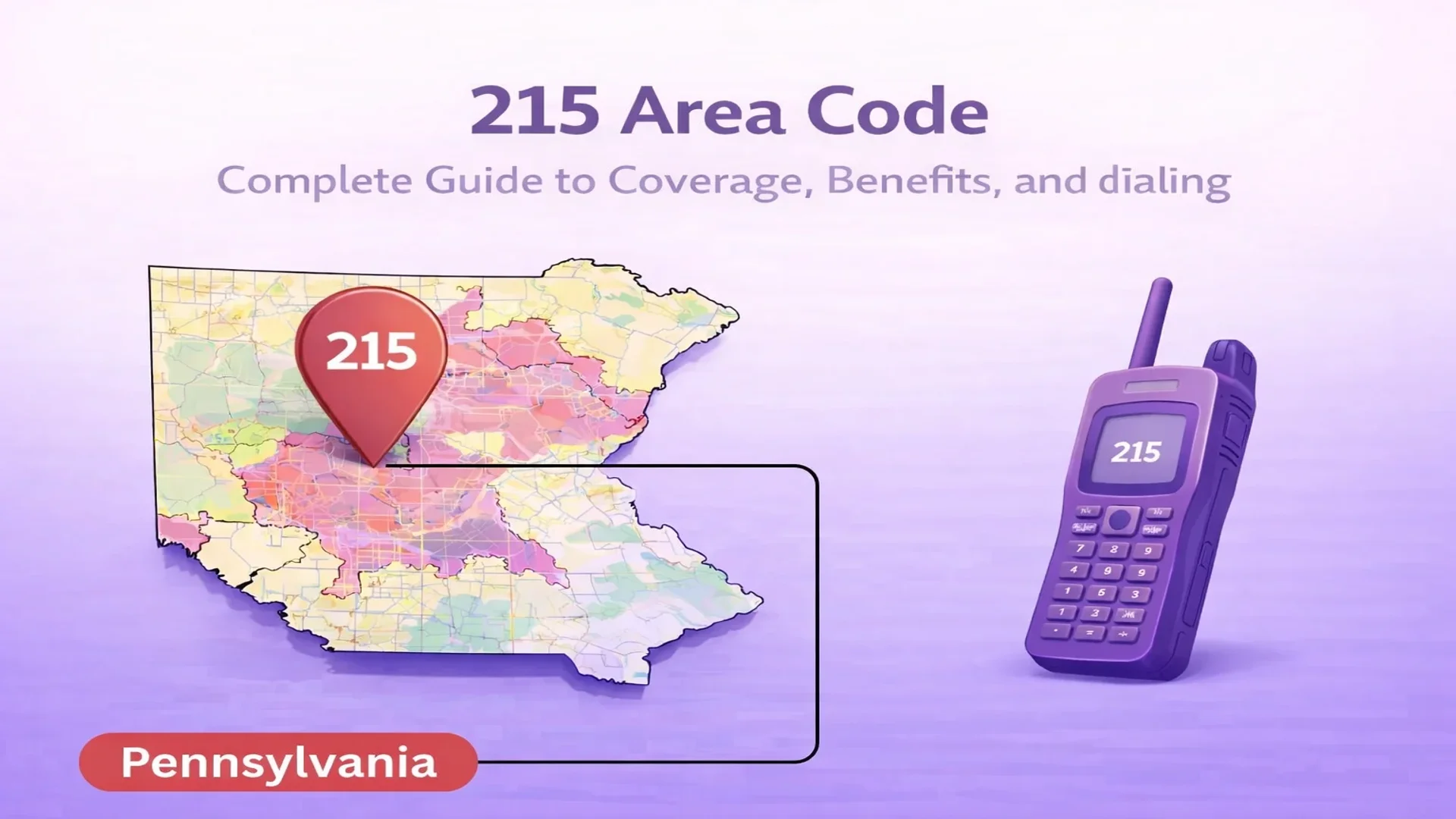
Philadelphia has carried the 215 prefix since January 1947, one of the very first area codes issued anywhere the moment the North American Numbering Plan launched. It still anchors the city and its inner suburbs today, now sharing that same footprint with two newer overlay codes.
This guide covers what actually changed since 1947: the single split that carved out 610, the overlay that added 267 on top of 215, and the second overlay that layered 445 over both. It also breaks down exactly which counties the 215/267/445 overlay reaches today and who relies on a 215 number the most, with the setup steps waiting at the end for anyone ready to activate one.
- The 215 area code was created in 1947 as one of Pennsylvania's original four area codes, alongside 412, 717, and 814.
- A single 1994 split carved off area code 610, shrinking 215 to Philadelphia, Bucks County, and northern/eastern Montgomery County.
- 215 didn't split again after that — regulators layered 267 on top in 1997 and 445 in 2018, giving Philadelphia a rare three-way overlay most U.S. metro areas never need.
- Healthcare systems, universities, Comcast, and downtown professional firms all lean on a 215 number for Philadelphia credibility.
The 215 Area Code, Explained
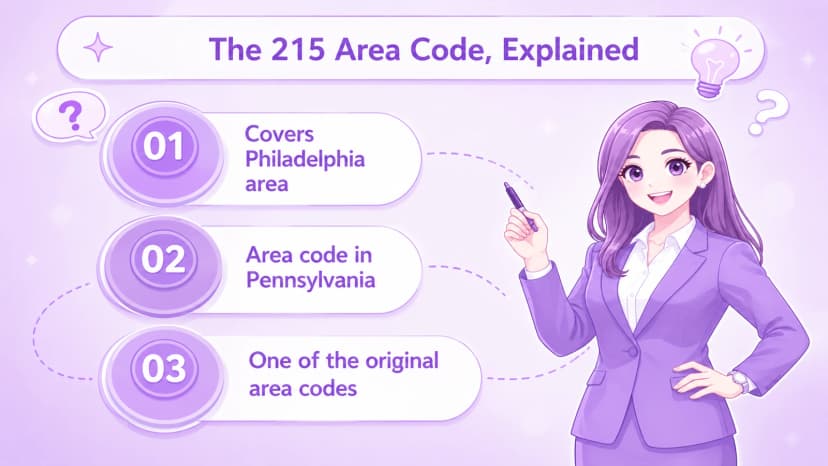
215 dates back to January 1, 1947, the day the North American Numbering Plan first went live nationwide and handed out 86 area codes across the US and Canada in one stroke. Pennsylvania got by with just four of them at the time — 215, 412, 717, and 814 — and 215 alone covered a wide swath of the southeast, stretching across both the Delaware and Lehigh river valleys.
That territory shrank just once. On January 8, 1994, regulators split off the western and northern portion of 215's footprint into a brand-new area code, 610, leaving 215 with Philadelphia, Bucks County, and the northern and eastern half of Montgomery County — roughly the shape it still holds today, three decades later.
That single split sets 215 apart from many original-era area codes, which often splintered five or six times as their regions grew through the second half of the twentieth century. Philadelphia's numbering story took a different turn after 1994, solved through overlays layered on top rather than further geographic division.
From a Statewide Code to a Three-Way Overlay
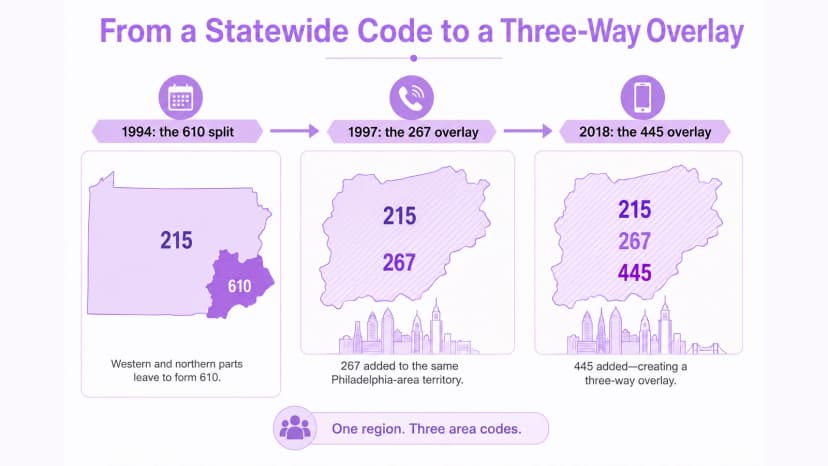
215 didn't need another geographic split after 1994 — instead, regulators stacked two overlay codes directly on top of it as demand for phone numbers kept climbing, a pattern that has become the standard fix nationwide once regulators realized repeated splits force residents to change numbers just to stay reachable:
- 1994: the 610 split. The western and northern edge of 215's original territory broke away into its own area code, shrinking 215 to the Philadelphia-area footprint it holds today.
- 1997: the 267 overlay. Rather than split the shrunken 215 territory again, regulators added 267 as a second code serving the exact same area, an early example of the overlay approach nationally.
- 2018: the 445 overlay. The Pennsylvania PUC approved a third code, 445, in November 2016; new numbers went live on March 3, 2018, capping off a rare three-way overlay for a single U.S. metro area.
215/267/445 Coverage: Which Counties Are Included
The 215/267/445 overlay covers a specific, well-defined footprint in southeastern Pennsylvania, concentrated almost entirely inside a single metro area rather than spread across the state:
- Full coverage. All of Philadelphia County, plus parts of Bucks, Montgomery, Berks, and Lehigh counties that ring the city on its northern and western edges.
- Key cities and townships. Abington, Bensalem, Bristol, Cheltenham, and Warminster, alongside every Philadelphia neighborhood from Center City to the Far Northeast.
- Not Chester or Delaware counties. Both border Philadelphia directly, but they're served by a separate overlay built on the 610 and 484 area codes instead.
- Not the Lehigh Valley. Allentown and Reading fall under that same 610/484 overlay, not 215/267/445.
Comparing 215 to 267, 445, and Nearby Codes
Philadelphia's numbering map confuses even longtime residents because of exactly this overlap between an original code and two later overlays. Here's how the codes that actually touch the region relate to one another:
| Area Code | Type | Region Covered | Introduced |
|---|---|---|---|
| 215 | Original code (post-1994) | Philadelphia County & inner suburbs overlay | 1947 / 1994 |
| 267 | Overlay of 215 | Identical footprint to 215 | 1997 |
| 445 | Overlay of 215/267 | Identical footprint to 215 | 2018 |
| 610 / 484 | Separate overlay pair | Chester, Delaware counties & Lehigh Valley | 1994 / 1999 |
In short: 215, 267, and 445 are three labels stamped on one identical Philadelphia-area territory, so choosing between them comes down to availability at the moment of activation, not geography or prestige. For the full breakdown of that shared overlay from the 267 side, including its own dialing rules, see our 267 area code guide.
Which Philadelphia Industries Rely on 215
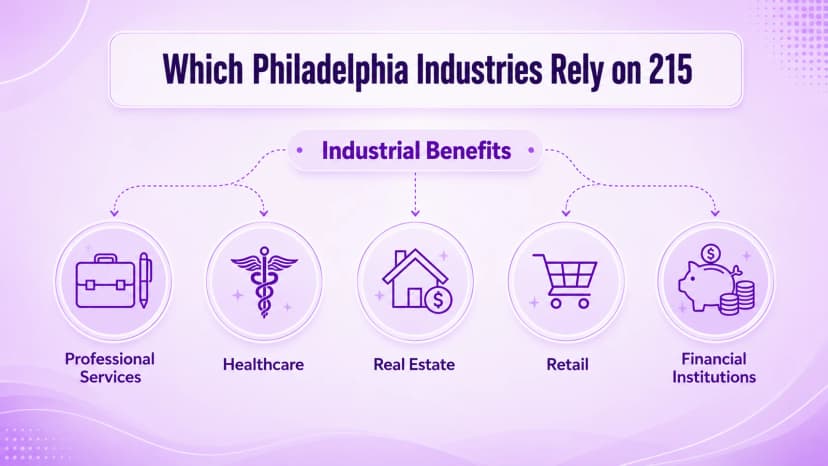
A 215 line earns its keep for reasons beyond just looking familiar on a caller ID screen — Philadelphia's economy runs through a handful of specific, well-documented industries where a genuinely local number still matters:
- Healthcare and academic medicine. Penn Medicine, Children's Hospital of Philadelphia, Jefferson Health, and Temple Health all anchor major campuses inside the 215 footprint.
- Higher education. The University of Pennsylvania, Temple University, and Drexel University draw students, staff, and vendors who all dial and expect local numbers.
- Media and telecom. Comcast Corporation is headquartered in Center City Philadelphia, anchoring a cluster of media and telecom businesses around it.
- Professional services. Law firms, insurers, and consulting firms in Center City lean on 215 for the same institutional credibility downtown Philadelphia carries nationally.
A physical Center City address isn't a prerequisite for any of this. Plenty of companies keep the 215 number and run hybrid or fully remote teams instead, forwarding calls to wherever a given employee is working — a home office out in Bucks County one day, a laptop several states away the next.
Setting Up a 215 Number for Your Business
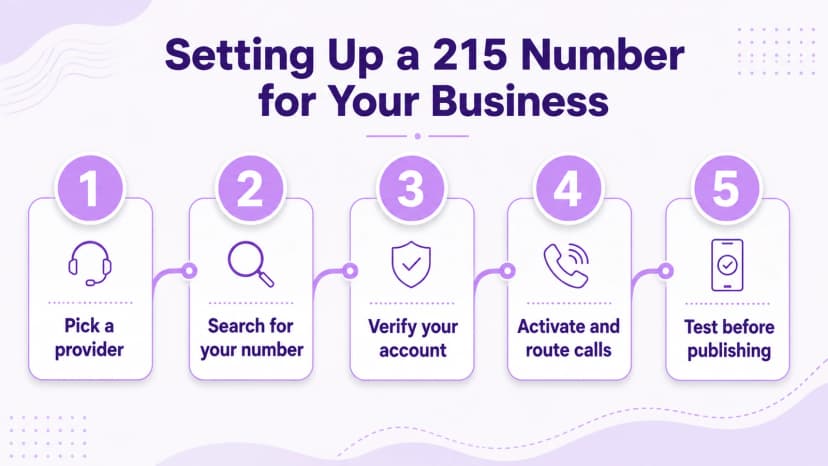
Neither a Center City lease nor a Pennsylvania mailing address is needed to claim one of these — a cloud provider like Ringflow handles the entire thing online:
- 1Pick a provider. Choose a cloud phone service that lists Philadelphia-area numbers as available inventory.
- 2Search for your number. Browse combinations across 215, 267, or 445 — all three are equally local.
- 3Add payment details. A name, an email address, and a card is typically all that's asked for.
- 4Wire up call routing. Send calls to a team member, a shared queue, or an auto-attendant.
- 5Run a live test. Call and text the new line before putting it in front of customers.
A ported number keeps functioning until the old carrier signs off, which typically runs a few business days start to finish. Pricing tracks what a plan actually includes — voicemail transcription, IVR menus, and the like — much more than whether the caller ID shows 215, 267, or 445; see our business phone system cost breakdown for specifics.
Dialing and Setup Errors to Watch For
Stacking three codes on identical territory sets up a few recurring mix-ups — none of them serious once someone's aware they can happen:
- Dropping to 7-digit dialing. Since 215, 267, and 445 share one footprint, every local call needs all ten digits, a rule in effect since the 267 overlay arrived in 1997.
- Assuming 215 reaches Chester or Delaware counties. Those fall under the separate 610/484 overlay, not 215/267/445.
- Expecting an '835 overlay' for 215. That code is real, but it was added to 610/484 in 2022 to serve the Lehigh Valley and western suburbs, not the 215 region.
- Skipping a test call after activation. Confirm routing works correctly before the number reaches customers.
The 215/267/445 overlay history, including the Pennsylvania PUC orders that approved each stage, is documented in detail on the overlay timeline, with citations back to the original regulatory filings.
Conclusion
Philadelphia has kept the 215 prefix since 1947, and compared to most major US cities, the road here was uncomplicated: one split in 1994 spun off 610, then two overlays — 267 in 1997, 445 in 2018 — added room without anyone having to change an existing number.
Whichever of the three codes gets chosen, Ringflow can typically activate it the same day it's requested, personal or business, and an existing line transfers over quietly with no service interruption.
Ready when you are
Ready to Get Your Own 215 Area Code Number?
Claim instant Philadelphia credibility with a 215 number from Ringflow. Set one up in minutes — free trial, no card required, and free number porting if you already have one to bring over.
FAQ
The 215 area code is Philadelphia's original telephone prefix, created in 1947 as one of the first area codes in the country. It's now part of a three-way overlay with 267 and 445.
There isn't a geographic difference — all three share the exact same Philadelphia-area footprint covering Philadelphia County and parts of Bucks, Montgomery, Berks, and Lehigh counties. 267 was added as an overlay in 1997, and 445 followed in 2018.
No. Those counties, along with the Lehigh Valley, are served by a separate overlay built on the 610 and 484 area codes, not 215/267/445.
Sign up with a cloud phone provider like Ringflow, search available numbers across 215, 267, or 445, and activate the line online. Most providers only need a name, email, and payment method.
Not currently. The most recent new area code in the region, 835, was added in 2022 to the neighboring 610/484 overlay, not to 215/267/445.