
Introduction
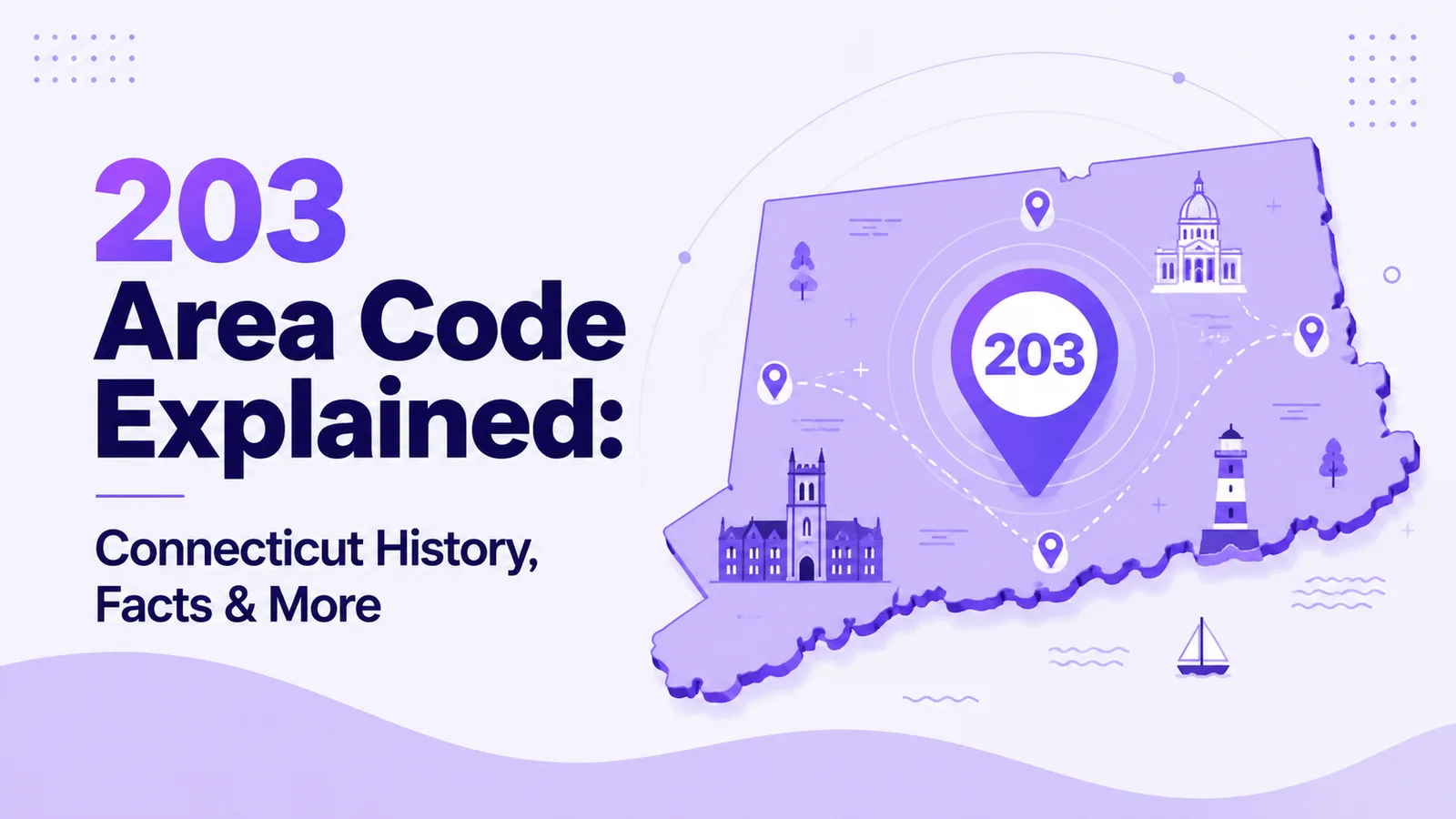
New Haven's Yale campus and Fairfield County's hedge fund offices don't have much in common — except that a call to either one dials through the same 203 area code. It's Connecticut's original telephone code, and it still covers both ends of that spectrum today.
This guide covers where the code actually reaches, why a second overlay code shares those exact same numbers, and exactly how to get one for a business or personal line.
The 203 area code has served southwestern Connecticut since 1947, making it one of the state's two original area codes. A newer overlay code, 475, now shares the same region, which is why ten-digit dialing is required for every local call. The code spans two very different economies — Yale and New Haven's health sector, and Fairfield County's finance corridor. Getting one today takes minutes through a VoIP provider, no Connecticut address required.
What Is the 203 Area Code?
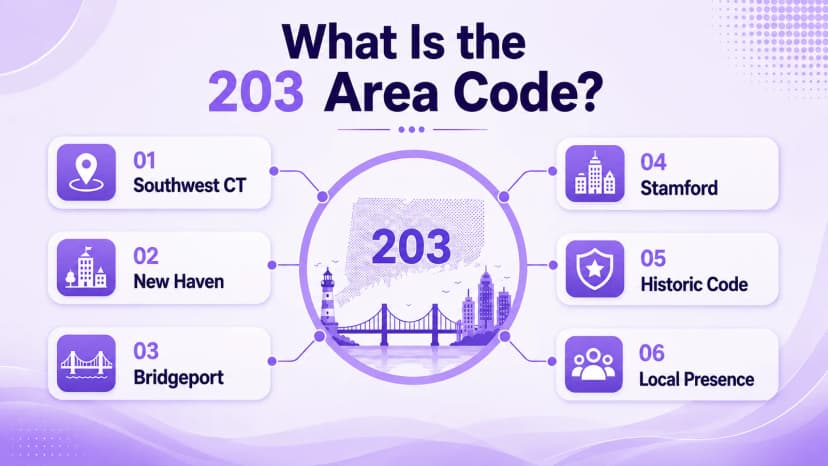
203 dates to 1947, when the newly formed North American Numbering Plan handed out its first batch of 86 three-digit codes. Back then it covered the entire state; a 1995 split peeled off 860 for the eastern and central half of Connecticut, leaving 203 with the southwest.
Today it serves southwestern Connecticut — Greenwich, Stamford, Bridgeport, New Haven, and Waterbury. By the mid-2000s it had run out of fresh number combinations, a form of area code exhaustion playing out nationwide, so regulators added 475 as an overlay in 2009 rather than splitting the region again.
An overlay is not a replacement: a 475 number is exactly as local as a 203 number, since both draw from the same shared pool for the same territory. Two neighbors on the same street can easily have one of each.
Who Actually Uses a 203 Number
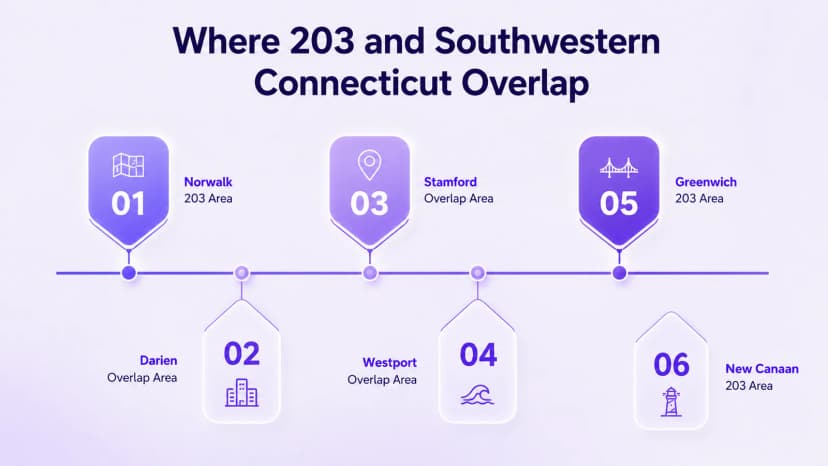
The 203 footprint covers two economies that rarely get mentioned in the same sentence, and who requests a number here tends to split along those lines:
- Yale-affiliated researchers and biotech startups. Yale University anchors New Haven and feeds a steady pipeline of life-sciences startups into the downtown "Innovation District."
- Healthcare organizations. Yale New Haven Health is one of Connecticut's largest employers, and affiliated clinics often want a recognizable New Haven number.
- Hedge funds and financial firms. Greenwich, Stamford, and Westport are nicknamed the "Gold Coast" for their concentration of finance professionals commuting into Manhattan.
- Law and wealth management firms. Practices courting finance clients who split time between the city and the suburbs often want that same regional association.
- Restaurants and local retail. New Haven is where American apizza was born, and businesses tied to that identity lean on a 203 number as a local credential.
Dialing Format and Time Zone
A number here follows the standard ten-digit US format: three-digit code, three-digit exchange, four-digit line number. Because 203 and 475 overlay each other, every local call needs all ten digits, even between two numbers on the same block.
The region sits in the Eastern time zone, matching New York City exactly. Forgetting the area code on a local call is the single most common dialing mistake residents run into.
203 vs. 475 vs. 860 vs. 959
Connecticut runs on four area codes in two overlaying pairs, and mixing them up is easy. Here's how they actually break down:
| Area Code | Type | Region Covered | Introduced |
|---|---|---|---|
| 203 | Original code | Southwestern CT — New Haven, Stamford, Bridgeport, Waterbury | 1947 |
| 475 | Overlay of 203 | Identical footprint to 203 | 2009 |
| 860 | Split from 203 | Central & eastern CT — Hartford, New London | 1995 |
| 959 | Overlay of 860 | Identical footprint to 860 | 2014 |
The short version: 203 and 475 are two labels for the same southwestern territory, and 860 and 959 are two labels for the rest of the state. All four require ten-digit dialing today.
How to Get a 203 Area Code Number
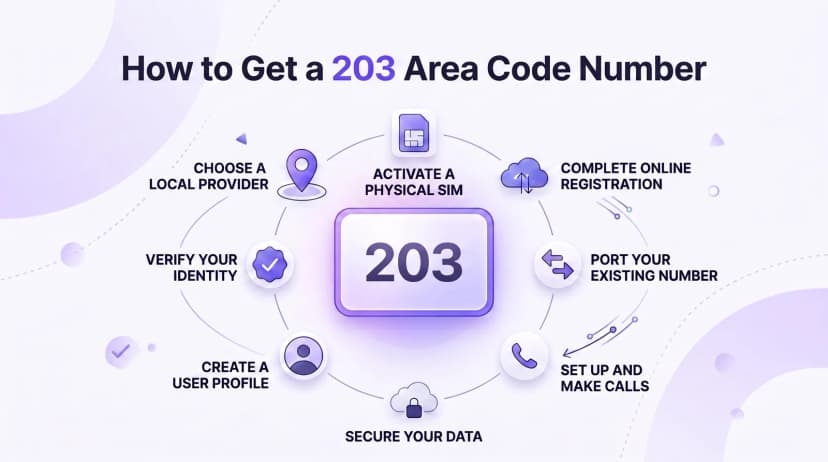
Getting one does not require living in Connecticut. Most providers can assign a number within minutes, with no physical office in the state required.
- 1Pick a provider that offers Connecticut numbers in its coverage area.
- 2Search available 203 numbers. Inventory runs tighter here than in newer area codes.
- 3Check the number against branding or client-facing needs before locking it in.
- 4Complete account verification — typically just an email address and basic business details.
- 5Connect the new number to a VoIP phone service or an existing phone system.
- 6Roll the number out across listings and client-facing materials once it's live.
Providers like Ringflow handle porting and activation automatically, so a new number in this region can be live the same day it's requested.
What a 203 Number Typically Costs
Pricing varies more by feature set than by the area code itself. A basic voice-only line can run as little as $10 to $15 a month, while a business-grade number with SMS and call recording is usually part of a standard business phone system plan.
Because 203 inventory is tighter than newer area codes, a handful of providers charge a small premium for a specific number — expect that to be the exception, not the rule.
203 Area Code Scams and Number Confusion
Most of these come from misunderstanding how overlays work — a natural side effect of the area code exhaustion driving Connecticut's numbering changes in the first place:
- Assuming 203 alone means "Connecticut." It only covers the southwestern part of the state — central and eastern Connecticut use 860 and 959 instead.
- Dropping the area code on local calls. Every call needs all ten digits, even between two neighbors on the same street.
- Treating a 475 number as "less local." Both draw from the same shared pool for the same territory.
- Trusting caller ID on an unexpected call. Scammers spoof 203 numbers just like any other area code — a spoofed caller ID doesn't require any real connection to Connecticut. Verify unfamiliar calls through a known number before sharing information.
- Picking a number before checking branding fit. Inventory is tighter here, so confirm it works before locking it in.
- Not setting a caller ID name. Businesses that skip this show up as "Unknown Caller," which hurts answer rates in a tight-knit region like this one.
Conclusion
The 203 area code has anchored southwestern Connecticut since 1947, covering two economies that rarely get mentioned in the same sentence: Yale's research corridor in New Haven, and Fairfield County's finance-heavy Gold Coast to the south.
Getting one is straightforward, whether the goal is a personal number or a business line serving Connecticut clients, and it can be live the same day it's requested.
Ringflow makes it simple to activate a 203 area code number and connect it to a full phone system in minutes.
Ready when you are
Building a Presence in New Haven or Fairfield County?
Ringflow makes it simple to activate a 203 area code number and connect it to a full phone system in minutes. Get a free trial with Ringflow.
Frequently Asked Questions
The 203 area code is the original telephone area code for southwestern Connecticut, assigned in 1947. It remains active today alongside the newer 475 overlay.
There isn't a geographic difference — 475 is an overlay added in 2009 that shares the exact same southwestern Connecticut footprint as 203. Both are equally local; 475 was simply introduced because 203 ran out of new number combinations.
Yes. New Haven, home to Yale University and Yale New Haven Health, sits in the northern half of the 203 (and overlay 475) coverage area, alongside Fairfield County to the south.
It covers southwestern Connecticut, including Stamford, Bridgeport, New Haven, Waterbury, and Fairfield County towns like Greenwich and Westport. It does not extend into eastern or central Connecticut, which use 860 and its 959 overlay instead.
The 203 area code was created in 1947 as one of Connecticut's original area codes. It later split with 860 in 1995 and gained the 475 overlay in 2009.