
Introduction
The 225 area code has anchored Baton Rouge and the surrounding Louisiana parishes since 1998, without ever splitting again or adding an overlay in nearly three decades of continuous service. Anyone moving to the region, calling a Baton Rouge number, or setting up a business line benefits from knowing exactly what this code covers and why it has held steady while neighboring codes across the state kept splitting or layering on overlays.
This guide covers how 225 broke away from its parent code, exactly which parishes it reaches today, its time zone and dialing rules, how it stacks up against Louisiana's other area codes, who actually relies on a 225 number for business, and exactly how to get one running in a few minutes, whether the goal is a personal line or a full business phone setup.
- The 225 area code split off from 504 on August 17, 1998, becoming Louisiana's third area code.
- 225 is a standalone geographic code — it has never split again and no overlay has been added, unlike neighboring 318, which added the 457 overlay in 2025.
- 225 covers nine core parishes anchored by Baton Rouge, including East Baton Rouge, Ascension, and Livingston.
- State government, LSU, the petrochemical corridor, and regional healthcare systems all rely on 225 numbers for local credibility.
Understanding the 225 Area Code
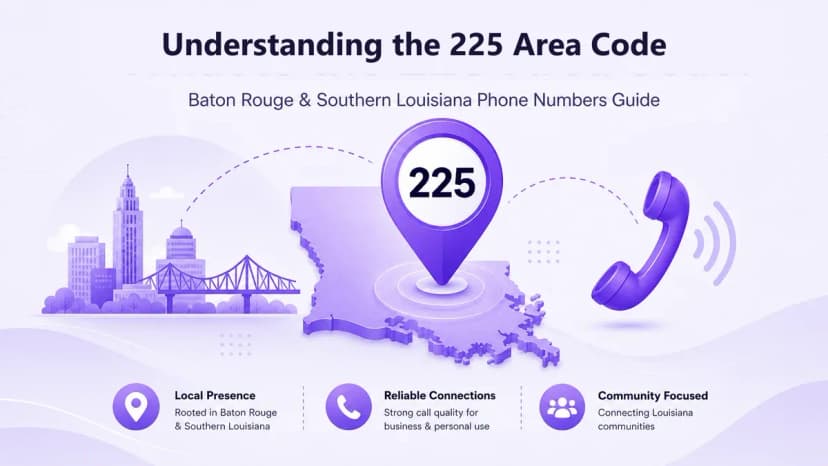
The 225 area code is a standard North American telephone prefix serving Baton Rouge and the parishes around it, written as +1 (225) XXX-XXXX in the standard NANP format. Unlike most area codes its size, it has never split into a second code or added an overlay since it went live in 1998, so every number in the region still shares the same three digits at the front, a rare stretch of stability few codes its age get to keep.
On a standard telephone keypad, the digits 2-2-5 happen to spell C-A-J, a small nod to the region's Cajun heritage that locals have leaned into ever since. A regional lifestyle magazine even took the name 225 after the code itself, turning three digits into a piece of local identity rather than just a dialing prefix, and residents reference it casually as shorthand for the whole Baton Rouge area.
How Baton Rouge Got Its Own Area Code
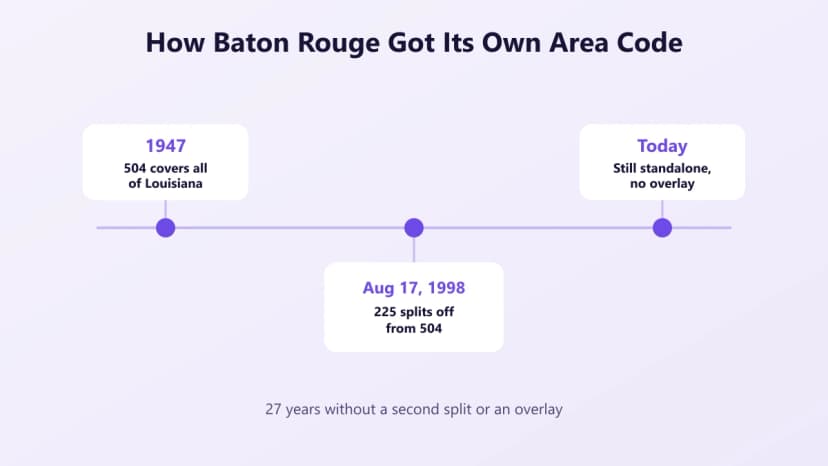
Every phone number in Louisiana traced back to a single code, 504, from 1947 until decades of growth around Baton Rouge and New Orleans finally pushed it toward exhaustion and forced regulators to carve out room elsewhere.
That carve-out landed on August 17, 1998, when 225 split off from 504 as Louisiana's third area code and its first new one in over 40 years. Thousand-block pooling — handing out numbers in smaller batches instead of full ten-thousand blocks — has stretched that supply far enough that Baton Rouge hasn't needed a second split or an overlay since, a run few codes its size manage to match.
Baton Rouge and the Parishes 225 Covers
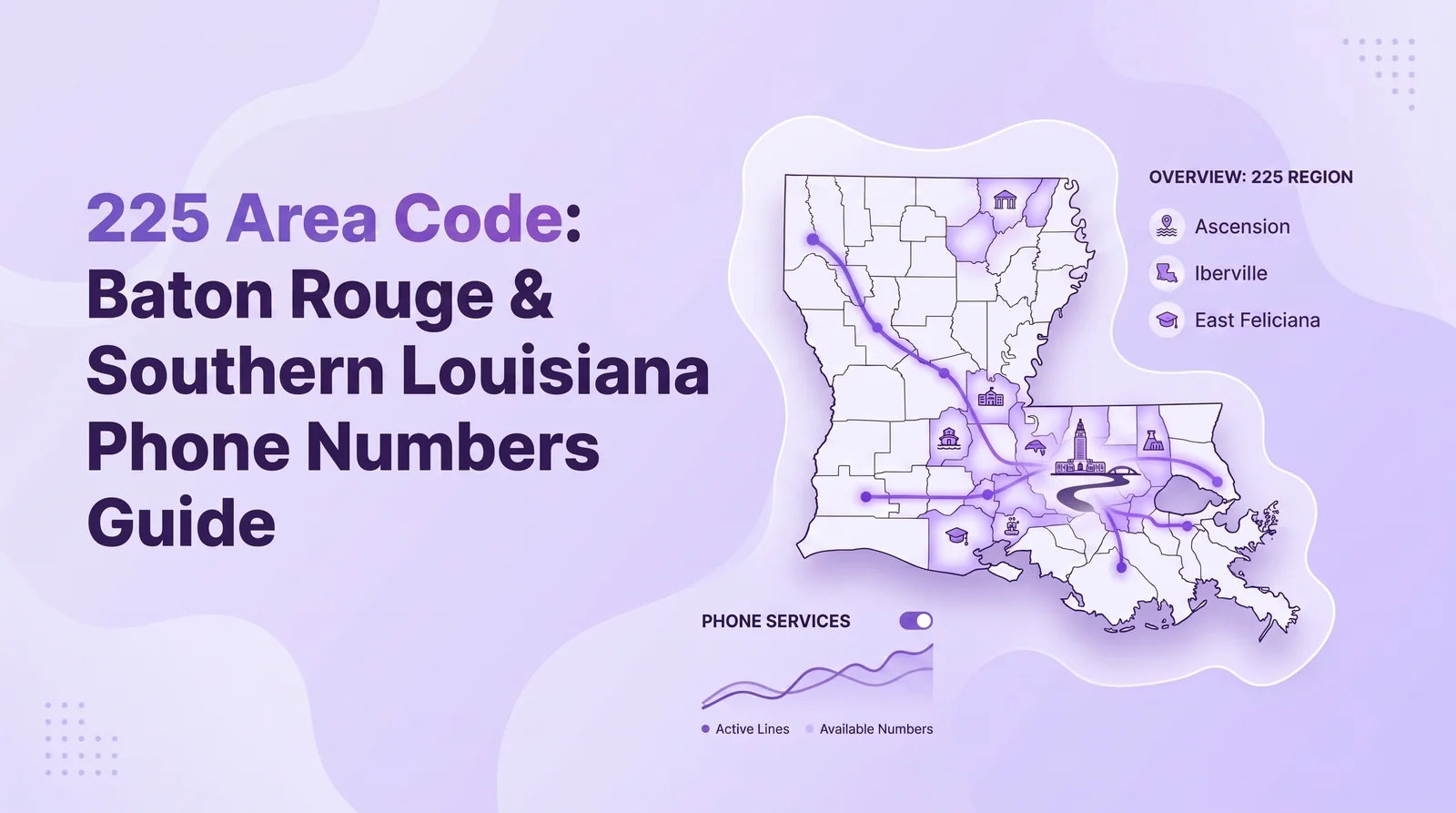
The 225 area code spans nine core parishes: East Baton Rouge, West Baton Rouge, Ascension, Livingston, Iberville, Pointe Coupee, East Feliciana, West Feliciana, and St. Helena, with parts of St. James sometimes included at the region's edge. Together, these parishes make up the core of the Baton Rouge metro area and share the same numbering plan regardless of how far they sit from downtown, from dense city blocks to rural farmland along the parish lines.
Cities and towns inside the region include Baton Rouge itself, Zachary, Denham Springs, Gonzales, Plaquemine, and St. Francisville, several of which sit close to the Mississippi River, where much of the area's industrial activity is concentrated. Nearly every call on this prefix traces back to Baton Rouge itself, with the surrounding parishes contributing a steady but much smaller share of residential and small-business lines.
225 Time Zone and Dialing Rules
225 runs on Central Time year-round — CST in winter, CDT once clocks spring forward — putting it an hour behind the East Coast at any given moment. A complete number breaks down as the area code, a three-digit exchange, then a four-digit line, formatted (225) XXX-XXXX for a domestic call or +1-225-XXX-XXXX for anyone dialing from overseas.
Because 225 has never added an overlay, it remains one of the few Louisiana codes exempt from the state's mandatory ten-digit dialing rollout, so seven-digit local calls still connect within the region without issue. Dialing the full ten digits always works too, and carriers increasingly default to it nationwide, so there's no real downside to using it out of habit even where it isn't required.
225 Next to Louisiana's Other Area Codes
Five area codes now cover Louisiana, and 225 doesn't play by quite the same rules as its neighbors — worth mapping out before assuming otherwise:
| Area Code | Type | Region Covered | Introduced |
|---|---|---|---|
| 225 | Standalone (split from 504) | Baton Rouge & nine parishes | 1998 |
| 504 | Original code | New Orleans metro | 1947 |
| 985 | Standalone (split from 504) | Southeast Louisiana | 2001 |
| 318 / 457 | Original code + overlay | Shreveport & northwest Louisiana | 1947 / 2025 |
225 stands alone on this list as the one code that never picked up a second layer — even 318, one of Louisiana's original 1947 codes, needed the 457 overlay in 2025 once its combinations ran thin. For a closer look at how that overlay actually works day to day, see our 318 area code guide.
Who Actually Dials a 225 Number
There's more to a 225 number than sounding familiar on caller ID — Baton Rouge's economy is anchored by a short list of institutions and industries, and whether the person on the other end is a vendor, a patient, or a constituent, a genuine local presence still counts for something:
- State government. Baton Rouge is Louisiana's capital, and the State Capitol along with dozens of state agencies route calls through this exchange.
- Higher education. LSU's flagship campus draws students, faculty, and vendors who all expect a local number for campus-related calls.
- Petrochemical industry. A dense corridor of refineries and chemical plants along the Mississippi River relies on 225 for logistics and supplier calls.
- Healthcare. Regional systems including Our Lady of the Lake Regional Medical Center and Baton Rouge General serve patients across the parishes.
A State Capitol-area office isn't required to carry the 225 identity, either. Businesses commonly route the number through a virtual line with Ringflow and forward calls to wherever the team actually is — a home office in Denham Springs one week, staff scattered across several parishes the next.
Claiming a 225 Number in Minutes
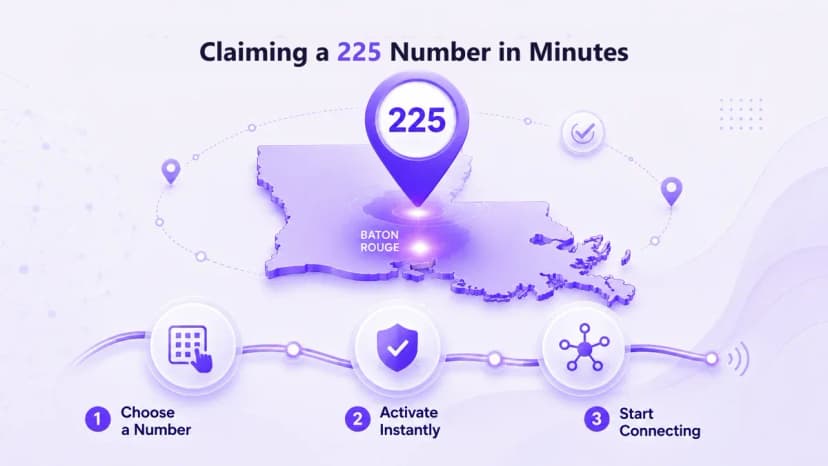
A Louisiana address almost never comes up anymore when claiming a Baton Rouge number — the whole thing happens through a browser with a provider like Ringflow, start to finish, no phone calls or office visits required:
- 1Choose a provider. Pick a cloud phone service that supports Louisiana numbers.
- 2Search available numbers. Browse combinations by city or prefix.
- 3Select a number. Confirm the plan and lock it in.
- 4Connect the number. Point it to a phone, softphone, or contact center system.
- 5Test before publishing. Confirm inbound and outbound calls both work first.
A brand-new line is generally usable the same day it's reserved; carrying an existing number into a new system adds a handful of business days for the transfer to clear — see our VoIP phone service options for specifics on pricing, features, and what to expect during the switch.
Common 225 Number Mix-Ups
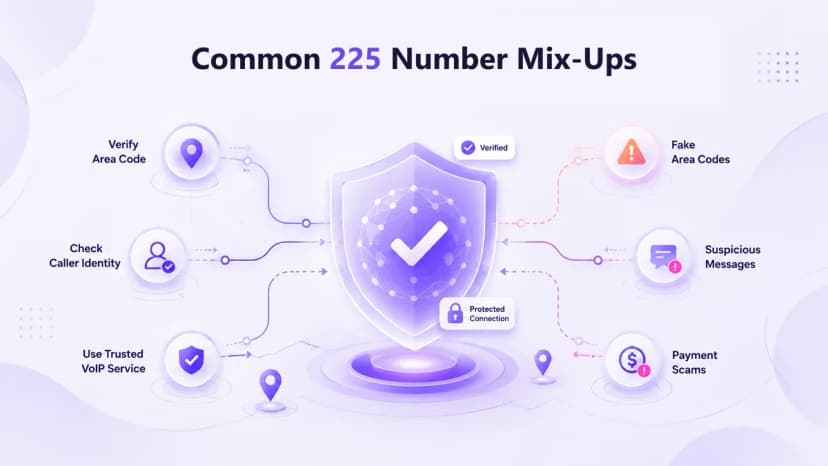
Most confusion about this code traces back to a small set of avoidable mix-ups rather than any actual risk in the number itself — each one takes seconds to rule out once you know to look:
- Assuming caller ID proves identity. Scammers spoof local 225 numbers to impersonate government offices or utilities, since a familiar prefix lowers a target's guard.
- Skipping independent verification. Calling an organization back on a number pulled from its official website resolves most suspicious calls in under a minute.
- Expecting an overlay someday. 225 has never needed one, unlike neighboring 318, which added the 457 overlay in 2025 once its numbers ran low.
- Dropping to old dialing habits. Ten-digit dialing always connects correctly, even though seven digits still work here since 225 was exempted from Louisiana's mandatory rollout.
Every area code decision in the state, overlays included, runs through the Louisiana PSC, which posts each proposal publicly as it moves from review to approval.
Conclusion
1998 is the last time Baton Rouge's numbering plan changed at all — no split, no overlay, just steady stability through nearly three decades of population and business growth that would have forced most area codes this size to split at least once.
Ringflow makes claiming one a quick process, and between the 504 split and the Cajun keypad trivia, 225 carries more backstory than most three-digit prefixes bother earning — reason enough on its own for a business that wants a genuine Baton Rouge presence.
Ready when you are
Ready to Get Your Own 225 Area Code Number?
Claim instant Baton Rouge credibility with a 225 number from Ringflow. Set one up in minutes — free trial, no card required, and free number porting if you already own a number you'd like to bring over.
FAQ
The 225 area code is Baton Rouge's original telephone prefix, created in 1998 when it split off from area code 504. It has never split again or added an overlay since.
225 covers nine core parishes anchored by Baton Rouge: East Baton Rouge, West Baton Rouge, Ascension, Livingston, Iberville, Pointe Coupee, East Feliciana, West Feliciana, and St. Helena, with parts of St. James at the edge.
No. Unlike neighboring 318, which added the 457 overlay in 2025, 225 is a standalone geographic code that has never needed an overlay since it launched in 1998.
Sign up with a cloud phone provider, search available numbers by city or prefix, and activate the line online. No Louisiana address is required.
Yes. Because 225 has no overlay, it was exempted from Louisiana's mandatory 10-digit dialing rollout, so 7-digit local calls still connect, though dialing all 10 digits always works too.