
Introduction
Searching for an "Iceland area code" turns up a question with a short answer: there isn't one. Iceland retired its regional numbering system in 1995 and has used a single, flat 7-digit numbering plan for the whole country ever since.
This guide covers what replaced area codes in Iceland, how to tell a landline from a mobile number by its first digit, how to dial an Icelandic number from the US, and where the old regional prefixes still show up.
- Iceland has no area codes. Since 3 June 1995 it has used one national 7-digit numbering plan for the whole country.
- Landline numbers start with 4 or 5. Mobile numbers start with 6, 7 or 8.
- Iceland's country code is +354, and there's no trunk prefix to drop since there's no area code in front of the number.
- Some regional prefixes, like Reykjavik's 55x-56x range, are still loosely followed for new landlines, but number portability means they're no longer a reliable way to tell where a number is based.
- Iceland has used UTC+0 (GMT) year-round since 1968, with no daylight saving.
Does Iceland Have Area Codes?
No. Iceland uses what its numbering plan calls a closed numbering scheme: one flat set of 7-digit numbers for the entire country, with no geographic area code in front of any of them. That's a genuine difference from most numbering plans people are used to, where a city or region gets its own prefix.
The current format took effect on 3 June 1995, when Iceland added one to three digits to its existing numbers to bring every number to a uniform 7 digits nationwide. The same change replaced Iceland's old "90" international access prefix with the now-standard "00", in line with ITU recommendations.
How Icelandic Phone Numbers Are Structured
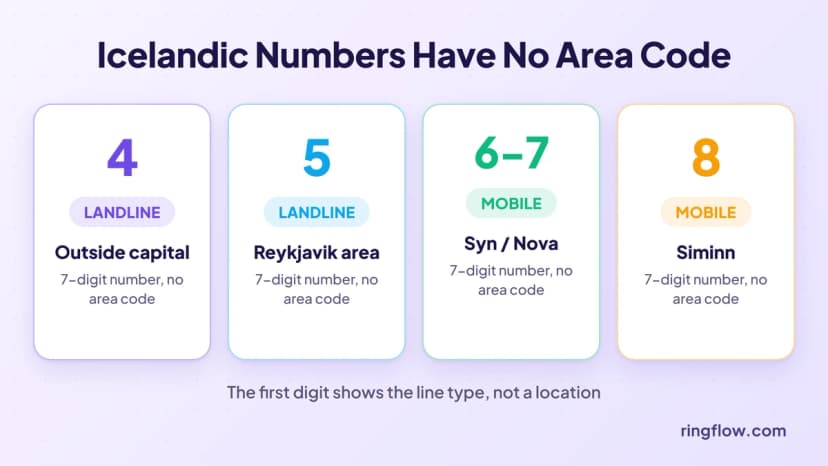
Every Icelandic number is 7 digits, and the first digit tells you roughly what kind of line it is rather than where it's located.
| First digit | Number type |
|---|---|
| 4 | Landline, outside the Capital Region |
| 5 | Landline, Reykjavik / Capital Region |
| 6 | Mobile (network Syn, plus Tetra) |
| 7 | Mobile (network Nova) |
| 8 | Mobile (network Siminn) |
| 800 | Freephone |
| 9xx | Premium rate |
That's the opposite of a system built around area codes: instead of the first digits naming a place, they name a type of line and, for mobiles, roughly which network issued it.
Ringflow gives your team a business number that rings on mobile and desktop apps, so international calls go through one shared line instead of someone's personal plan. Start a free trial and test it on your own calls.
How to Dial Iceland From the US
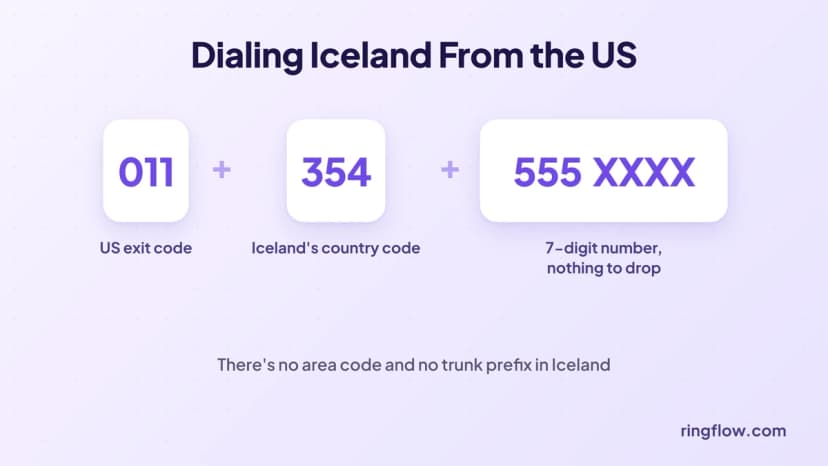
Start with 011, the exit code for leaving the North American Numbering Plan, add 354, Iceland's country code, and finish with the 7-digit number exactly as it is. There's no area code and no trunk prefix to drop, since Iceland's numbering plan doesn't have either one.
A landline written domestically as 555 XXXX becomes 011 354 555 XXXX from a US phone, and a mobile written 6XX XXXX becomes 011 354 6XX XXXX. Mobile users can dial + instead of 011.
The Old Regional Prefixes You Might Still See
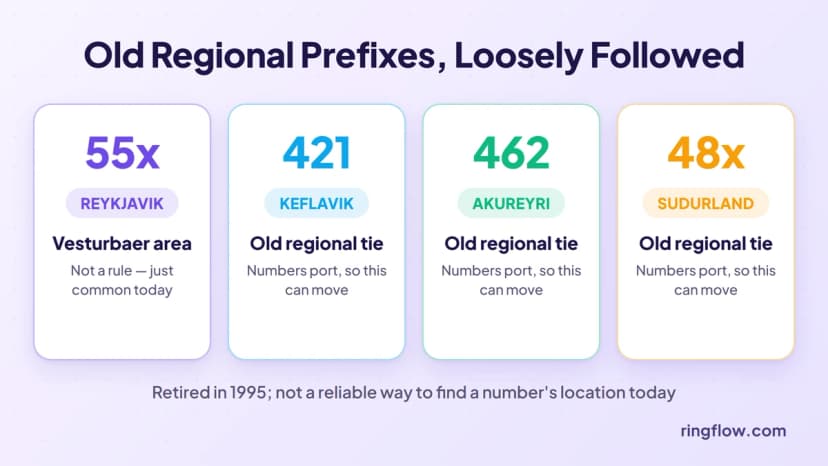
Before the numbering plan flattened in 1995, different parts of Iceland were associated with different prefixes, and some of that pattern is still loosely followed when new landlines are installed, even though it's no longer official.
| Area | Prefix range you might see |
|---|---|
| Reykjavik (Vesturbaer / Midbaer) | 551, 552, 561, 562 |
| Keflavik | 421 |
| Akureyri | 462 |
| Reykjanes | 42x |
| Vesturland | 43x |
| Vestfirdir / Nordurland Vestra | 45x |
| Nordurland Eystra | 46x |
| Austurland | 47x |
| Sudurland | 48x |
Treat this table as a loose pattern, not a lookup tool. Iceland has number portability, so a number that starts with a Keflavik-style prefix isn't guaranteed to still ring in Keflavik.
Time Zone: When to Call Iceland
Iceland has used UTC+0 (GMT) year-round since a law took effect on 7 April 1968, and it does not observe daylight saving time. Proposals to bring back seasonal clock changes have come up in Iceland's parliament since, most recently around 2019, but none has passed, so the country has stayed on permanent UTC+0.
- US Eastern Time: Iceland is 4 hours ahead during US daylight saving time and 5 hours ahead during US standard time.
- US Pacific Time: Iceland is 7 hours ahead during US daylight saving time and 8 hours ahead during US standard time.
Because Iceland doesn't change its clocks, the gap with the US only shifts when US clocks do, in March and November.
Conclusion
There's no Iceland area code to look up, because Iceland replaced the idea of one with a single national numbering plan back in 1995. Every number is 7 digits, the first digit points to a landline or a mobile network rather than a place, and dialing one from the US just takes 011, then 354, then the number as written.
US teams that call Iceland or other countries regularly can keep that calling in one place with Ringflow's cloud phone system, dialing out from a business number on mobile and desktop apps instead of a personal phone plan.
Ready when you are
Calling Iceland or Anywhere Else for Your Team?
Ringflow gives your team a business number that works from mobile and desktop apps, so international calls don't depend on someone's personal phone plan. Start a free trial and test it on your own calls.
FAQ
Iceland doesn't have area codes. It has used one flat, national 7-digit numbering plan for the whole country since 3 June 1995.
Dial 011, then 354 (Iceland's country code), then the 7-digit number as written. There's no area code or trunk prefix to remove.
By its first digit. Landline numbers start with 4 (outside the Capital Region) or 5 (Reykjavik and the Capital Region). Mobile numbers start with 6, 7 or 8.
Numbers were historically associated with regional prefixes, but Iceland moved to today's single national 7-digit plan on 3 June 1995, and that older regional pattern is no longer an official area-code system.
Iceland's country calling code is +354.
Iceland has used UTC+0 (GMT) year-round since 1968 and does not observe daylight saving time.
Not reliably. Some old regional prefixes, like Reykjavik's 55x range, are loosely followed for new landlines, but number portability means a number can keep its prefix even after moving to a different area.
Iceland moved to a single national numbering plan on 3 June 1995 to standardize every number to 7 digits, replacing the older regional prefix system with one flat plan for the whole country.