
Introduction
Which city does a 647 number belong to? Is an 800 number American or Canadian? Can you even tell a Canadian phone number apart from a US one just by looking at it? These are the questions that trip up businesses the first time they call north of the border, and getting the answer wrong can mean a missed connection or an awkward misdial on an important sales call.
This guide breaks down the Canada phone number format in plain terms: how the digits are structured, what real numbers look like by city, how toll-free numbers work, and how to dial in from anywhere in the world. It also covers the quirks that catch US businesses off guard, how storage mistakes creep into a CRM, and how to build a contact strategy that actually gets answered.
How the Canada Phone Number Format Works
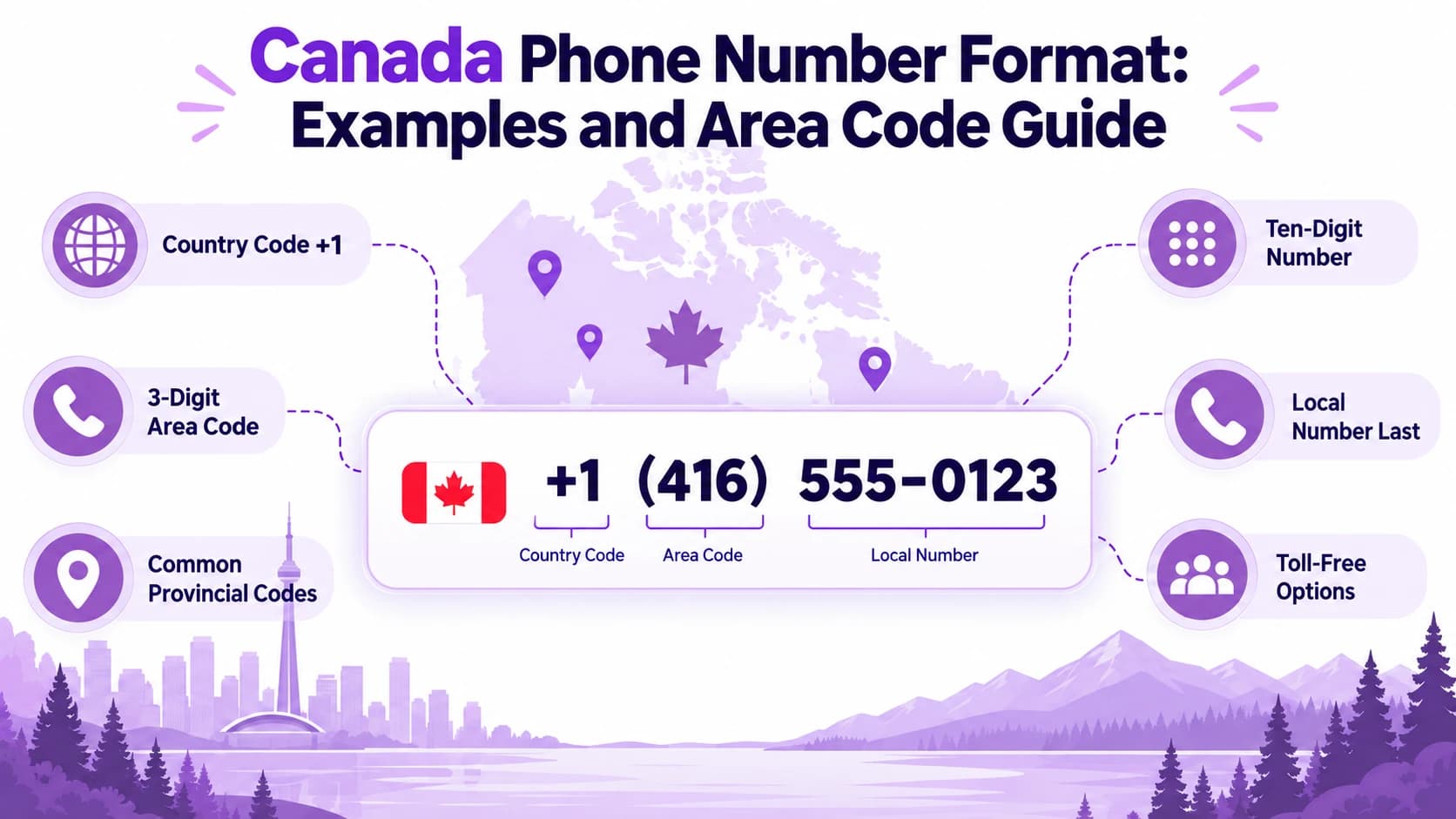
Every Canadian phone number follows the North American Numbering Plan, the same structure shared with the United States and a handful of Caribbean territories. The format breaks into three parts: a 3-digit area code, a 3-digit exchange code, and a 4-digit subscriber number, written as NPA-NXX-XXXX. That same structure has stayed unchanged for decades across the whole numbering plan.
That structure gives every Canadian phone number exactly 10 digits in its domestic form. Add the country code, +1, for international or long-distance dialing, and the number becomes 11 digits. Area codes always start with a digit between 2 and 9, so a number that begins with 0 or 1 before the area code has been formatted incorrectly somewhere along the way, and any system that accepts such a number should be flagged for review.
- NPA is the 3-digit area code, always starting with a digit from 2 to 9
- NXX is the 3-digit exchange code tied to a local switch or carrier block
- XXXX is the 4-digit subscriber number unique to the line
- Domestic calls are written as (NPA) NXX-XXXX, like (416) 555-0123
- Long-distance calls within Canada add a leading 1, as in 1-416-555-0123
- International calls use E.164 format: +1 followed by all 10 digits, no spaces
- There is no separate prefix for mobile numbers, unlike many other countries
- The country code +1 is shared with the US, so the area code is what matters
Canada Phone Number Format: Real Examples by City
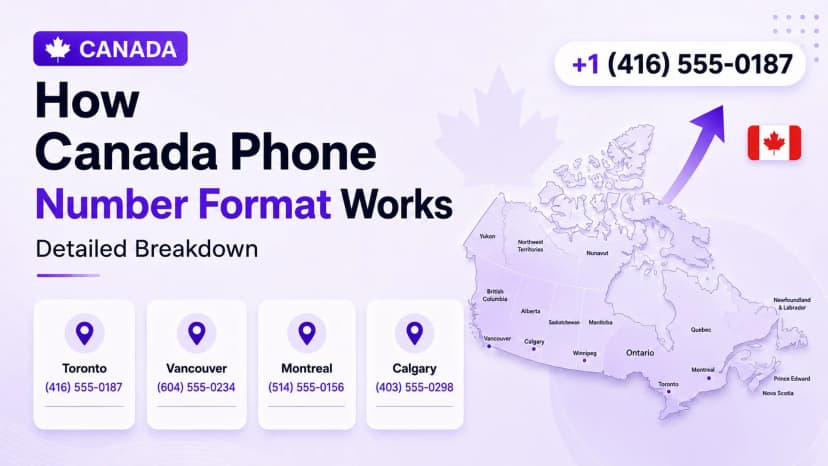
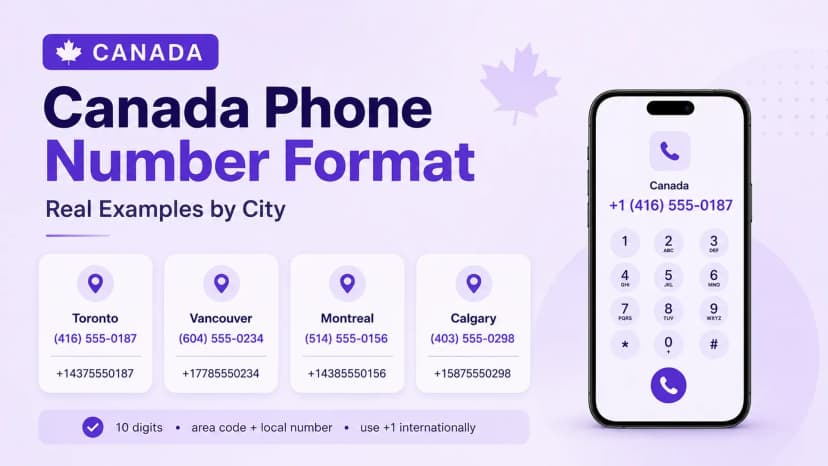
Seeing real examples makes the format click faster than reading the rule alone. Toronto uses area codes 416, 647, and 437, so a local number looks like (416) 555-0187 and becomes +14165550187 internationally. Vancouver uses 604, 778, and 236, giving numbers like (604) 555-0234, and the same three-part structure applies no matter which of those codes a business is assigned.
Montreal draws from 514 and 438, Calgary from 403, 587, and 825, and Ottawa from 613 and 343. Halifax, on the East Coast, uses 902 and 782. Every one of these follows the identical 10-digit pattern, and the only thing that changes city to city is the area code sitting in front of the same 7-digit local number, which makes the whole system easy to learn once a handful of real examples click into place.
- Toronto, Ontario: area codes 416, 647, and 437
- Vancouver, British Columbia: area codes 604, 778, and 236
- Montreal, Quebec: area codes 514 and 438
- Calgary, Alberta: area codes 403, 587, and 825
- Ottawa, Ontario: area codes 613 and 343
- Halifax, Nova Scotia: area codes 902 and 782
- New number assignments are managed by the North American Numbering Plan Administrator
- Multiple area codes per city usually mean an overlay was added once the original code filled up
Canadian Toll-Free Number Format
Toll-free numbers cause more confusion than almost any other part of the Canada phone number format, mostly because Canada and the US draw from the exact same prefix block. An 800, 833, 844, 855, 866, 877, or 888 number could belong to either country, and the prefix alone never tells you which one is actually on the other end of the line.
The routing setup, not the digits, decides where the call actually lands. Businesses that need both reach and a recognizable local presence often compare toll-free vs local numbers before deciding, since a toll-free line signals national scale while a local number builds regional trust with a nearby audience, which matters for support and sales teams alike.
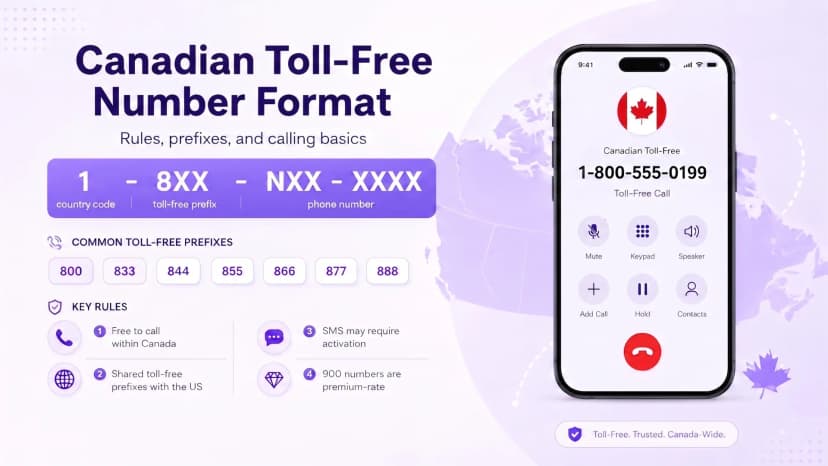
- Canadian toll-free numbers are free to call only from within Canada
- The same prefix block, 800 through 888, is shared with the United States
- Callers outside Canada may pay international rates or be blocked entirely
- Toll-free numbers are voice-only by default and need SMS enabled separately
- 900-prefix numbers charge the caller and never belong in a business contact list
- A toll-free number cannot be identified as Canadian or American by its prefix alone
- Routing configuration on the provider's side determines where a toll-free call lands
How to Dial Canada from Outside North America
Calling Canada from anywhere outside the US and Canada takes three steps in order: your own country's exit code, Canada's country code of 1, and the full 10-digit number with no leading zero. Skipping or misordering any one of the three steps is the most common reason an international call to Canada fails to connect, even when every digit of the local number itself is correct.
Exit codes vary quite a bit by country, so it genuinely helps to know a few common ones before you actually dial. The United Kingdom and most of Europe use 00, Australia uses 0011, and Japan uses 010. A call from Germany to a Toronto number would be dialed as 00 1 416 555 0187, while the same call from Australia would start with 0011 instead of the shorter European code.
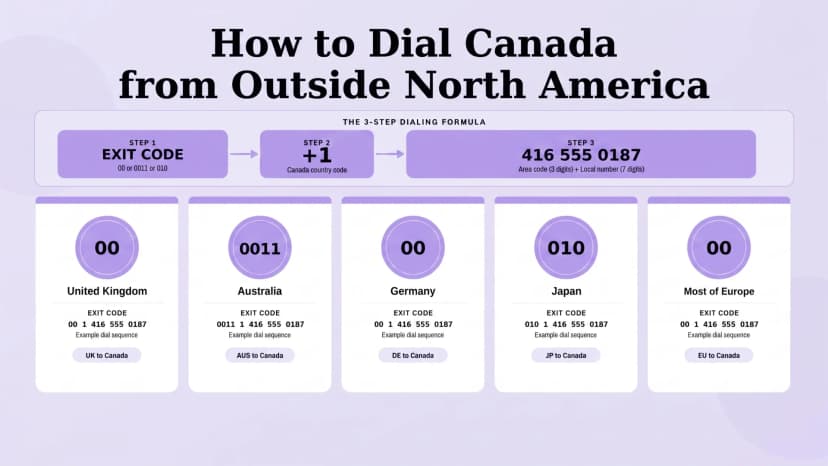
- United Kingdom and most of Europe use exit code 00
- Australia uses exit code 0011 before the country code
- Germany uses exit code 00, the same as most of Europe
- Japan uses exit code 010, one of the less common formats
- After the exit code, dial Canada's country code, which is 1
- Finish with the full 10-digit number, never dropping a leading zero that does not exist
- E.164 format, such as +14165550187, skips the exit code entirely on most modern systems
Why Canadian Numbers Look Identical to US Numbers
A Canadian phone number is visually indistinguishable from an American one. Both run exactly 10 digits, both share the +1 country code, and both display as (NPA) NXX-XXXX. A Toronto 416 number and a New York 212 number follow the identical pattern, and only the area code itself reveals which country you are actually calling, a detail most people never think to check.
That surface-level similarity creates real problems in day-to-day business practice. Many US carriers bill calls to Canadian numbers as international even though the format looks completely domestic. Storing numbers without the +1 prefix is just as risky, since a bare 10-digit string can be misread as either country. Compliance follows the number too: calling into Canada still means respecting the Do Not Call registry.
- Both countries use identical 10-digit formatting under the shared +1 country code
- US carriers often bill Canadian calls as international despite the domestic-looking format
- A number missing its +1 prefix can be misread as the wrong country entirely
- Always store Canadian numbers in full E.164 format, such as +16045550234
- Only the area code itself reveals whether a number is Canadian or American
- CRM defaults matter here, since some platforms assume US formatting unless told otherwise
- Confirm a carrier's Canada policy before running any high-volume outbound campaign
Building a Canadian Contact Strategy That Works
Getting the format right is only step one. Businesses that actually want Canadian contacts to pick up need a local caller ID strategy too, since a 416 number calling Toronto or a 604 number calling Vancouver is recognized instantly and answered far more often than an unfamiliar area code from another region entirely, especially on a first outbound attempt.
A rotating pool of local Canadian numbers, matched to the city being called, automates that recognition at scale without anyone manually swapping caller ID before each call. Pair that with a virtual phone number setup stored consistently in E.164 format, and calling windows scheduled by province rather than by country, since a 10 AM call from a US office lands at 7 AM in Vancouver.
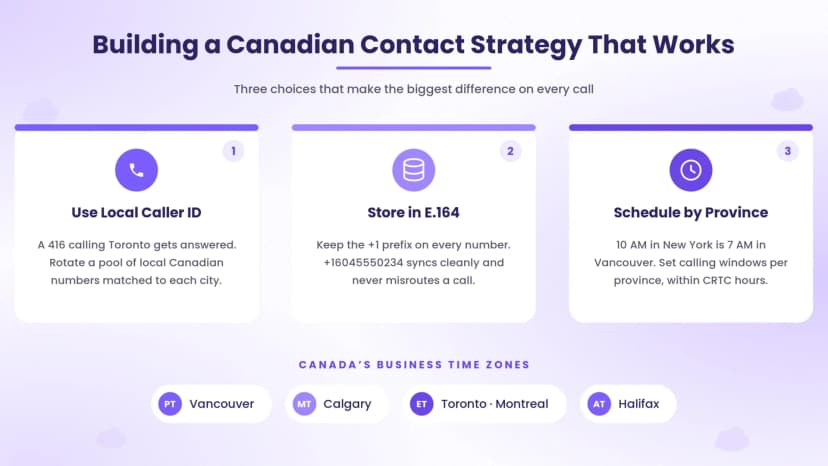
- Use local Canadian caller ID matched to the city or region you are calling
- Rotate a pool of numbers automatically, which Ringflow handles instead of managing them one by one
- Store every number in E.164 format to avoid misrouted or duplicate contacts
- Schedule calls by province, since Canada spans four business-relevant time zones
- Respect Canada's National Do Not Call List regardless of where your team is based
- Track answer rates by area code to see which local presence is actually working
- Review your calling list quarterly as area code overlays get added in growing cities
Conclusion
The Canada phone number format is simple once the structure clicks: 10 digits domestically, an area code plus a 7-digit local number, and a +1 prefix for anything international. The real complexity lives in the details most guides skip, like shared toll-free prefixes, carrier billing quirks, and how easily a Canadian number gets mistaken for an American one inside a CRM built with US defaults in mind.
Get the format right, store every number in E.164, and match your caller ID to the region you are calling, and answer rates follow naturally. Ringflow gives teams local Canadian numbers, rotating caller ID, and CRM-native call logging, so every outbound call to Canada shows the right number and logs itself automatically without extra manual work from anyone on the floor.
Ready when you are
Reach Canadian Contacts With the Right Caller ID
Ringflow gives your team local Canadian DIDs, rotating caller ID, and CRM-native call logging — so every outbound call to Canada displays the right number and logs automatically.
FAQ
Canadian numbers follow NPA-NXX-XXXX: a 3-digit area code, 3-digit exchange code, and 4-digit subscriber number, totaling 10 digits. International calls add the +1 country code in front.
Canada's country code is +1, shared with the US and several Caribbean nations under the North American Numbering Plan.
You cannot tell from the format alone, since both use +1 and 10 digits. Only the area code, such as 416 for Toronto or 604 for Vancouver, reveals the country.
Canadian toll-free numbers use 800, 833, 844, 855, 866, 877, and 888, the same prefixes shared with the United States.
Dial your country's exit code, then Canada's country code of 1, then the full 10-digit number. E.164 format, like +14165550187, skips the exit code on most modern phones.