
Introduction
Calling India from the US comes down to one sequence: 011, then 91, then the Indian number with its leading 0 dropped. The part people get wrong is usually that leading 0, since it belongs to India's own domestic dialing and doesn't carry over once you're calling in from abroad.
This guide covers the exact dialing sequence, how Indian mobile and landline numbers are built, the time difference and when to call, what a call actually costs, whether an Indian toll-free number can be reached from the US at all, and a 2024 government warning worth knowing before you place the call.
- Dial 011, then 91, then the Indian number without its leading 0. On a mobile, + can replace 011.
- Indian mobile numbers are 10 digits starting with 6, 7, 8 or 9. Landline numbers pair a city STD code with a local number, also 10 digits combined.
- India Standard Time is UTC+5:30 year-round, with no daylight saving.
- AT&T and T-Mobile both sell $15/month add-ons with unlimited calling to India; standard per-minute rates apply otherwise.
- Indian 1800 toll-free numbers are generally built for callers inside India and typically can't be reached by dialing them from abroad.
How to Dial India From the US
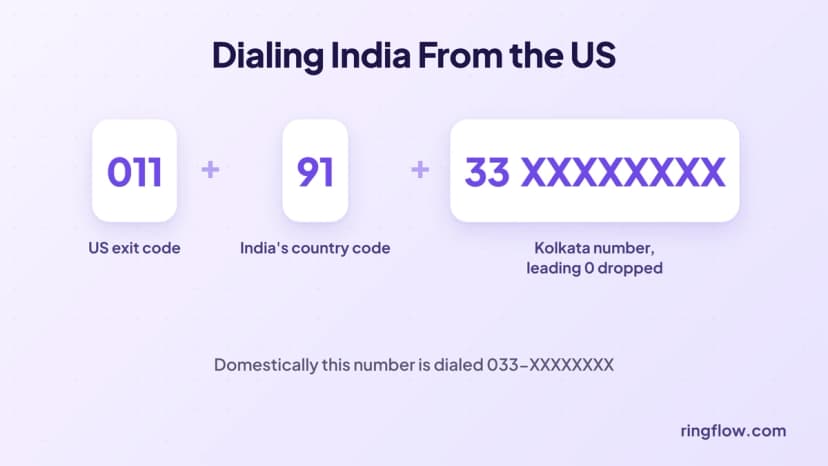
Start with 011, the exit code for leaving the North American Numbering Plan. Add 91, India's country code. Finish with the Indian number, dropping the leading 0 if the number domestically starts with one. A Kolkata landline dialed inside India as 033-XXXXXXXX becomes 011 91 33 XXXXXXXX from a US phone, and a mobile number keeps all 10 of its digits after the 91.
From a mobile phone, you can dial + in place of 011: +91 33 XXXXXXXX works the same way. The 0 you see on an Indian landline number is a domestic trunk prefix used for long-distance calls inside India, not part of the number itself, so it never appears in the international format.
Indian Mobile and Landline Number Formats
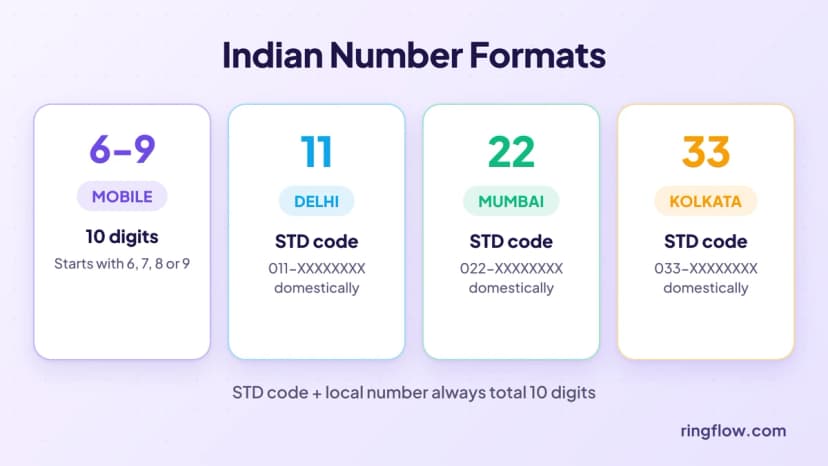
An Indian mobile number is always 10 digits and starts with 6, 7, 8 or 9. A landline number pairs an STD (city) code with a local number, and the two together always add up to 10 digits, so a shorter STD code means a longer local number and vice versa.
| City | STD code | Dialed in India | International format |
|---|---|---|---|
| Delhi | 11 | 011-XXXXXXXX | +91 11 XXXXXXXX |
| Mumbai | 22 | 022-XXXXXXXX | +91 22 XXXXXXXX |
| Kolkata | 33 | 033-XXXXXXXX | +91 33 XXXXXXXX |
| Chennai | 44 | 044-XXXXXXXX | +91 44 XXXXXXXX |
That domestic 0 in front of an STD code, like Kolkata's 033, is the same long-distance trunk prefix mentioned above. It's correct for dialing inside India and dropped once +91 is in front of the number. For more on how these numbers are built and formatted, see our India phone number format guide.
Time Zone: When to Call India
All of India uses India Standard Time (IST), UTC+5:30, and the country does not observe daylight saving time. Because the offset includes a half hour, the gap with the US doesn't line up on the hour the way it does with some other countries.
- US Eastern Time: India is 9.5 hours ahead during US daylight saving time and 10.5 hours ahead during US standard time.
- US Pacific Time: India is 12.5 hours ahead during US daylight saving time and 13.5 hours ahead during US standard time.
In practice, a morning call from India lands the previous evening in the US. A 9 a.m. call from Delhi in summer reaches New York around 11:30 p.m. the night before. Our best time to call India page lays out overlapping business-hour windows.
Ringflow gives your team a business number that rings on mobile and desktop apps, so calls to India go through one shared line instead of someone's personal plan. Start a free trial and test it on your own calls.
What a Call to India Costs
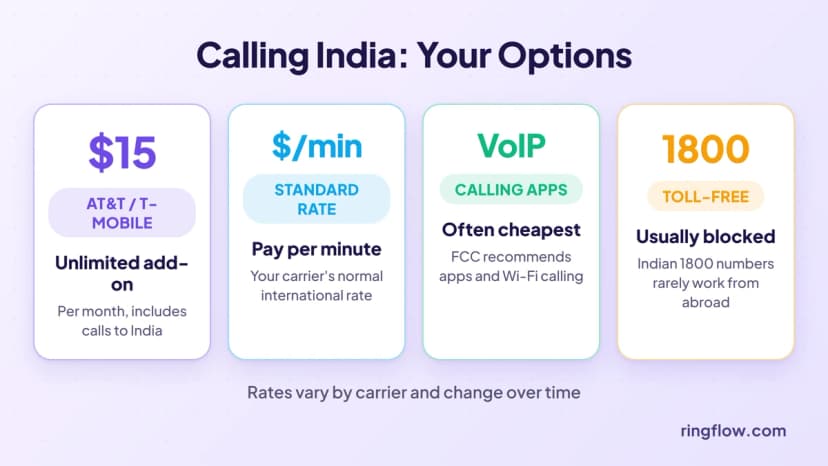
Two major US carriers sell flat-rate add-ons that include India. AT&T's $15/month International Calling add-on gives unlimited calling from the US to more than 85 countries, including India. T-Mobile's $15/month Stateside International Talk add-on covers unlimited calling to about 70 countries and destinations, also including India. Both are worth comparing against your carrier's standard per-minute rate if you call India regularly.
Without an add-on, calls are billed per minute at your carrier's standard international rate, which varies and is worth checking directly on your carrier's site since rates change. The FCC's own consumer guidance points to calling apps and VoIP services as a way to cut or avoid per-minute charges, particularly over Wi-Fi.
Calling an Indian Toll-Free (1800) Number
Indian 1800 numbers are toll-free for callers inside India, but they're generally built for domestic reachability only. Unless the business behind the number has separately set up international access, dialing an Indian 1800 number from a US phone typically won't connect the way a US toll-free number would from within the US. If you need to reach an Indian business from abroad, look for a direct landline or mobile number instead.
A 2024 Warning About Spoofed International Calls
In May 2024, India's Department of Telecommunications warned that fraudsters were spoofing +91 numbers on international calls so they would look like ordinary domestic Indian calls, using them to impersonate officials in scams. A genuine international call is not supposed to display a bare Indian number the way a spoofed one did.
The government responded by launching the International Incoming Spoofed Calls Prevention System in October 2024, built to identify and block spoofed international calls before they reach Indian subscribers. By December 2024, the government reported a more than 90% reduction in spoofed international calls within two months of the system going live. It's a good reminder for anyone calling into India, or receiving calls back, to be wary of a call that claims to be an Indian official number but behaves like it's coming from outside the country.
Conclusion
Calling India from the US is a fixed sequence once you know it: 011, then 91, then the number with its leading 0 dropped. From there, the details that matter are the time difference, since IST's half-hour offset makes the overlap with US business hours easy to misjudge, and the cost, where a flat-rate add-on can beat per-minute billing if you call often.
A team that calls India regularly benefits from keeping that number in one place. With Ringflow's cloud phone system, calls to and from India go through a business number on mobile and desktop apps instead of someone's personal phone plan.
Ready when you are
Give Your Team One Number for Calls to India
Ringflow gives your team a business number that works from mobile and desktop apps, so calling India doesn't depend on a personal phone plan. Start a free trial and test it on your own calls.
FAQ
Dial 011, then 91, then the Indian number with its leading 0 removed. From a mobile phone, you can dial + instead of 011.
Yes. The 0 in front of an Indian STD code, such as Kolkata's 033, is a domestic long-distance prefix. It's dropped once you're dialing with +91 or 011 91 from abroad.
India Standard Time is UTC+5:30 year-round. It's 9.5 to 10.5 hours ahead of US Eastern Time and 12.5 to 13.5 hours ahead of US Pacific Time, depending on US daylight saving.
It depends on your plan. AT&T and T-Mobile both offer $15-a-month add-ons with unlimited calling to India; without one, calls are billed per minute at your carrier's standard international rate.
Usually not. Indian 1800 numbers are generally built for callers inside India and typically don't work when dialed from abroad unless the business has set up international access separately.
They are always 10 digits and start with 6, 7, 8 or 9, such as 9XXXXXXXXX domestically or +91 9XXXXXXXXX internationally.
The STD code and local number together always total 10 digits. A 2-digit code like Delhi's 11 leaves an 8-digit local number, while a longer rural STD code leaves a shorter local number.
India's Department of Telecommunications warned that fraudsters were spoofing +91 numbers on international calls to make them look like domestic calls, often to impersonate officials. A prevention system launched in October 2024 cut spoofed international calls by more than 90% within two months.