
Introduction
Birmingham and the cities around it in central Alabama share the 205 prefix, one of the 86 original codes assigned when the numbering plan launched in 1947. A call or text from it raises three practical questions: where it's actually based, how dialing works now, and whether it's safe to answer.
This runs through the coverage area itself, the 659 overlay that changed local dialing rules, and how to claim a number here if a business is expanding into the Birmingham market — enough to dial, answer, or register a 205 number without second-guessing any of it.
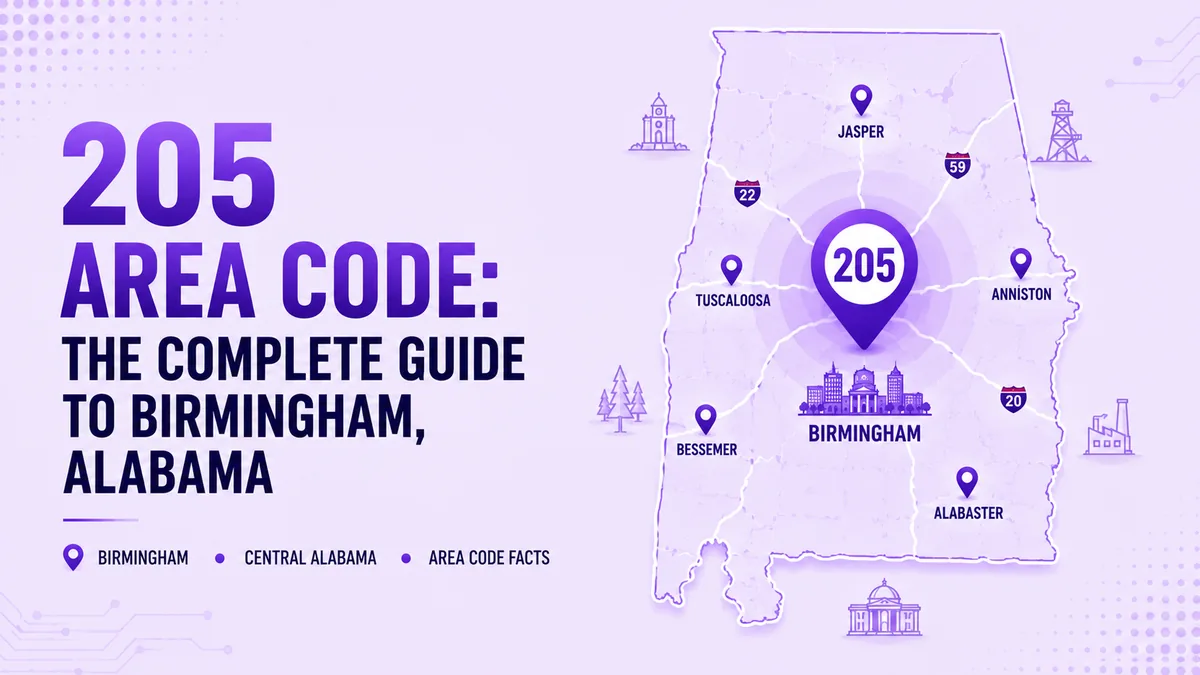
- This area code covers Birmingham, Tuscaloosa, Hoover, and the rest of central Alabama on Central Time.
- A 659 overlay added in 2018 means every local call now needs all 10 digits, not just 7.
- A call from this area code isn't automatically a scam, but caller ID spoofing makes any area code fair game for fraud.
- Businesses expanding into Birmingham can get a local number in minutes without opening a physical office there.
What Is the 205 Area Code?
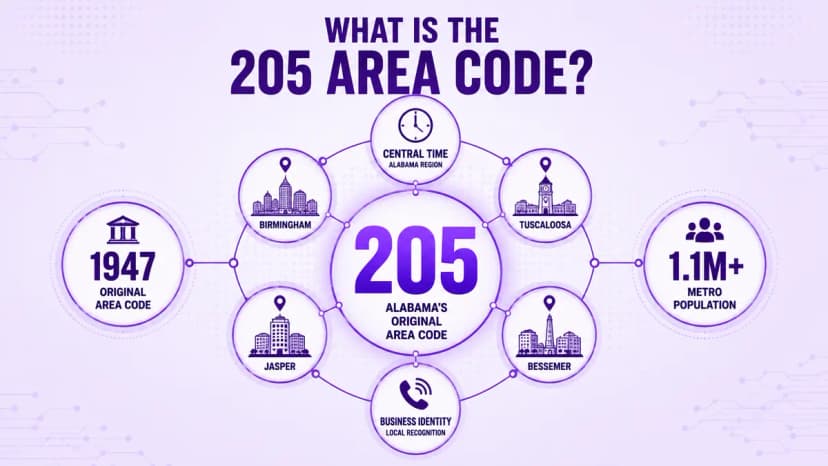
205 goes back to 1947, one of the 86 codes the newly created North American Numbering Plan handed out that year. It covered the whole state of Alabama at first, until 251, 256, and 334 each split off to take other regions. What's left today is Birmingham and the central Alabama counties around it — still one of the oldest, most recognizable codes in the state.
Most directories that mention area code 205 stop at "covers Birmingham" and never touch the overlay, which is the actual gap worth filling here. Written either way — "205 area code" or "area code 205" — both phrasings point at the same Birmingham region.
Calls and texts from this area code run on Central Time, the same zone used across most of Alabama. Birmingham itself is Alabama's largest metro area, with roughly 1.1 million people across the wider metropolitan region, which is part of why this particular code has needed extra number capacity over the decades.
Where Is This Area Code Located?
Birmingham anchors the region, but this area code stretches well beyond the city itself into several surrounding communities. Any carrier's own lookup tool confirms the same central Alabama footprint for 205.
Cities and Communities Covered
- Birmingham, the largest city and unofficial capital of the region
- Tuscaloosa, home to the University of Alabama
- Hoover, one of the largest suburbs in the Birmingham metro
- Bessemer, a historic industrial city just southwest of Birmingham
- Vestavia Hills, a residential suburb south of downtown
Together, these cities and their surrounding counties make up one of the most densely populated calling regions in Alabama. Jefferson County, where Birmingham sits, alone accounts for a large share of the numbers issued across the whole region.
Smaller communities just outside these main cities, like Homewood and Mountain Brook, fall under the same coverage area too. Anyone moving into the region for work or opening a second location there will find the same local numbers available regardless of which specific suburb they land in.
The 205/659 Overlay: What It Means for Dialing
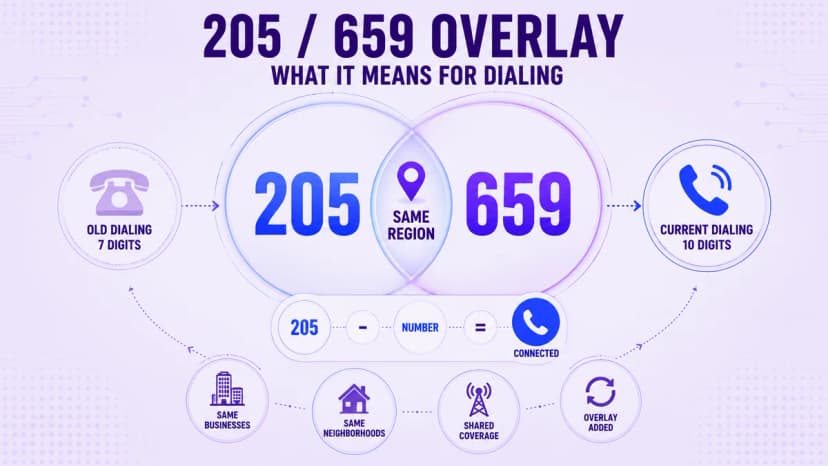
Alabama regulators added the 659 area code as an overlay to this region in 2018, since the region was running out of available number combinations. An overlay means two area codes now share the exact same geographic region instead of splitting it into separate zones.
Before the overlay, the area briefly used permissive dialing, where both 7-digit and 10-digit calls worked side by side while residents adjusted. That transition period is standard practice whenever a region moves to an overlay, giving people time to update saved contacts and equipment.
That change has one practical effect every caller in the region needs to know: ten-digit dialing is now required for every local call, area code included, even when calling a neighbor a few blocks away. Dropping the area code and dialing just 7 digits no longer connects the call.
This is the exact detail most guides gloss over, and it trips up residents and businesses that assumed local calling still worked the old way.
How to Get a 205 Area Code Phone Number
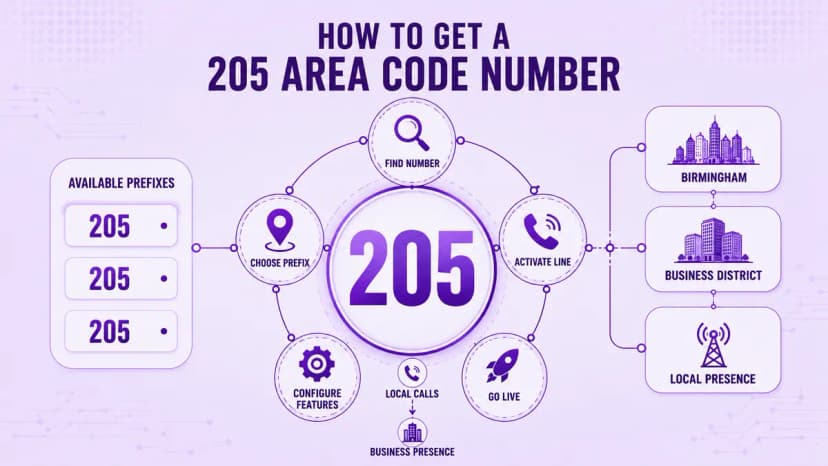
A local number here is a few minutes of setup away, whether the goal is a personal line inside the region or a Birmingham presence for a business based elsewhere.
- 1Pick an Alabama-friendly provider — one built with business features in mind, not just consumer lines.
- 2Browse the available inventory by city or prefix until something fits.
- 3Lock in a number and assign it to a person, a device, or a call flow.
- 4Configure voicemail, forwarding, and business hours before the number goes live.
- 5Already have a number worth keeping? Phone number porting handles that instead of starting fresh.
Ringflow shows the available prefixes up front, so picking one tied to a specific Birmingham neighborhood or business district — if that detail actually matters to customers — is straightforward.
Nearly every provider's search tool surfaces the full 205 inventory the moment someone looks, which makes hunting down a number tied to one particular Birmingham neighborhood a quick exercise rather than a chore.
Testing a new number is as simple as installing a softphone app and running a real inbound and outbound call from a laptop, all before it ever reaches a customer.
Is This Area Code Associated With Scams?
Nothing about 205 itself makes a call riskier than one from anywhere else — the overwhelming majority of calls and texts on this prefix come from real Birmingham residents, local businesses, or companies with a legitimate presence there.
Spoofing is where the actual danger sits: scammers can fake any area code, 205 included, to make a call read as local and trustworthy. The tell is usually urgency — a warranty about to expire, a debt suddenly due, an account "problem" that needs an answer right now.
Nationally, robocall complaints tied to spoofed local numbers have kept climbing for years, and Alabama's regulators log complaints for this region the same as every other state does. Seeing a Birmingham number on caller ID confirms exactly nothing about who's actually on the line.
Blocking one spoofed number rarely sticks, since scammers cycle through fresh numbers the moment one gets flagged. Reporting the call to a carrier does more long-term good than blocking alone — that's the data carriers use to train spam filters against the next wave.
The safe default, regardless of area code: never hand over personal information mid-call, hang up on any unsolicited payment request, and verify independently before acting on anything that feels urgent.
Should Your Business Get a Local Number?
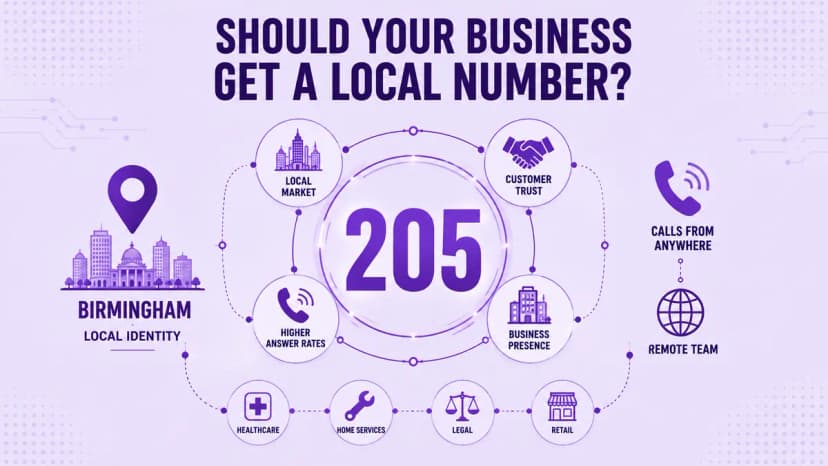
To a Birmingham customer, a local number reads as a specific promise: this business understands the area and won't cost anyone a long-distance call to reach. Service businesses, local retailers, and anyone competing against companies already entrenched in the region get the most mileage out of that promise.
Home services, healthcare practices, and law firms in particular see the biggest lift, since those customers tend to want someone who feels genuinely local before they'll book or sign anything. None of that requires the team to actually sit in Birmingham — a remote staff can answer the same local number from anywhere, since the local presence lives entirely in what the customer sees on caller ID.
A number search here turns up plenty of established local businesses already on 205, and that's exactly the kind of borrowed credibility a new number picks up just by matching the prefix.
Ringflow activates a Birmingham number without requiring an actual Alabama office, routing calls to wherever the team is really working — useful for testing the market before committing to anything permanent.
Pair a local number with local presence dialing on outbound calls, so a Birmingham customer sees a familiar area code calling them back instead of an out-of-state number they're likely to ignore.
Conclusion
205 answers for Birmingham and central Alabama on Central Time, with the 659 overlay meaning every local call now needs the full ten digits rather than seven. None of that makes a call from this prefix any riskier than one from anywhere else — the risk always sits with spoofing, not the area code itself.
A provider built for business, not just consumer lines, is the right place to start. Ringflow gets a local Birmingham number running in minutes, with the routing and forwarding tools a growing team actually needs from day one.
Ready when you are
Ready to Sound Like a Local Business in Birmingham?
See how Ringflow gets your Birmingham number active in minutes, with call routing built in from day one. Get a free trial with Ringflow.
Frequently Asked Questions
It's one of the original 1947 area codes, now covering Birmingham and central Alabama. It shares its region with the newer 659 overlay, added in 2018 for additional number capacity.
It covers Birmingham, Tuscaloosa, Hoover, Bessemer, and Vestavia Hills, all in central Alabama. The region runs on Central Time, matching most of the rest of the state.
The overlay took effect in 2018, requiring all 10 digits for every local call from that point forward. Calls dialed with just 7 digits stopped connecting once the change was fully in place.
Choose a business phone provider that offers Alabama numbers, then search and select an available one. Most providers activate the number within minutes and let you set up forwarding right away.
Yes, answering is safe, since simply picking up a call can't compromise your information on its own. Stay cautious about sharing details or making payments if the caller pressures you urgently.