
Introduction
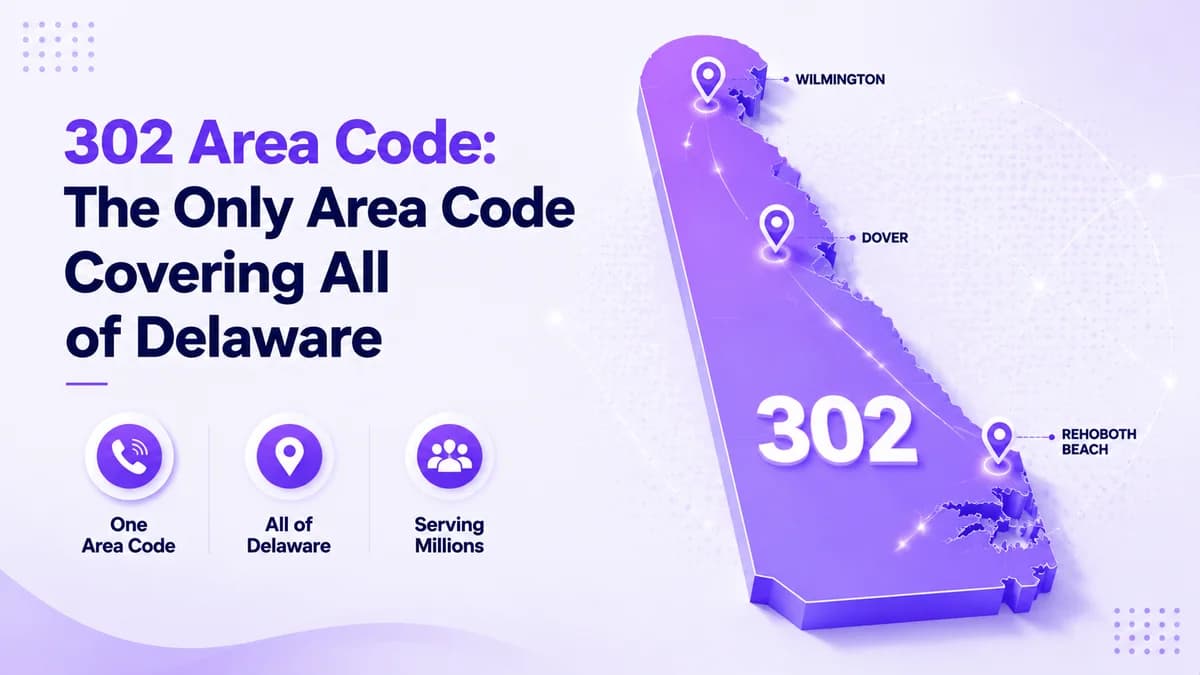
The 302 area code covers all of Delaware, from Wilmington in the north to Rehoboth Beach in the south. Anyone who's gotten a call from it, needs a local number, or is just curious about a Delaware company should understand how it works.
This guide covers where it reaches, why Delaware never split it, whether it's safe to answer, and how to get a number. By the end, you'll know exactly what makes Delaware's numbering plan different from every neighboring state.
- The 302 area code covers every county in Delaware, from Wilmington's banking corridor to the Sussex County beaches, making it one of only a handful of true single-code states left in the country.
- Delaware has never needed a split or an overlay, even though this area code has stayed active and completely unchanged since it was first assigned in 1947.
- Calls from this area code aren't inherently risky, but scammers have recently spoofed it in text messages about fake unpaid highway tolls tied to I-95.
- Businesses incorporated in Delaware, even fully remote ones with no local office anywhere in the state, often still need a working 302 number for banks and state filings.
One State, One Area Code: The 302 Footprint
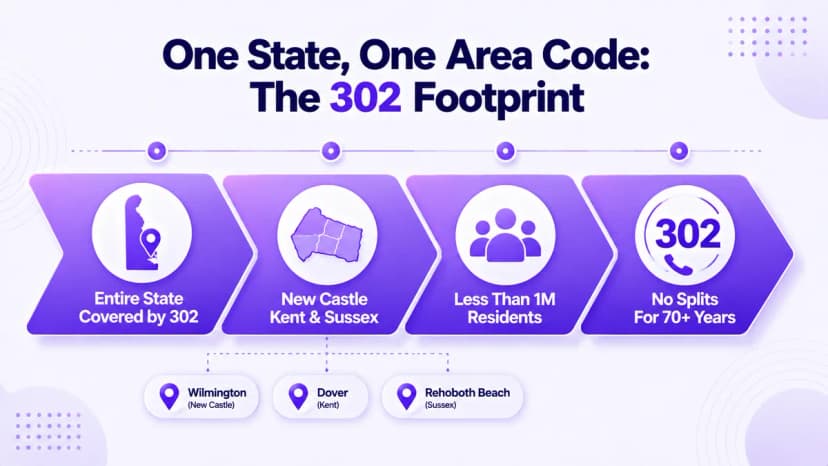
Delaware, nicknamed the First State, is small enough, and was assigned its area code early enough, that a single code has always covered the whole state comfortably without straining its number supply. The 302 area code reaches all three counties: New Castle, Kent, and Sussex, without a single split in over seven decades of steady, unhurried growth.
Delaware's population growth has stayed modest enough that area code 302's number supply covers the whole state comfortably, even as neighboring states like Pennsylvania and New Jersey have split their own codes multiple times. Fewer than one million residents share this single code, well under the roughly eight million numbers each area code can support.
- New Castle County: Wilmington, Newark, Middletown, and Bear
- Kent County: Dover, the state capital, plus Smyrna and Camden
- Sussex County: Rehoboth Beach, Lewes, Seaford, and Georgetown
- All three counties share the same area code and the same Eastern Time zone
- Every prefix in the state, urban or rural, still starts with 302
Which Delaware Cities Fall Under the 302 Area Code?
Wilmington anchors the northern half of the state and carries the largest share of numbers within area code 302, thanks to its banking and corporate-services industry that draws workers from three neighboring states. Dover, the capital, and the beach towns further south round out the rest of the coverage area, each with its own distinct calling patterns shaped by government work or tourism.
Smaller towns like Newark and Milford fill in the gaps between these hubs with their own steady mix of residential and small-business traffic.
Northern Delaware
Wilmington, Newark, and the fast-growing Middletown corridor make up most of the state's population and daily business activity, including most of the banks and law firms that serve Delaware-incorporated companies. Interstate 95 runs straight through this stretch, connecting it tightly to Philadelphia's suburbs.
Central and Southern Delaware
Dover handles state government and Dover Air Force Base traffic, while Rehoboth Beach, Lewes, and Milford see heavy seasonal calling from summer visitors and vacation rental businesses. Call volume in these beach towns can double or triple during peak summer months, straining local customer service lines.
Why Delaware Never Needed a Second Area Code
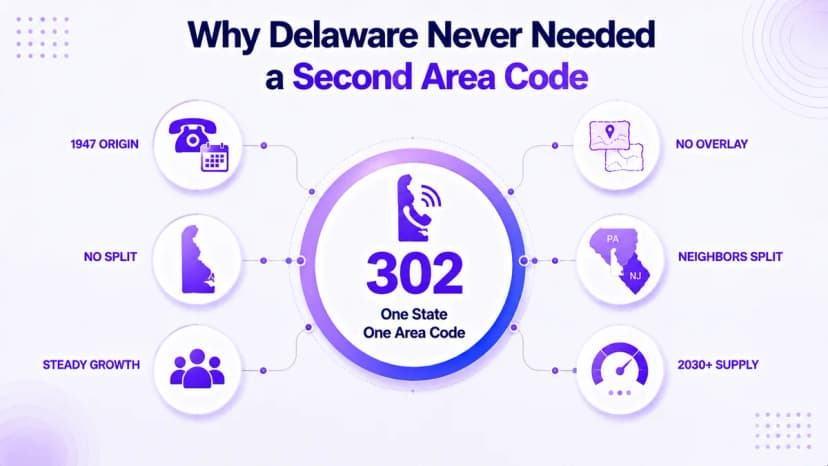
This code was one of the original 86 area codes assigned across North America back in 1947, when the numbering system first launched nationwide, as the area code 302 record confirms. Most states its size have split or overlaid their code at least once since then to keep up with demand, but Delaware's population has never grown fast enough to exhaust its number supply.
That steady, modest growth is unusual for a small state sandwiched between two much larger, faster-growing metro areas like Philadelphia and Baltimore. It's part of why Delaware remains one of only a small handful of American states still served by a single area code today, alongside states like Rhode Island and Hawaii.
- Assigned in 1947, among the first wave of North American area codes
- No split has ever been needed, unlike neighboring Pennsylvania and New Jersey
- No overlay exists either, so every Delaware number still dials with just 302
- Industry number-supply forecasts don't expect a change before the 2030s
- Even the state's fastest-growing towns haven't strained the existing prefix supply
- Delaware's compact geography also keeps demand lower than in sprawling neighboring states
Claiming a 302 Number in Three Steps
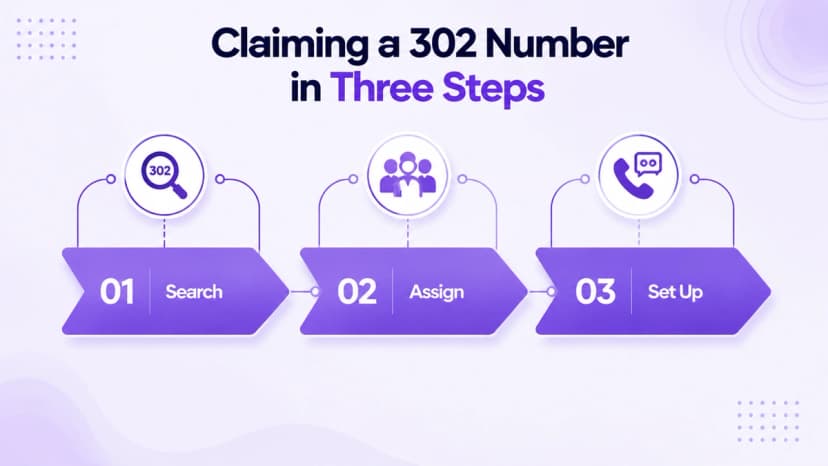
Getting a number in area code 302 takes minutes once you pick a provider built for business use, whether you're setting up a single home office line or a full call center with dozens of agents. Ringflow lets you preview available 302 prefixes before committing to one, so you can pick something that fits your business and the city you want to represent.
- 1Search available 302 prefixes by city, whether Wilmington, Dover, or a beach town further south, and compare a few options side by side.
- 2Assign the number to a team, a device, or an automated call flow that routes to the right person automatically, even outside business hours.
- 3Set up voicemail and forwarding, or complete number porting if you already have a number worth keeping instead of starting fresh.
Why Businesses Incorporated in Delaware Still Need a Local Line
More than a million businesses are legally incorporated in Delaware, drawn by its business-friendly courts and tax structure, and most of them have never set foot in the state. A local 302 number gives that entity a legitimate point of contact for banks, registered agents, and state filings, without the cost of a physical office or a lease anywhere near Wilmington or Dover.
That gap between legal address and actual operations is exactly where a local number earns its keep.
For Remote-First Companies
A second phone number for business use in area code 302 satisfies bank and compliance requests without opening a physical office, and calls can route straight to a remote team anywhere in the country. That's a common setup for founders who incorporated in Delaware for the legal benefits but run their company from somewhere else entirely.
For Registered Agent Correspondence
Registered agents and the Delaware Division of Corporations sometimes call to verify filings or renewal details, and a local number makes that call easier to recognize and answer promptly instead of letting it go to voicemail. Missing that call can delay a filing or trigger an avoidable late fee that's simple to prevent. Annual franchise tax deadlines are a common reason for that outreach, and a missed reminder call can add unnecessary penalties.
The Toll Text Scam Using Delaware's Area Code
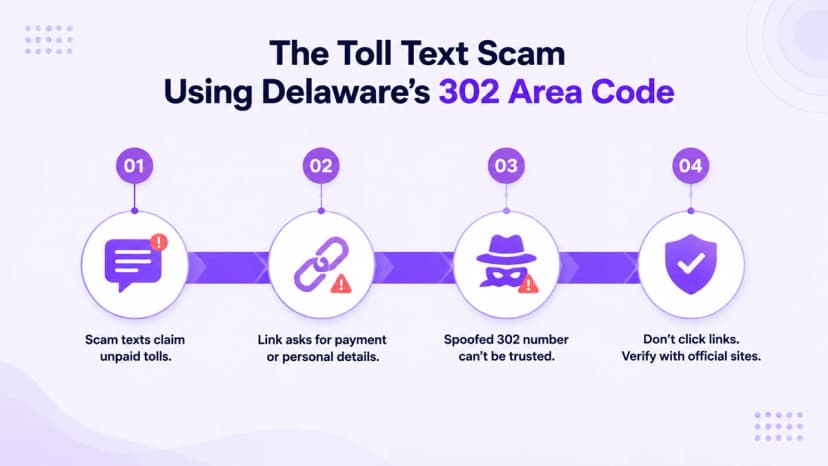
Scammers have recently spoofed the 302 area code in text messages claiming unpaid tolls on Delaware's highways, including stretches of I-95 and the Delaware Turnpike. The messages push a link asking for payment or personal details, closely mimicking official toll-agency alerts, and they often arrive right after a real trip through the state.
A real call or text from area code 302 is not inherently dangerous. Most 302 traffic comes from real businesses, residents, or government offices with a genuine reason to reach you. Spoofing technology lets scammers fake any area code cheaply, so the presence of a local number alone proves nothing about who's really texting. Similar toll-text scams have spread to other East Coast states, so the pattern is worth recognizing beyond Delaware too.
- Urgent language demanding quick payment of a small, specific toll or fine
- A link asking you to "resolve" the balance immediately or face penalties
- A sender number that doesn't match any official state or toll-agency contact
- Requests for card details over text instead of a secure payment portal
Conclusion
The 302 area code Delaware relies on covers every corner of the state, from Wilmington to Rehoboth Beach. It's stayed a single, unchanged code since 1947, with no split and no overlay. A call or text from it carries no more risk than any other, aside from the toll-scam texts making the rounds. Knowing how this code works helps you dial and answer with real confidence.
Delaware's numbering plan isn't likely to change anytime soon. If your business needs a local presence here, start with a provider that makes setup simple. Ringflow activates a Delaware number in minutes and routes calls to wherever your team works. Get your 302 number started today and give Delaware contacts a number they recognize.
Ready when you are
Worried a Spoofed 302 Call Might Be Real?
Ringflow gives your business a genuine Delaware number, so customers always know it's really you and not a scam text. Get a free trial with Ringflow.
Frequently Asked Questions
The 302 area code is Delaware's only area code, covering the entire state from Wilmington to Rehoboth Beach. It's one of just a handful of area codes nationwide that cover an entire state. Delaware runs entirely on Eastern Time, with no time-zone splits within the state.
It covers all of Delaware, including New Castle, Kent, and Sussex counties. That spans Wilmington, Dover, Newark, and the state's beach towns.
It was assigned in 1947, as part of the original set of 86 North American area codes. Delaware has kept it unchanged ever since.
Pick a provider that offers Delaware numbers, then search available prefixes by city. Ringflow activates a number in minutes and lets you port an existing one if needed. Banks, registered agents, and state filings often expect a working Delaware contact number, and a local 302 number provides one without a physical office.
Yes, most calls from this area code are legitimate residents or businesses. Scammers can still spoof any area code, so verify unexpected requests independently.