
Introduction
The 305 area code covers Miami-Dade County and the Florida Keys, though it once covered the entire state of Florida on its own under the original 1947 numbering plan. Anyone who has gotten a call from it, needs a local number for a growing team, or wonders why Miami now shares three area codes at once deserves the full picture before choosing a provider.
This guide covers where it reaches today, how one statewide code split into several over the decades, why a newer overlay called 645 just joined the mix, and how to get a number of your own for a growing team. By the end, you'll know exactly why a Miami number can start with 305, 786, or 645 and still ring the very same neighborhood.
- The 305 area code now covers only Miami-Dade County and the Florida Keys, though it originally covered the entire state of Florida after its 1947 assignment.
- Two overlays share that same footprint today: 786, added in Miami-Dade in 1998 and extended to the Keys in 2015, and the newer 645, activated in August 2023, so every local call needs all 10 digits.
- Scammers have recently used this area code to spoof fake cruise-prize calls, a pattern worth recognizing well beyond Miami too.
- International and bilingual businesses often request a 305 number specifically, since it signals a genuine Miami presence to Latin American clients and partners.
Miami-Dade and the Keys: Where the 305 Area Code Reaches
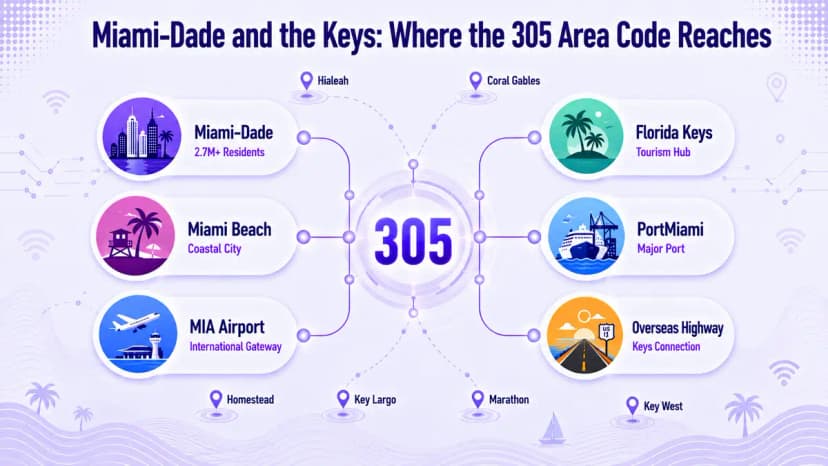
Area code 305 covers exactly two Florida counties today: Miami-Dade and Monroe, home to the Florida Keys. That's a small slice of its original 1947 range, which once stretched across the entire state, but it remains one of the busiest, most call-dense areas in the country even after decades of splits, thanks to steady population growth, a booming tourism industry, and a nonstop stream of visitors year after year.
Miami-Dade alone holds more than 2.7 million residents, and the Keys add a steady wave of seasonal, tourism-driven calling on top of that year-round base. New prefixes keep getting released across both counties to match that demand, from downtown Miami high-rises to the northernmost Keys, and carriers rarely run short now that three separate codes share the same coverage area.
- Miami-Dade County: Miami, Hialeah, Miami Beach, Coral Gables, and Homestead
- Monroe County: Key West, Marathon, Islamorada, and Key Largo
- Both counties sit in the Eastern time zone year-round
- Every number in this footprint carries a 305, 786, or 645 prefix
- The Overseas Highway links the Keys back to the mainland Miami-Dade grid
- PortMiami and Miami International Airport both operate inside this same coverage area
- Roughly 2.7 million residents share this footprint with millions of yearly visitors
The Four Splits That Shrank a Statewide Code
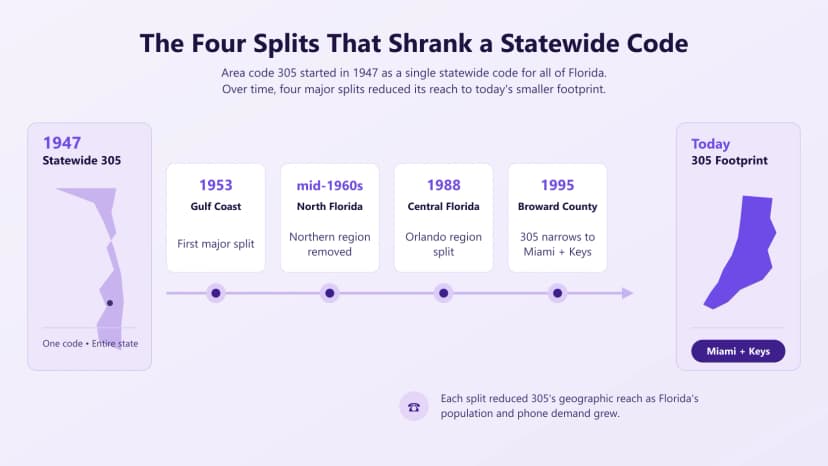
Area code 305 wasn't always a Miami-only code. It was one of the original 86 area codes assigned nationwide when the North American Numbering Plan launched in 1947, and it covered the entire state of Florida on its own for years, stretching from the Panhandle all the way down to the Keys without a single split in between.
That single-code status didn't last long. Florida's population exploded during the postwar decades, and regulators carved off new codes for the Gulf Coast in 1953, North Florida in the mid-1960s, Central Florida in 1988, and finally Broward County in 1995, each split trimming this area code closer to the two-county footprint it still holds today, decades after that last change.
How the Neighboring 954 Area Code Compares
Broward County, just north of Miami-Dade, split off into area code 954 back in 1995 and has stayed a single code ever since, with no overlay required so far. That makes it an easy point of comparison for anyone weighing a Fort Lauderdale presence against a Miami one before picking a number for a new office.
A number here signals Miami and the Keys specifically, while a 954 area code number signals Broward instead, even though both sit inside the same South Florida calling region, share the same Eastern time zone, and both require 10-digit local dialing on every single call today, no matter which prefix either side is dialing from.
Which Miami Industries Lean Hardest on a 305 Number
PortMiami calls itself the Cruise Capital of the World, and the tourism, hospitality, and shipping jobs built around it still expect a local prefix on every callback. Real estate agents, property managers, and short-term rental hosts across Miami-Dade and the Keys lean on that same signal to reassure buyers and renters booking a property sight unseen from out of state.
Healthcare providers, entertainment companies, and the growing finance and tech scene downtown all draw on that same local credibility, especially when reaching patients or clients who expect a Miami-based line to pick up on the first ring. A recognizable area code still shortens the distance between a cold call and an answered one, even in a crowded inbox of missed calls.
Why International Businesses Still Want a Recognizable 305 Number
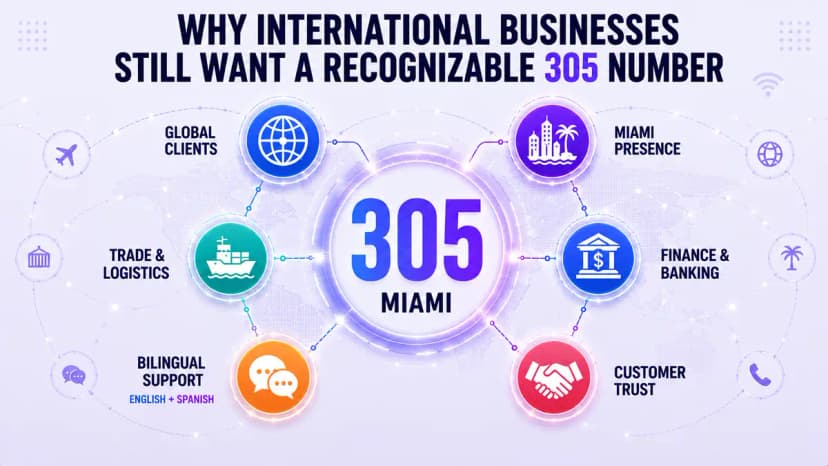
Miami is one of the busiest gateways between the United States and Latin America, and the 305 area code Miami businesses rely on carries that reputation well past the city limits. A local number here signals a genuine Miami presence to banking, trade, and logistics clients across the region, not just a US mailing address.
That signal matters most for companies leaning on bilingual support or cross-border trade, where a familiar area code builds trust faster than an unfamiliar one ever could. PortMiami, Miami International Airport's cargo routes, and the Brickell financial district all depend on that same local credibility with overseas partners, and a matching local presence dialing strategy extends it to outbound sales calls too.
Three Codes, One Region: 786 and 645 Join 305
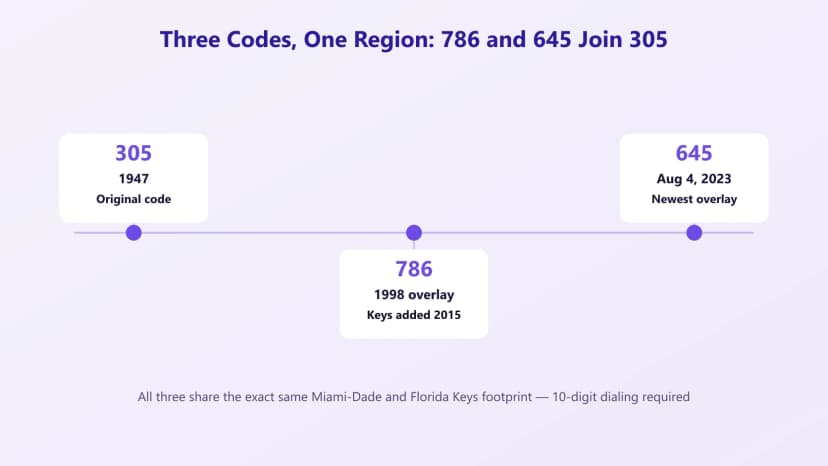
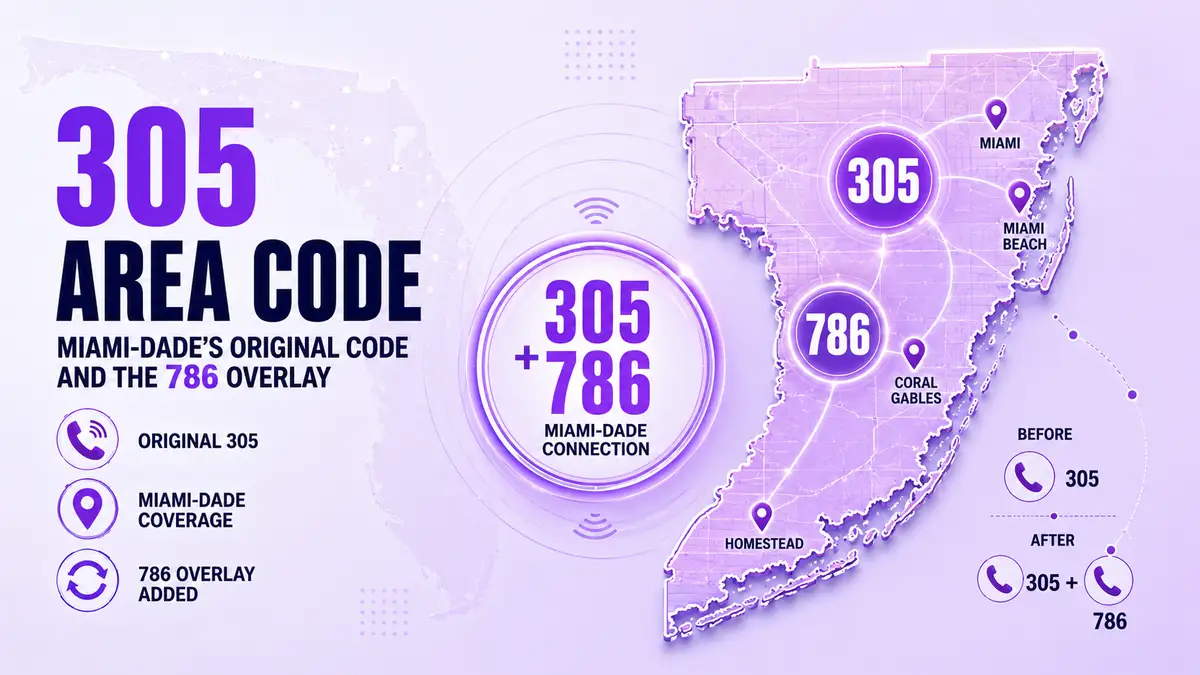
By 1998, even the trimmed two-county footprint was running low on numbers, thanks to pagers, fax lines, and the first wave of cell phones flooding the local supply. Regulators added area code 786 as an overlay that March rather than splitting the map again, but only for Miami-Dade at first. The Florida Public Service Commission approved extending 786 to the Keys in 2000 as a backup plan, and number-saving measures kept the Keys on 305 alone for another 14 years: ten-digit dialing became mandatory there on April 18, 2015, and new Keys lines began receiving 786 numbers on June 1, 2015. Since then Miami-Dade and the Keys have shared the same codes, with no geographic line between them.
The overlay pool ran low again by the early 2020s as demand for new lines kept climbing. The Florida Public Service Commission approved a third code in February 2022, and area code 645 went live on August 4, 2023, covering the exact same Miami-Dade and Keys footprint as its two neighbors. The overlay history traces each stage back to the original regulatory orders.
Picking Up a 305 Number in Three Steps
Getting a number in this area code takes only minutes with the right provider, whether you're an individual, a solo agent, or a growing business running a full sales and support team across several offices in different neighborhoods.
- 1Search available prefixes by city, whether Miami, Coral Gables, or Key West, and compare the 305, 786, and 645 options side by side.
- 2Assign the number to a team, a device, or an automated call flow that keeps routing calls even outside business hours.
- 3Set up voicemail and forwarding, or port an existing number over if you already have one worth keeping.
Ringflow lets you preview available prefixes before committing, so you can pick a number that fits the exact Miami neighborhood you want to represent, all without waiting on a lengthy contract, a site visit, or a slow manual setup process handled over email.
The Cruise-Prize Scam Targeting This Area Code
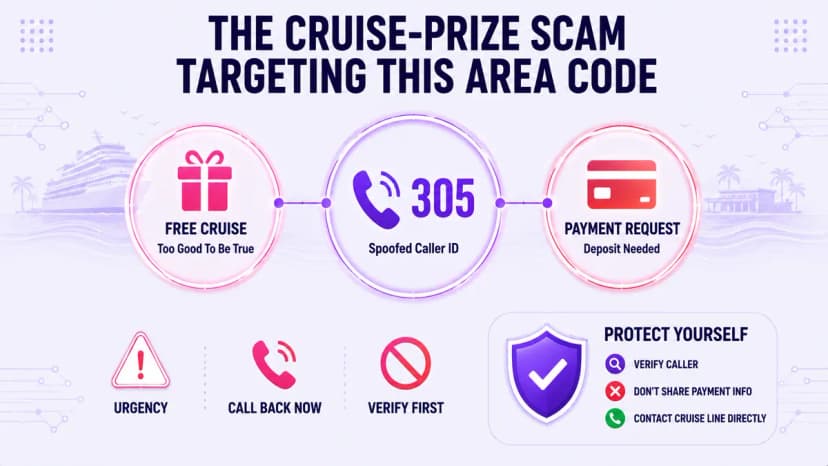
Scammers have recently spoofed this area code in calls claiming the recipient won a free cruise, a scheme that leans on Miami's reputation as a major cruise-port city and home to some of the world's busiest terminals. The calls push urgent callback requests or ask for a deposit to "claim" the prize before it "expires," hoping the pressure outruns any second thought a wary recipient might otherwise have.
A real call from this area code isn't inherently dangerous. Most calls here come from actual residents, businesses, or legitimate cruise-line service lines, especially during booking season, and spoofing lets scammers fake any of the three local prefixes just as easily, so a familiar-looking number alone proves absolutely nothing about who is really calling you.
- Unsolicited claims that you won a free cruise or vacation package
- Pressure to call back immediately or lose the prize
- Requests for a deposit or card details to "release" the reward
- Caller ID showing a local number that doesn't match any cruise line you booked with
- A recorded voice instead of a real agent when you call the number back
- Refusal to send written confirmation of the prize by email before you pay anything
Conclusion
The 305 area code Miami and the Keys share today has come a long way from its original statewide reach, narrowing through four splits before picking up two overlay codes, 786 and the newer 645, along the way. A call from any of the three carries no more risk than usual, aside from the cruise-prize scam calls worth watching for during booking season and holiday travel months.
Miami's numbering plan probably won't change again for a while, so the details above should hold for years to come. If your business wants a genuine Miami presence, Ringflow activates a local number in minutes and routes every call to wherever your team actually works. Get your 305 number started today and give Miami contacts a number they instantly recognize on sight.
Ready when you are
Worried a Free Cruise Call From a 305 Number Might Be Real?
Ringflow gives your business a genuine Miami number, so customers always know it's really you calling back. Get a free trial with Ringflow.
Frequently Asked Questions
The 305 area code covers Miami-Dade County and the Florida Keys today, though it once covered the entire state. It shares that footprint with the 786 and 645 overlays.
It covers Miami-Dade County, including Miami and Coral Gables, plus Monroe County's Florida Keys. Both counties run on Eastern Time.
It was assigned in 1947, as one of the original 86 North American area codes. It covered all of Florida before later splits narrowed it down.
Area code 645 is the newest overlay on this footprint, activated August 4, 2023. It covers the same Miami-Dade and Florida Keys territory as 305 and 786.
Pick a provider that offers Miami numbers, then search available prefixes by city. Ringflow activates a number in minutes and lets you port an existing one if needed.