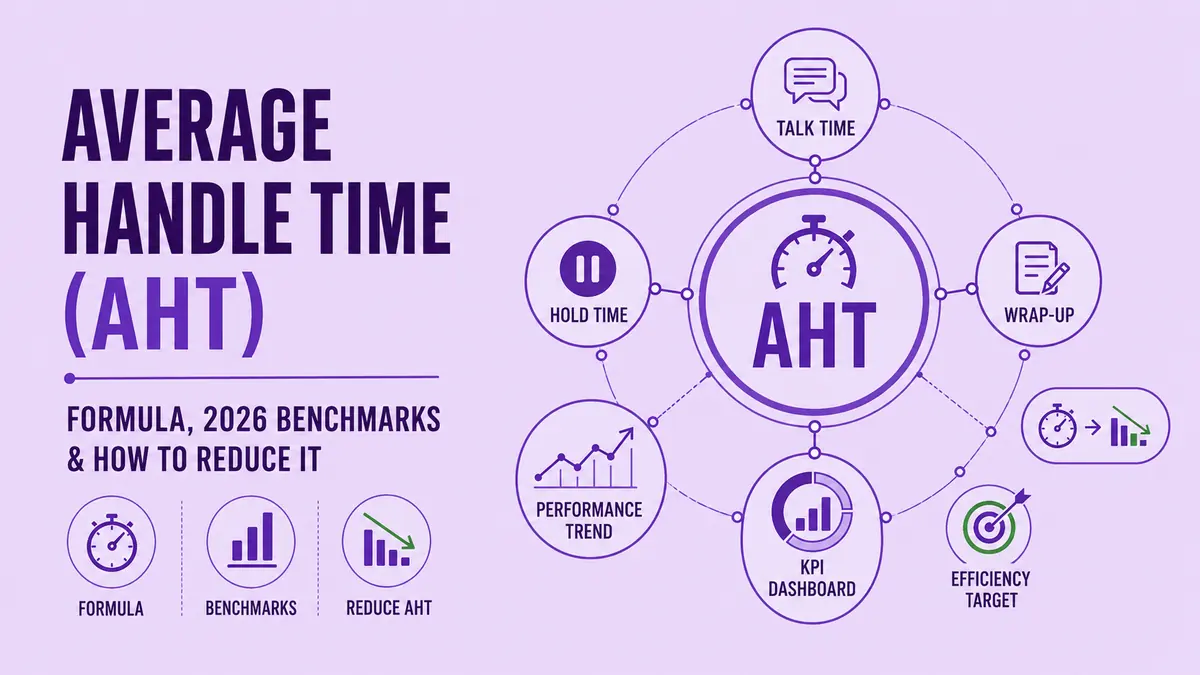
Average handle time measures exactly how long an agent spends on a single customer interaction, from pickup to final wrap-up. Track it wrong, and you'll chase a number that doesn't reflect real service quality. This guide gives you the exact formula, 2026 benchmarks broken down by channel, and proven ways to lower AHT without rushing customers off the phone. By the end, you'll know exactly where your team stands and what to fix first.
- AHT equals talk time plus hold time plus after-call wrap-up time, not just time spent talking.
- The 2026 phone-channel AHT number sits between 4 and 6 minutes for most industries.
- Cutting AHT too aggressively often raises repeat contact rates and hurts customer satisfaction.
- AI-assisted wrap-up and a better knowledge base cut AHT without rushing agents.
What Is Average Handle Time (AHT)?
Average handle time is the average length of a single customer interaction, measured from the moment an agent answers to the moment they finish any after-call work. It includes three parts: active talk time, hold time, and after-call wrap-up. Contact centers track it per agent, per team, and per channel, since phone, chat, and email interactions behave very differently. A high AHT isn't automatically bad, and a low one isn't automatically good, since the right target depends on what the interaction actually requires.
A retail return call and a technical support call rarely deserve the same target, even on the same phone line. Comparing them against one blended number hides which call type actually needs process help.
AHT vs. Average Talk Time: What's the Difference?
Average talk time only counts the minutes an agent spends actively speaking with the customer. AHT adds hold time and wrap-up work on top of that, giving a fuller picture of how long an interaction really ties up an agent. Teams that only track talk time often underestimate how much capacity each interaction actually consumes.
Some platforms also report a metric called occupancy, which measures how much of an agent's shift goes toward handling contacts versus sitting idle. AHT and occupancy answer different questions, and mixing them up leads teams to fix the wrong problem.
The AHT Formula: How to Calculate Average Handle Time
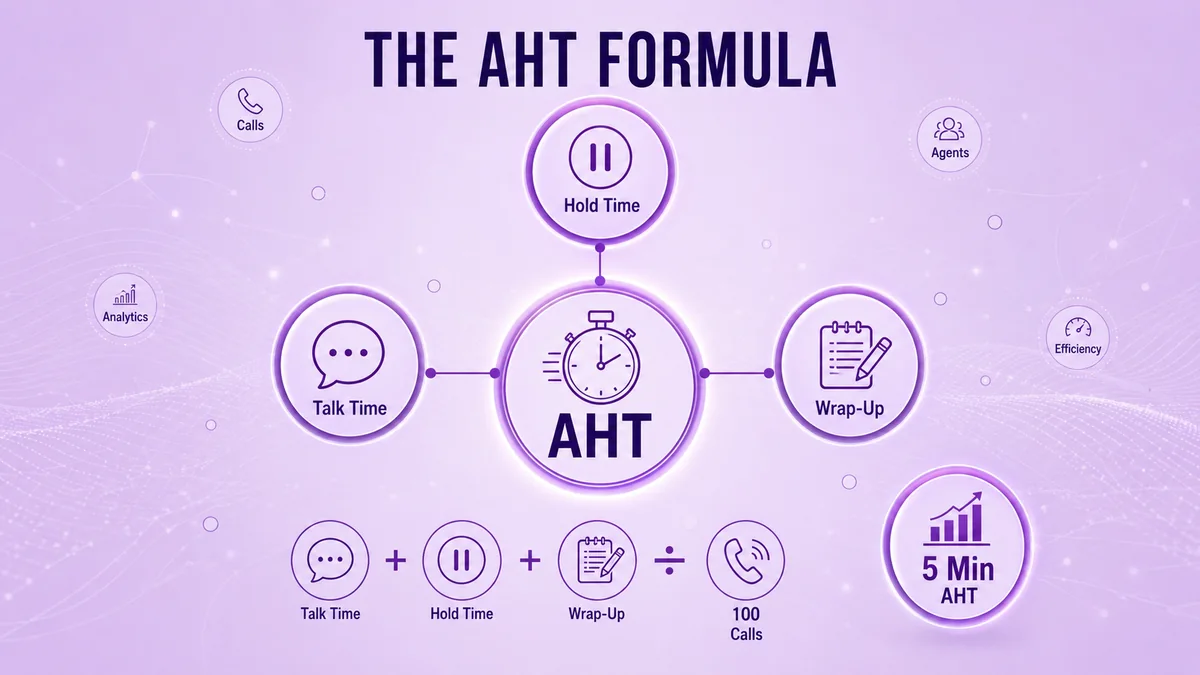
The formula is simple: add total talk time, total hold time, and total after-call wrap-up time, then divide by the number of calls handled in that period. Here's a worked example: a team logs 400 minutes of talk time, 60 minutes of hold time, and 40 minutes of wrap-up time across 100 calls in a day. That's 500 total minutes divided by 100 calls, for an AHT of 5 minutes. Run this calculation per agent, per channel, and per week to spot real patterns instead of reacting to one unusual day.
Some teams also add transfer time to the formula when a call bounces between departments before resolution. Whether you include it depends on whether your reporting tracks the original call or each individual leg separately.
Skipping any one of the three parts of this formula produces a number that looks better than reality, which is one of the most common tracking mistakes teams make.
2026 AHT Benchmarks by Channel
AHT varies enormously by channel, so comparing your phone number against a chat benchmark tells you nothing useful.
| Channel | 2026 Benchmark | Typical Range |
|---|---|---|
| Phone | 5 minutes | 4–6 minutes |
| Live chat | 8 minutes (concurrent chats) | 6–10 minutes |
| 4 hours (handling time) | 2–6 hours | |
| Social media | 10 minutes | 7–15 minutes |
These numbers shift by industry too. Healthcare and financial services tend to run 1 to 2 minutes higher than retail, since compliance steps and identity verification add real time to every call. A team well below its channel's AHT benchmark isn't necessarily efficient, since it might be rushing calls and pushing volume into repeat contacts instead of solving anything the first time.
Team size matters too. A 10-agent team often runs a slightly higher AHT than a 200-agent enterprise floor, since larger teams can afford tighter specialization and more targeted coaching.
Async channels like email and social media are harder to benchmark precisely, since handling time often gets split across multiple short sessions instead of one continuous interaction.
What Affects Your Average Handle Time?
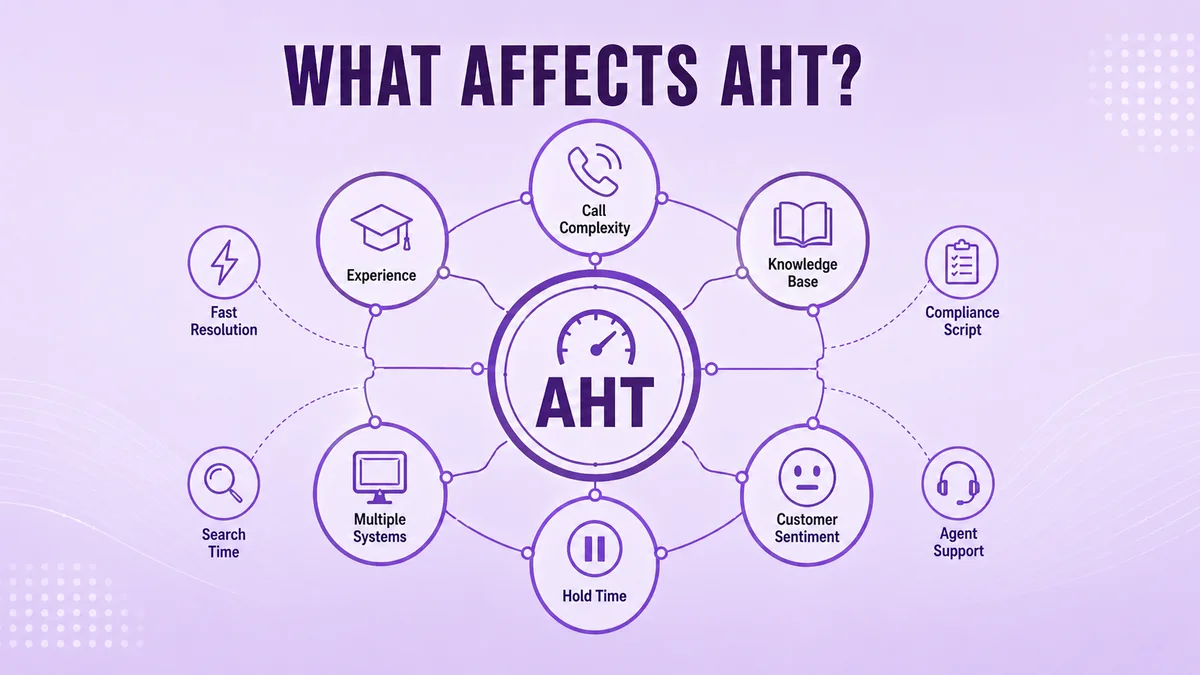
Several factors shift average handle time before you ever touch a process or a tool:
- Agent experience and tenure
- Call or ticket complexity
- Knowledge base quality and search speed
- Number of systems an agent switches between mid-call
- Hold time needed for lookups or approvals
Script length plays a role as well. A mandatory compliance disclosure that takes 20 seconds to read adds real time to every single call, regardless of how efficient the agent is.
New agents typically run 20 to 30% above team AHT during their first 90 days, which is normal and expected. The number of separate tools an agent has to switch between during a single call adds up fast, since every alt-tab or copy-paste is dead air the customer hears as silence.
Customer sentiment matters too, since a frustrated caller who has already contacted support twice this week takes longer to satisfy than a first-time caller with a simple question.
How to Reduce Average Handle Time: Proven Strategies
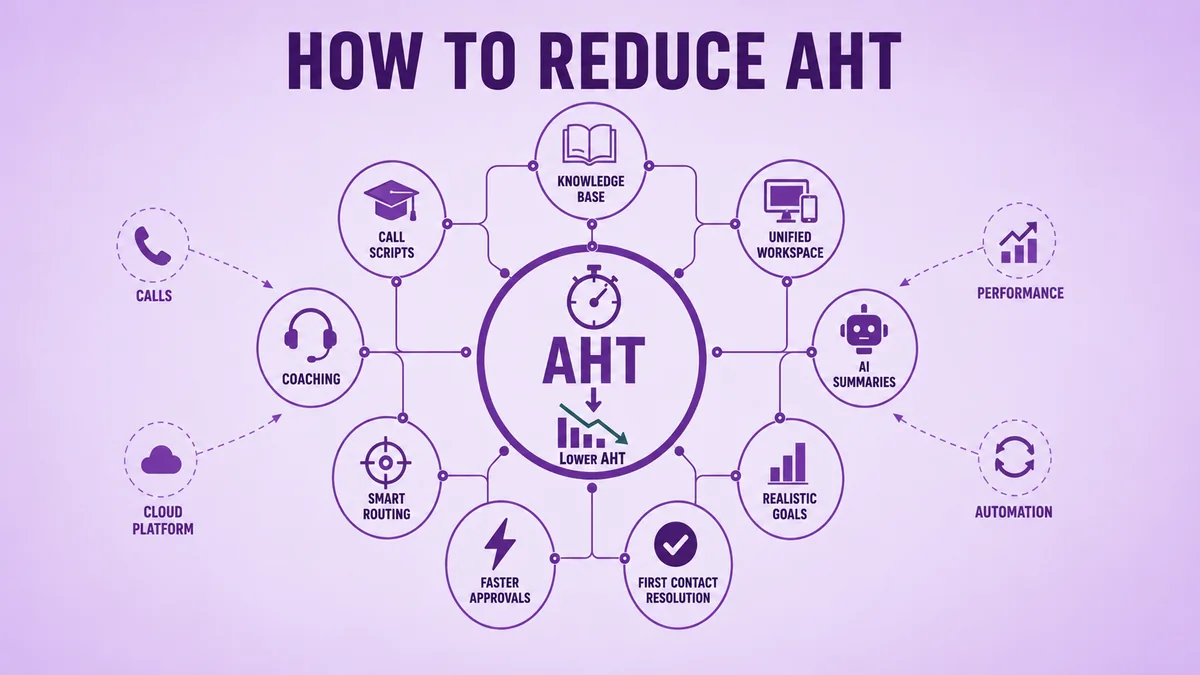
Most of the fixes below fall into three buckets: what agents do, what tools support them, and how the process is structured around both. Start with whichever bucket shows the biggest gap in your own reporting.
Agent-Side Fixes
- 1Build a searchable knowledge base agents can query in seconds, not minutes.
- 2Script the first 15 seconds of common call types so agents open at a natural pace.
- 3Coach agents individually using recorded calls, not just aggregate AHT stats.
Technology-Side Fixes
- 1Use automatic call summaries so agents skip typing manual wrap-up notes. Ringflow's AI call summaries handle this step automatically after every call.
- 2Reduce the number of separate systems agents log into during a single interaction. A softphone app that consolidates dialing, notes, and call history into one screen removes several of those extra tool switches on its own.
- 3Route calls to the right specialist the first time using skills-based routing. An auto attendant handles the first layer of that routing before a call ever reaches an agent's queue.
Process-Side Fixes
- 1Set realistic per-channel targets instead of one blanket number for every team.
- 2Review AHT alongside first-contact resolution, never on its own.
- 3Give agents authority to resolve common issues without escalating for approval every time.
None of these fixes work in isolation. A better knowledge base helps less if agents still have to switch between four separate screens to use it. Average handle time is also one of the core metrics tracked across the call center industry, so improvements here compare cleanly against published benchmarks.
Ringflow customers who combine AI wrap-up summaries with skills-based routing typically lower AHT by 15 to 20% within the first quarter, without any drop in customer satisfaction scores.
Common AHT Formula Mistakes to Avoid
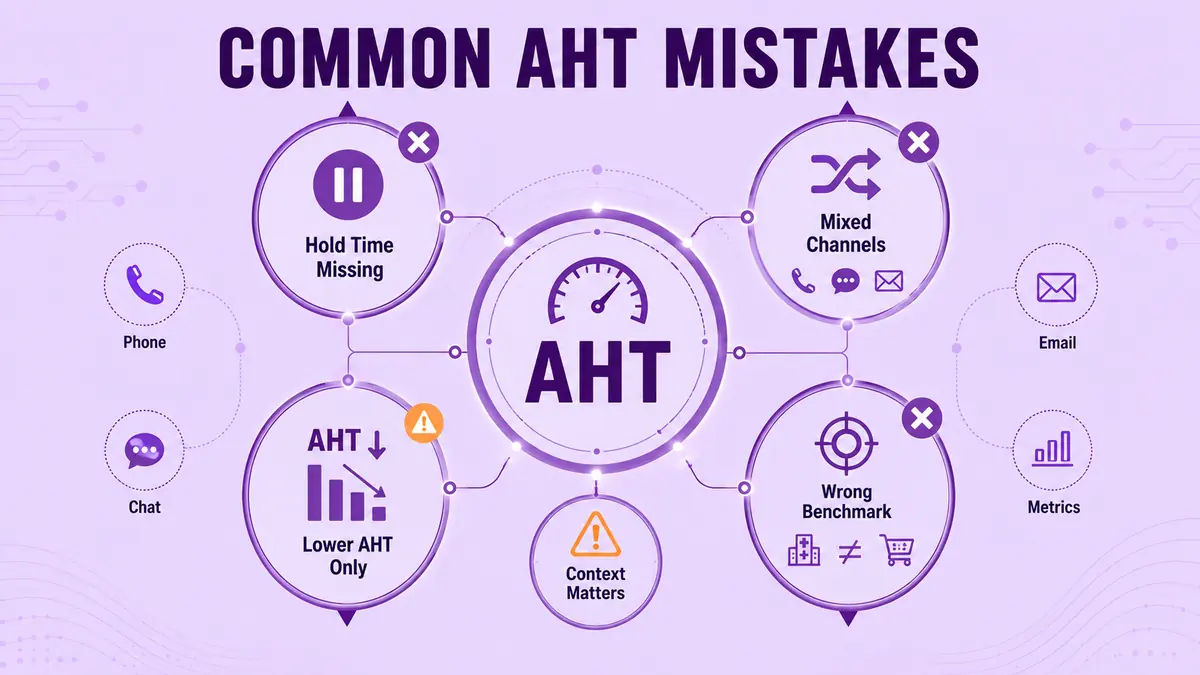
- Excluding hold time: leaving it out of the formula understates real handle time.
- Averaging across channels: phone, chat, and email need separate calculations, not one blended number.
- Chasing a lower number alone: a drop in AHT without watching first-contact resolution often just means more repeat calls.
- Comparing against the wrong industry: a retail number tells you nothing about a healthcare team's target.
Each of these mistakes shares the same root cause: measuring one number without the context around it. A formula only tells a useful story when it's paired with the right comparison. Reviewing it alongside your AI in call centers reporting keeps that context front and center.
Most AHT tracking errors come from an incomplete formula, not bad math. Leaving out hold time or wrap-up time makes a team look faster than it actually is, which hides real capacity problems until they show up as long queue times later. Average handling time has been a standard contact center metric for decades precisely because it captures the full interaction, not just the talking portion.
Conclusion
Average handle time comes down to one simple formula: talk time plus hold time plus wrap-up time, divided by total calls handled. Your target should match your channel's 2026 benchmark, not a number pulled from a different industry entirely. Track AHT alongside first-contact resolution so a faster number never comes at the cost of quality. With the formula and benchmarks above, you now have a clear, accurate picture of where your team actually stands.
Cutting AHT doesn't require rushing agents through calls or pressuring anyone to hang up faster. Small changes, like a better knowledge base or automatic call summaries, add up to real time savings within weeks. Ringflow's AI tools handle the repetitive parts of wrap-up so agents can focus on the conversation itself. Start applying even two or three of the strategies above, and you'll see your average handle time move in the right direction fast.
Ready when you are
Tired of Your Agents Drowning in Manual Wrap-Up Notes?
See how Ringflow's AI call summaries and skills-based routing help teams lower AHT without rushing a single customer.
Frequently Asked Questions
Average handle time is the average length of a customer interaction, including talk time, hold time, and after-call wrap-up. It's one of the most common metrics contact centers use to measure agent efficiency.
Most contact center platforms, including Ringflow, calculate AHT automatically per agent, team, and channel. You can usually find it directly on your analytics dashboard without any extra setup.
Worry when AHT climbs well above your channel's benchmark without a matching rise in first-contact resolution. A rising number tied to more complex calls is often fine and expected.
Add total talk time, hold time, and wrap-up time, then divide by the number of calls handled. A team logging 500 total minutes across 100 calls has a 5-minute average handle time.
Not always, since agents rushing calls to hit a number often push customers into repeat contacts. Watch first-contact resolution alongside AHT to confirm speed isn't hurting quality.
Yes, overnight and early-morning shifts often see a different AHT due to call mix and staffing levels. Compare each shift against its own historical average rather than one company-wide target.
Most cloud contact center platforms include AHT tracking in standard reporting at no extra cost. Advanced per-channel breakdowns may require a higher-tier plan depending on the provider.
Most phone-based teams should target 4 to 6 minutes, adjusted for industry and call complexity. Use your channel's 2026 benchmark as a starting point, not a rigid rule.