
Introduction
Few small decisions shape a first impression as quietly as the phone number on your website. A toll free number says national reach, while a local number says nearby and familiar, and customers read those signals before anyone says hello. Choosing between them affects your costs, your answer rates, and how your brand feels. It is worth getting right early, because changing numbers later means updating every listing, ad, and business card.
This guide explains the real difference between toll-free and local numbers, what each one does best, and how they compare side by side. It then shows how to match the choice to your business stage and why many companies end up using both. By the end, you will know which number to buy first and when to add the other. Whether you run a small shop or a growing brand, the same logic applies.
Toll-Free vs. Local Number: The Core Difference
A toll free number starts with a prefix such as 800, 833, 844, 855, 866, 877, or 888, and it costs the caller nothing to dial from anywhere in the United States and Canada. The business pays for the call instead, usually by the minute. Callers see a number they can dial without a second thought. These numbers are assigned through a central registry run by the Somos toll-free administrator.
A local number is tied to a specific area code, such as 212 or 415, and it makes a business feel like part of the neighborhood. Callers dial it like any other local line, so it carries no sense of distance or cost. Technically the two work the same way, so the choice is really about perception, cost, and reach. That makes the decision easier than it first looks.
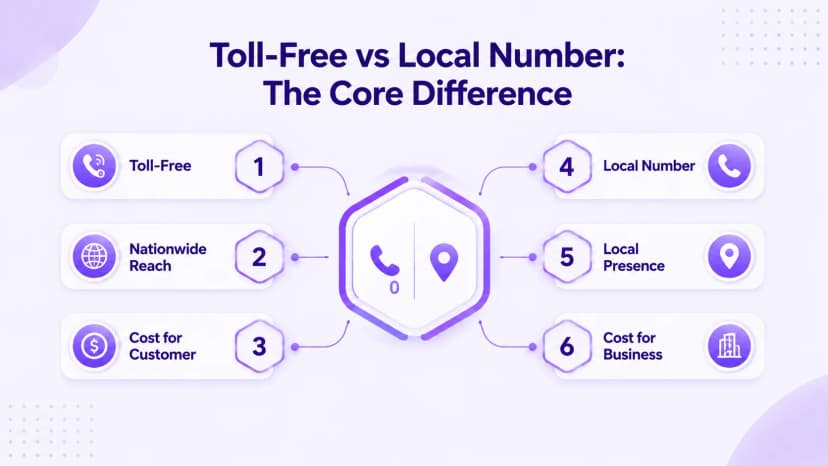
- Toll free numbers use prefixes like 800, 833, 844, 855, 866, 877, and 888
- Local numbers use a geographic area code that signals a specific city or region
- Toll-free calls cost the caller nothing, while the business pays the per-minute charge
- Local calls are billed like ordinary calls, so callers rarely think about cost
- Toll free numbers are not tied to a location, so they suit national or remote teams
- Local numbers signal a real presence in the community the caller lives in
- Both number types can ring the same phones, apps, or cloud phone system at the same time
Toll-Free Number Benefits
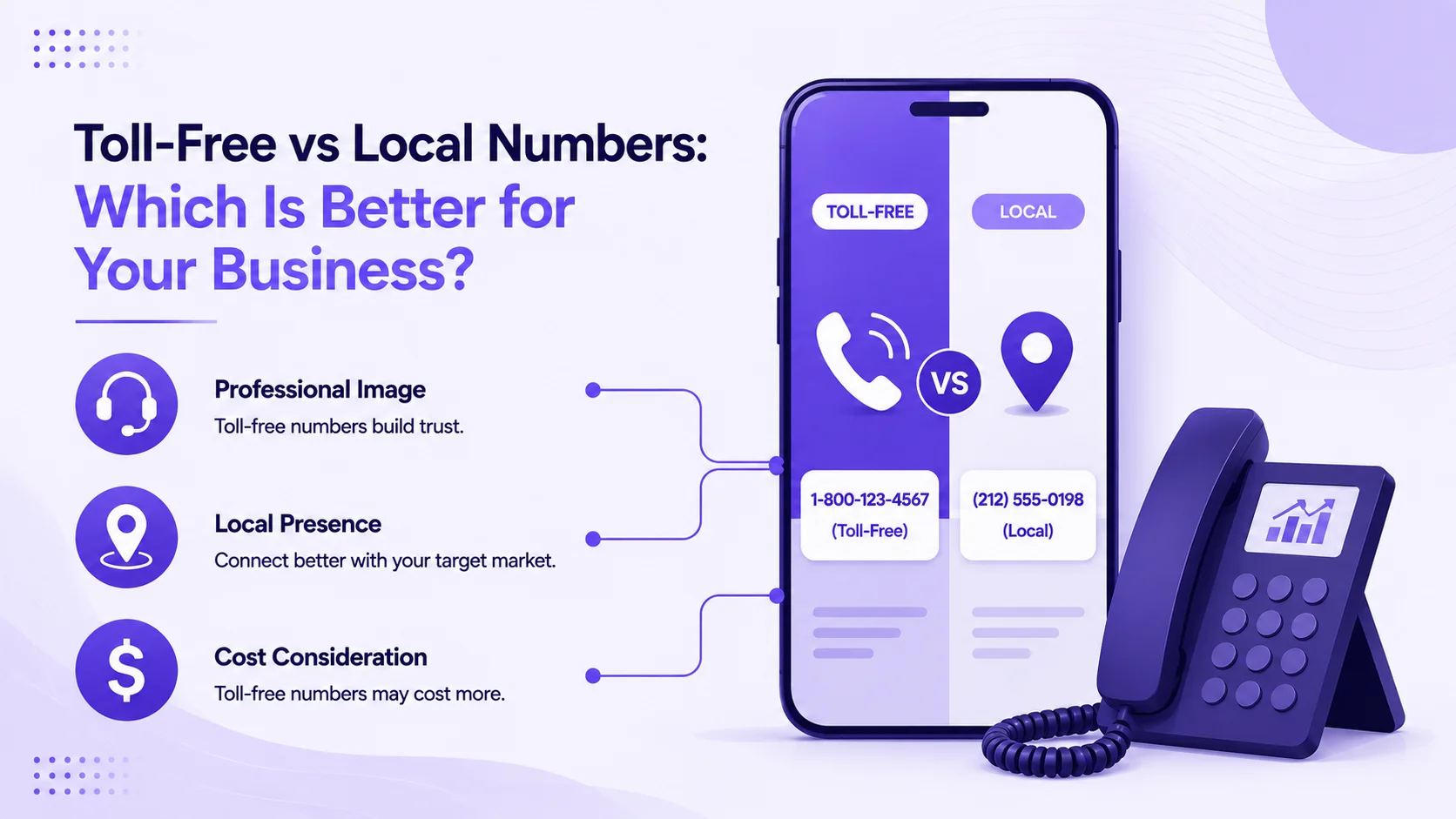
Businesses that serve customers across many states, or expect high call volume, tend to lean on toll-free lines. The number tells callers that the company operates at scale, no matter where the office sits. It also removes a small but real barrier, since customers never wonder whether a long call will cost them money. Support teams and order desks often see the clearest benefit.
Toll free numbers also support memorable formats. A vanity phone number such as 1-800-FLOWERS turns the digits into a piece of marketing that people recall without writing it down. That recall matters for radio, billboards, and vehicle wraps, where customers cannot copy a number and must remember it instead. The same number can carry that branding for years, and customers learn to trust it.
- A toll free number signals national reach even when your team works from a single office or from home
- Removes cost worries for customers who call about long or complex issues
- Supports vanity formats that make a toll free number easy to remember and repeat
- Works well on ads, packaging, and billboards where recall matters most
- Can stay the same even if you move offices, add locations, or hire remote staff
- Routes calls from every region to one shared team, queue, or department
- Fits support lines, sales hotlines, and order desks with steady inbound volume
Local Phone Number for Business
A local number does the opposite job, because it makes a company feel close to the customer. People searching for a nearby plumber, dentist, or accountant often trust a business whose area code matches their own. That familiarity can make a first call feel safer, especially for services that involve visiting a home or an office. Trust matters most at the moment of the first call.
Local numbers are usually cheaper to set up and maintain than toll-free lines, since there is no inbound per-minute charge built into the pricing. They also tend to look more familiar on a caller ID, which can help outbound calls get answered. Many teams pick a local number first, because it fits a small budget and a single service area. Adding another area code later is easy.
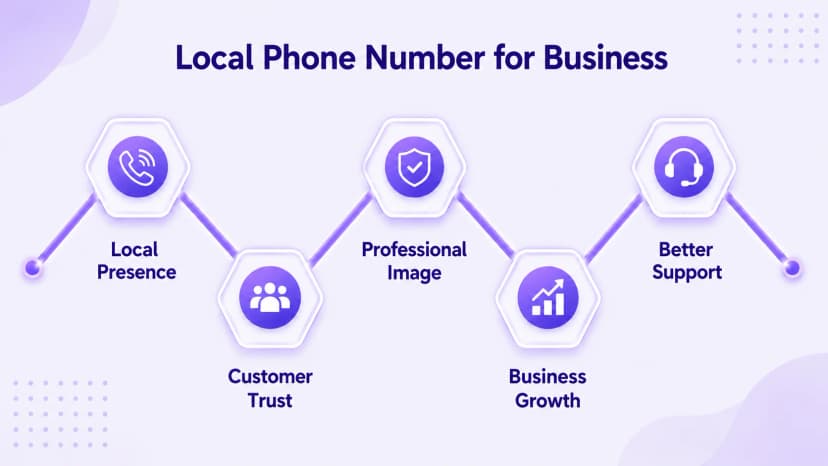
- Builds trust in a specific city, county, or region where you actually work
- Costs less to provision and keep than most toll free number plans with per-minute pricing
- Looks familiar on caller ID, which can improve outbound answer rates
- Matches the area code customers already use on their own phones and contacts
- Works well alongside a Google Business Profile and local directory listings
- Lets you add a new area code when you open in another city or state
- Suits service businesses that visit customers or serve one metro area or county
Toll-Free vs. Local Number: Side-by-Side Comparison
Put side by side, the two number types trade strengths. Toll-free wins on national reach, free calling for customers, and brand recall, while a local number wins on cost, community trust, and familiarity on caller ID. Neither is better in every situation, which is why the right answer depends on who your customers are and where they live. Seeing the trade-offs helps you avoid paying for unneeded reach.
The clearest way to compare them is to ask four questions. Where do your customers live, who pays for the call, how much volume do you expect, and what do you want the number to say about your business? Your answers usually point to one number type, or show that you need both. Write your answers down before you buy a number or sign a plan.
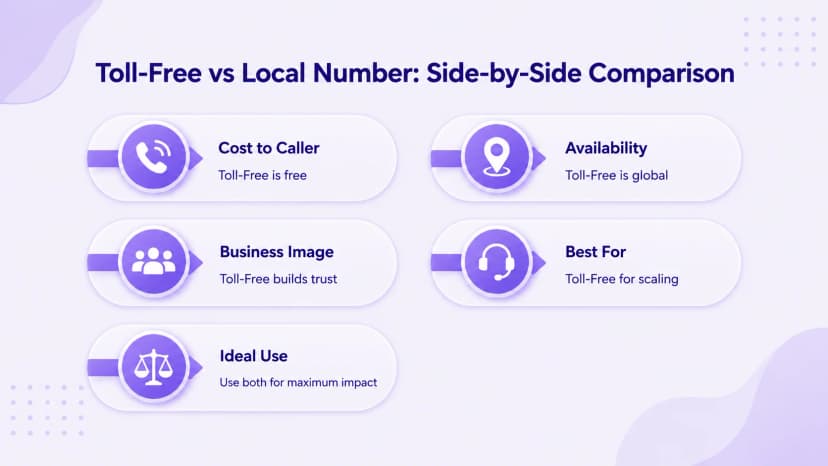
- Reach: a toll free number covers the whole country, while a local number covers one area code
- Caller cost: toll-free is free to dial, while local calls follow normal rates
- Business cost: toll-free usually adds per-minute charges, while local is often cheaper
- Trust: toll-free signals scale, while local signals a neighbor down the street or across town
- Memorability: toll-free supports vanity numbers, while local numbers rarely do
- Outbound calling: local numbers often earn more answers than toll-free ones
- Flexibility: both can forward to any phone or cloud system you choose, including mobile apps
Match the Number to Your Business Stage
The right answer changes as your business grows. Early on, a single local number usually covers everything, since it is cheap and builds trust with your first customers. There is rarely a reason to pay extra for national reach before you have national demand, since it adds cost without adding customers. Keep the first setup simple.
As you serve more cities, a toll free number for your main support line paired with local numbers for each market often works best. At national scale, toll-free usually becomes the primary line, with local numbers reserved for individual locations. Revisit the choice each time your customer map changes. Virtual phone numbers make each change easy, since you can add or retire a line without touching any phones.
- Startups and solo operators: begin with one local number and a simple, friendly greeting
- Growing local businesses: add a second local line or a toll free number for support
- Regional companies: use local numbers per market and one toll-free main line for support
- National brands: make toll-free the headline number and keep local lines for stores
- E-commerce and mail order: toll-free helps buyers who are far from your address
- Home services: local numbers help customers trust a nearby technician who will visit
- Review your number mix each year, or sooner, as your customer locations shift
The Hybrid Approach: Using Both Number Types
You do not have to choose only one. Many businesses use a toll free number for national support and sales, plus local numbers in the cities where they operate. Each number reaches the customer in the way that feels most natural to them, and the company gets the strengths of both without giving up either. It also gives customers a choice of how to reach you.
The setup is simple with virtual phone numbers, because every line can route into the same cloud phone system. Agents see one inbox instead of separate phones, and calls follow the same routing rules. Ringflow supports this kind of setup, letting a business run both lines side by side. When you show a local number on outbound calls, follow the FCC caller ID rules.
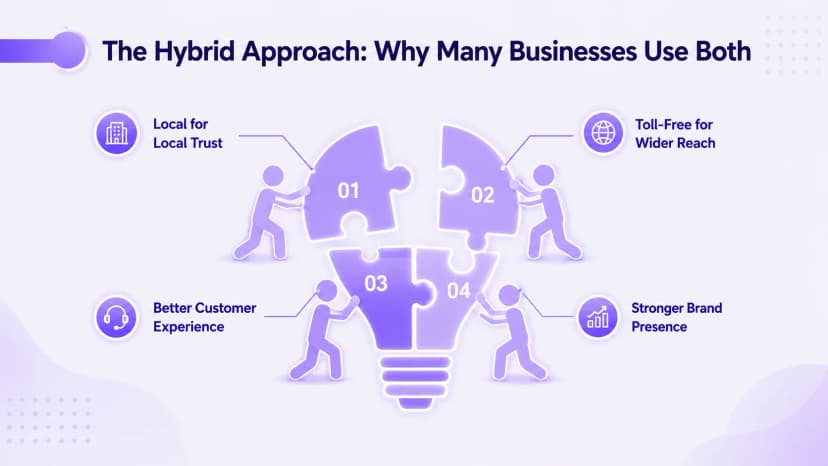
- Use a toll free number as the main line on your website, national ads, and printed materials
- Add local numbers for each city, and list them on that city's pages
- Route every number into one team inbox with shared call routing rules
- Track which number each caller used to see which channel works best for your budget
- Show a local number on outbound calls in each market to improve answer rates, using only numbers you own
- Forward after-hours calls from any number to voicemail or an AI receptionist
- Add or remove numbers as your markets change without changing your phones or your team's workflow
Conclusion
The toll-free versus local decision comes down to how your customers already think about your business. A toll free number suits national reach and memorable branding, while a local number builds trust and keeps costs low. For most growing companies the answer is not either-or but a sequence: start local, add toll-free as you expand, and keep both routed into one system. Either way, the goal is a number your customers trust on sight.
Treat the choice as something to revisit rather than a permanent commitment. Review your call data every few months, look at where callers come from, and adjust the number mix to match. Ringflow makes that easy, letting you test both number types on one platform before you commit to either. That evidence beats guessing, and it costs far less than switching numbers after a large print run.
Whichever number you land on, texts sent from it should actually arrive. If a customer says a message never showed up, our text message not delivered guide walks through the most common causes.
Ready when you are
Get the Right Number for Where You're Headed
See how Ringflow handles both number types on one platform, so your team never has to choose blind — free trial, no card required.
Frequently Asked Questions
A toll free number (800, 888, and similar) is free for callers and billed to the business, while a local number uses an area code and follows normal call rates.
Neither wins everywhere. Toll-free suits national reach and branding, and a local number suits community trust and lower cost.
Usually the business pays per-minute charges on inbound toll-free calls, so the total is often higher than a local line at the same call volume.
Yes. Many businesses route both into the same cloud phone system so every call reaches one team.
Many businesses find that local numbers earn more answers, because they look familiar on the recipient's caller ID.