
Introduction
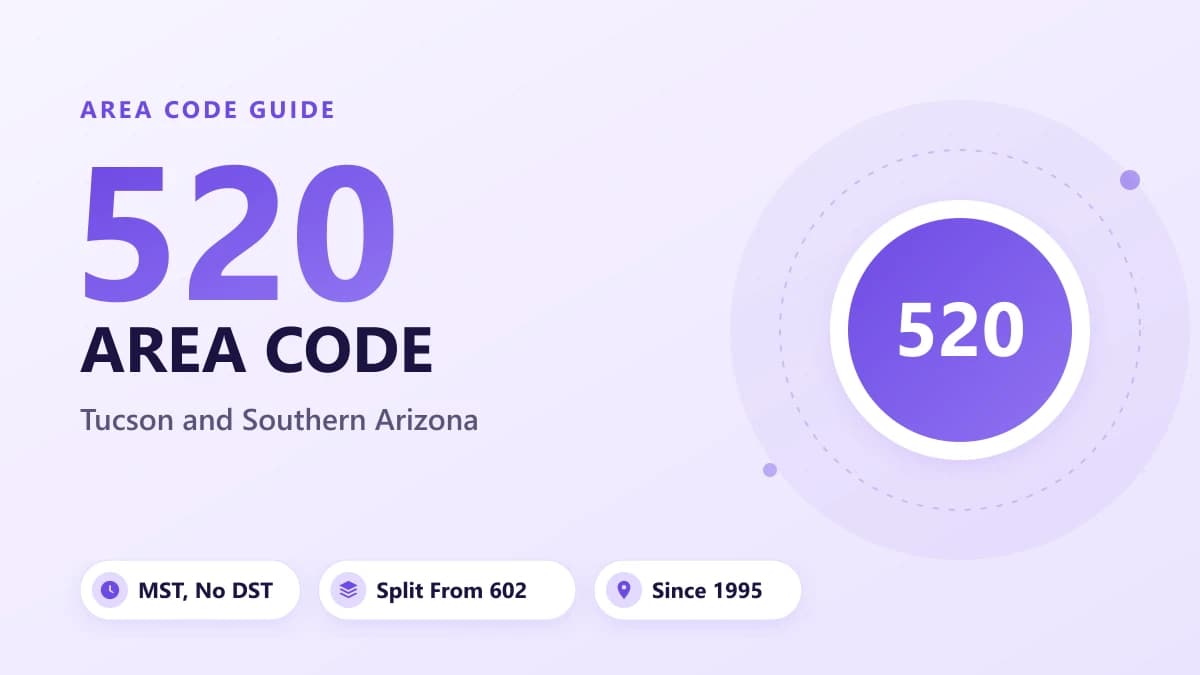
The 520 area code belongs to Tucson and the southeastern corner of Arizona. Its territory runs from Casa Grande and Florence south through Tucson to Nogales, Sierra Vista and Douglas, covering Pima, Pinal, Cochise and Santa Cruz counties. Unlike Phoenix, the region still has just this one code.
Most people look up 520 after a missed call from a number they don't know, or when a business wants a Tucson presence. Below you'll find the towns inside the code, the two splits that shaped it, why Arizona time confuses out-of-state callers, and how to dial and vet a 520 number.
- Area code 520 serves Tucson and southeastern Arizona, mainly Pima, Pinal, Cochise and Santa Cruz counties.
- It split from 602 in 1995, then handed the rest of its original territory to the new 928 code in 2001.
- The region stays on Mountain Standard Time all year because Arizona does not use daylight saving time.
- Ten digits have been required on local calls since October 2021. A new overlay code is expected once 520 runs short of numbers, projected for about 2030.
Where Is the 520 Area Code?
Area code 520 serves southern Arizona outside the Phoenix metro area, with Tucson as its anchor. Its map stretches from Casa Grande and Florence through Tucson, west to the Pima County line, then south and east through Nogales, Sierra Vista and Douglas to the edge of the state.
The Phoenix area to the north uses 480, 602 and 623. Most of the rest of Arizona, including Yuma and Graham counties, uses 928. That leaves 520 as the code for the state's southeast.
A 520 number shows where a line was first assigned, not where its owner is today. Someone who got a Tucson cell number years ago and moved to Texas still has a 520 number, so the caller's location can differ from the code's.
Cities and Counties in the 520 Area Code
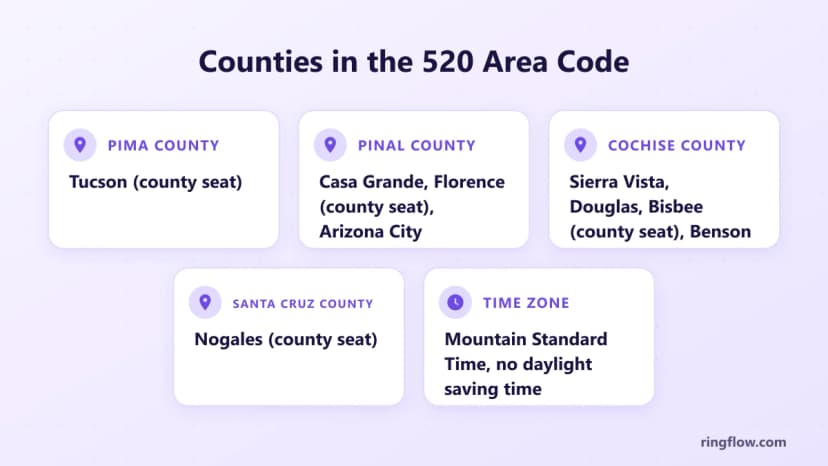
When the Arizona Corporation Commission split off 928 in 2001, it kept four counties in 520: Pima, Pinal, Cochise and Santa Cruz. A few small areas are exceptions, because telephone rate centers don't always follow county lines. Here is each county with towns found in 520 listings.
| County | Cities and towns | Notes |
|---|---|---|
| Pima | Tucson | County seat and the code's best-known city |
| Pinal | Casa Grande, Florence, Arizona City | Florence is the county seat |
| Cochise | Sierra Vista, Douglas, Bisbee, Benson | Bisbee is the county seat |
| Santa Cruz | Nogales | County seat |
If a town sits near a county edge, double-check its code, since a few rate centers cross county lines. Our Arizona area codes page shows how 520 fits with the state's four other codes.
520 Area Code Time Zone (Mountain Standard Time)
Tucson keeps Mountain Standard Time, UTC−7, in January and July alike. Arizona's legislature voted in 1968 to exempt the state from daylight saving time, and standard time has been the rule ever since.
What shifts is the gap between Tucson and everyone else. At noon in Tucson in winter, it is 2 p.m. in New York. After the East Coast moves its clocks forward in March, that same Tucson noon lines up with 3 p.m. in New York, a three-hour gap that lasts until November.
If you book meetings with Tucson, choose the Arizona or Phoenix time zone in your calendar rather than plain Mountain Time, which follows daylight saving time. The Navajo Nation in Arizona's northeast does change its clocks, but it lies well outside 520.
How 520 Split From 602, Then Gave Way to 928
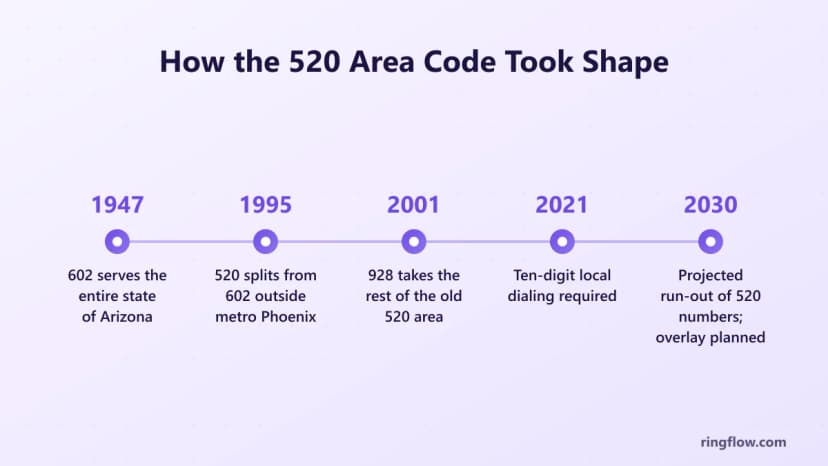
For almost five decades, 602 was Arizona's only area code. In 1995, 520 was split off for the state outside metropolitan Phoenix, so at first it stretched well beyond Tucson, to Flagstaff and Yuma.
That arrangement lasted about six years. Demand from cell phones, pagers and fax machines kept shrinking the supply of numbers, so the Arizona Corporation Commission split 520 again. On June 23, 2001, Cochise, Pima, Pinal and Santa Cruz counties kept 520, and the remainder of the old territory, including Yuma and Graham counties, moved to 928. Either code worked for the moved areas until January 5, 2002.
The next change is expected to be an overlay rather than a split. The Arizona Capitol Times reported in December 2025, citing the Corporation Commission's executive director, that 520 is projected to run out of numbers around 2030. A new code, not yet chosen, would then be added on top of 520. Current 520 customers would keep their numbers, and new lines would start receiving the new code.
Is 520 a Country Code? What That Search Really Means
No country dials 520 as its calling code. The digits mark an area inside the +1 zone the United States shares with Canada, so a Tucson number formatted for overseas callers begins +1 520.
The mix-up is understandable this close to the border, because Mexico's country code is +52. A Mexican number in international format starts +52 with no 1 in front. A number that begins +1 520 is in Arizona; one that begins +52 is in Mexico.
On a US phone, caller ID that starts with 520 is showing the Arizona area code. Our page on the +1 country code explains how US numbers look to callers abroad.
520 Area Code vs ZIP Codes
A search for a "520 zip code" usually means someone wants to turn a phone number into a place. The two systems don't connect: area codes come from the North American Numbering Plan, the Postal Service sets ZIP Codes for delivery routes, and neither map follows the other.
Since the 520 area covers four counties and many towns, no single ZIP Code matches it. For a mailing address in Tucson, Sierra Vista or Nogales, use the Postal Service's ZIP Code lookup.
How to Tell If a Call From 520 Is Legitimate
Nothing about the digits 520 makes a call risky or trustworthy. Caller ID can be spoofed, and the FTC notes that scammers sometimes display a number with the same area code as the person they're calling, a trick known as neighbor spoofing. A Tucson-looking number on a Tucson phone is exactly what that trick produces.
A Quick Check Before You Trust the Caller
- 1Let unknown numbers go to voicemail, then decide whether the message sounds real.
- 2Notice pressure. Threats of arrest, a closed account or a missed deadline are meant to stop you from thinking it through.
- 3Refuse unusual payment requests, such as gift cards, wire transfers or cryptocurrency.
- 4Never read back a verification code, or give a Social Security or bank account number to someone who called you.
- 5Call back through a number you find yourself, such as the one on your card, a bill or the organization's official website.
If you lost money or shared information, report it at ReportFraud.ftc.gov. Unwanted telemarketing calls can be reported at DoNotCall.gov. Stopping repeat calls takes a few taps: block the number in your phone's settings, look into your carrier's call-blocking options or install a blocking app. Landlines can use a plug-in call-blocking box.
How to Dial a 520 Phone Number
Southern Arizona gave up seven-digit dialing in 2021. Some local numbers in 520 began with 988, the short code the FCC chose for the National Suicide Prevention Lifeline, so the area code had to switch. Ten digits became mandatory for local calls after October 24, 2021.
- Local call inside 520: dial 520 plus the seven-digit number, with no 1 in front, for example 520-555-0137.
- Calling from outside southern Arizona, within the US or Canada: add 1 before 520 and the seven digits.
- International callers: start with the exit code used in their country, add 1 520, then the seven digits (+1 520 555 0137).
Because 520 has no overlay yet, the code on a number still tells you it came from southeastern Arizona. That will stop being true once a second code arrives. For how the ten digits are grouped, see our explainer on US phone number format.
How to Get a 520 Phone Number for Your Business
A 520 number tells callers in Tucson, Casa Grande or Sierra Vista that they're reaching someone local, and it doesn't require an office in Arizona. A cloud number works through apps, so a team in Phoenix or another state can answer it.
- 1Pick a provider and search the Arizona area codes it offers for a 520 number, then confirm availability before you commit.
- 2Send calls to your team's apps on phones and computers, or forward calls to a phone you already use.
- 3Enable business texting for appointment reminders and quick replies.
- 4Move an existing Tucson line over with number porting so your published number keeps working.
Ringflow provides local numbers in the area codes listed in its US directory, along with an auto attendant and a free trial. If you'd rather have one number for callers across Arizona and beyond, a toll-free line is another option.
Conclusion
Area code 520 is southern Arizona's code, covering Tucson, the four counties around it and towns as far south as Nogales and Douglas. It has kept Mountain Standard Time since 1968, needs ten digits for local calls, and is expected to get an overlay partner around 2030.
Treat an unexpected 520 call with ordinary caution, and verify before paying or sharing details. If you're building a presence in the Tucson market, Ringflow can help you check its Arizona area codes for a local number and add texting and call forwarding, and you can try it free.
Ready when you are
Serving Tucson Customers From Anywhere?
See which Arizona area codes Ringflow offers, check for a Tucson-area number and take calls in the mobile or desktop app. Try it free and move your current number over when you're ready.
FAQ
The 520 area code is in southeastern Arizona. It covers Tucson and most of Pima, Pinal, Cochise and Santa Cruz counties, including Casa Grande, Florence, Sierra Vista, Douglas, Bisbee and Nogales.
Tucson and the rest of 520 stay on Mountain Standard Time (UTC−7) in every season, because Arizona opted out of daylight saving time. That puts Tucson two hours behind New York in winter and three hours behind in summer.
No. The 520 code belongs to southern Arizona and sits under country code +1. Mexico's country code is +52, so a number beginning +1 520 is in Arizona and one beginning +52 is in Mexico.
Not yet. Area code 520 is the only code for its region today. In December 2025, the Arizona Capitol Times reported that 520 is projected to run out of numbers around 2030 and that a new overlay code will be added then, with existing 520 numbers unchanged.
Not necessarily. The area code only shows where a number was assigned, and scammers can spoof local-looking numbers. End the call if someone rushes you, wants gift cards or asks for a one-time code, then file a report at ReportFraud.ftc.gov.
Find a cloud phone provider with Arizona numbers, look for an open 520 number and pick where calls should go. Ringflow provides mobile and desktop apps, texting and number porting, and you can start on a free trial.