
Introduction
The 571 area code identifies phone numbers across Northern Virginia, the newer of two area codes now layered over the same stretch of the Washington, D.C. suburbs. It arrived once the original 703 code ran short of fresh numbers to hand out.
Ahead: the exact ground 571 reaches, the three regulatory moves that carved Northern Virginia's numbering map into its current shape, what fuels the region's growth, and the steps a business actually takes to put one of these numbers to work.
What Is the 571 Area Code?
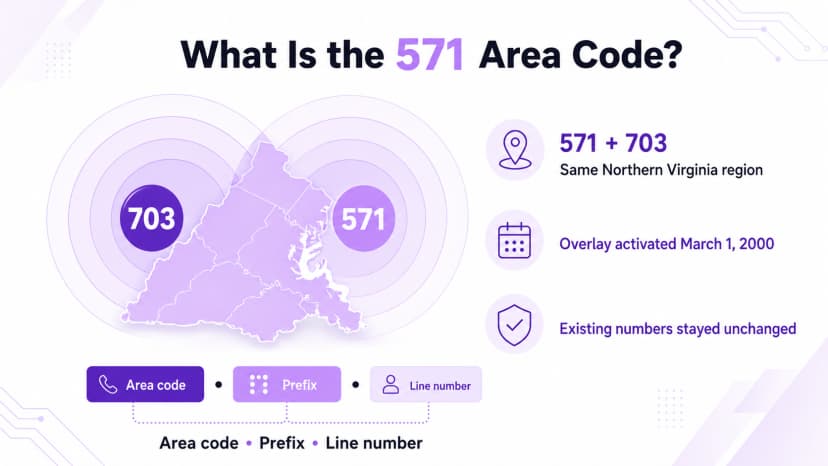
571 marks Northern Virginia within the North American Numbering Plan's structure. Regulators activated it March 1, 2000, layering it straight onto the existing 703 footprint instead of redrawing any lines on the map — a second set of prefixes for the same ground once the first ran short.
Permissive ten-digit dialing began June 1, 1999, giving residents and carriers time to adjust before the new code activated the following spring. Regulators chose an overlay specifically so nobody had to change an existing number just to free up room for new ones.
An overlay works because a phone number is really three separate blocks: the area code, a central-office prefix assigned to a specific carrier, and a four-digit line number. Stacking a second area code onto the same ground just opens a fresh set of prefixes to assign, without touching a single digit already in use on 703.
Where the 571 Area Code Covers
571 covers the same footprint as 703, every neighborhood already served by the older code, from the Potomac River waterfront to the edge of Loudoun County's data center corridor. There is no separate territory to map; both codes describe one region.
- Arlington — home to the Pentagon and Amazon's HQ2 campus in National Landing
- Alexandria — a historic riverfront city just south of Washington, D.C.
- Fairfax — anchoring a dense corridor of government contractors and tech offices
- Reston and Tysons — corporate campuses strung along the Dulles Toll Road
- Loudoun County — home to the largest concentration of data centers in the world
A quick glance at the area code will not tell you which business showed up first, either. Plenty of brand-new Northern Virginia startups carry 703 numbers just because that block happened to be open when they signed up, while firms that have operated here for twenty years sometimes ended up on 571 for the exact same reason.
The whole footprint sits inside the wider Washington, D.C. metro area, with Washington Dulles International Airport anchoring the western edge and the Metro's Silver Line now running straight through Reston and Tysons into the district itself, tying the region's commuting patterns as tightly together as its phone numbers.
History of the 571 Area Code
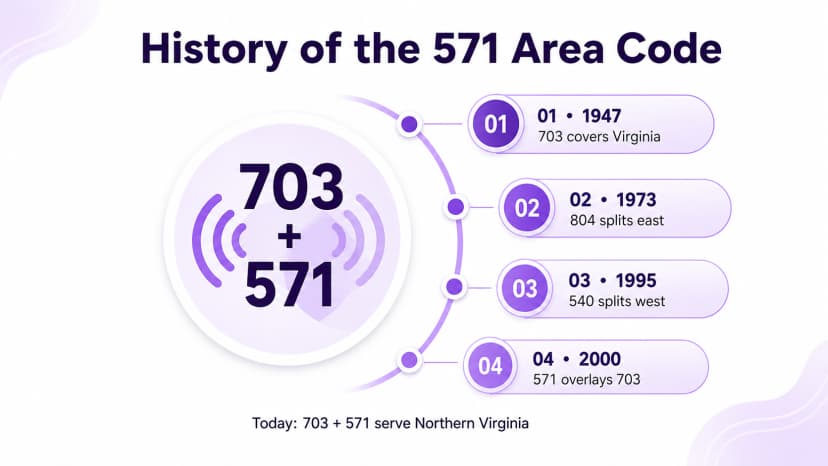
703 goes all the way back to October 1947. Eighty-six area codes launched across North America that year, and 703 was one of them, drawn wide enough at the time to cover the entire Commonwealth of Virginia on its own.
Covering an entire state with one code proved short-lived. Between the postwar population boom and the federal government's own growth just across the Potomac, Virginia's regulators ended up redrawing Northern Virginia's numbering map twice more before the region settled into today's two-code arrangement.
- 1973 — On June 24, regulators split the state in two: the eastern half became area code 804, while 703 held onto the northern and western regions.
- 1995 — A second split on June 19 carved area code 540 off the western portion of 703, confining it to just Northern Virginia for the first time.
- 2000 — 571 activates March 1 as an overlay, after Virginia's State Corporation Commission approved it rather than drawing a third boundary.
- Today — Area code 804 anchors Richmond and eastern Virginia, and 540 covers the Shenandoah Valley, both direct descendants of the single footprint 703 drew in 1947.
Northern Virginia's Economy
Northern Virginia anchors one of the wealthiest, fastest-growing corners of the country, propelled less by any single employer than by two forces layered on top of each other: the federal government just across the Potomac, and a technology sector that keeps expanding around it.
Loudoun County's so-called Data Center Alley makes the case clearest. It is the largest concentration of data centers anywhere in the world, routing an estimated 70 percent of global internet traffic through more than 200 facilities, and a state-commissioned study credits the industry with roughly 74,000 jobs and 9.1 billion dollars in GDP for Virginia every year.
- Amazon's HQ2 campus at Metropolitan Park opened in 2023 barely a mile from the Pentagon, and the surrounding National Landing neighborhood has become a magnet for the same contractors and consultancies that have anchored the region for decades.
- Fairfax County alone pulls in more federal procurement spending than any other county in the country, home to more than 50 aerospace and defense companies and a sector-specific workforce approaching 200,000 people.
- Recent arrivals keep reinforcing that base — German defense contractor Rheinmetall relocated two U.S. subsidiary headquarters into Fairfax County, and defense-tech startup GRVTY chose Tysons for a new headquarters bringing roughly 200 additional high-tech jobs.
- Mid-career engineers working in data center operations around Fairfax now average total compensation above 150,000 dollars a year, a reflection of how tight the regional talent market has become.
- Virginia Tech opened the first academic building of its 1.1 billion dollar Innovation Campus in Alexandria's Potomac Yard in January 2025, and George Mason University is set to fully open its own tech-focused building in Arlington in August 2026.
Why Businesses Choose a 571 Number
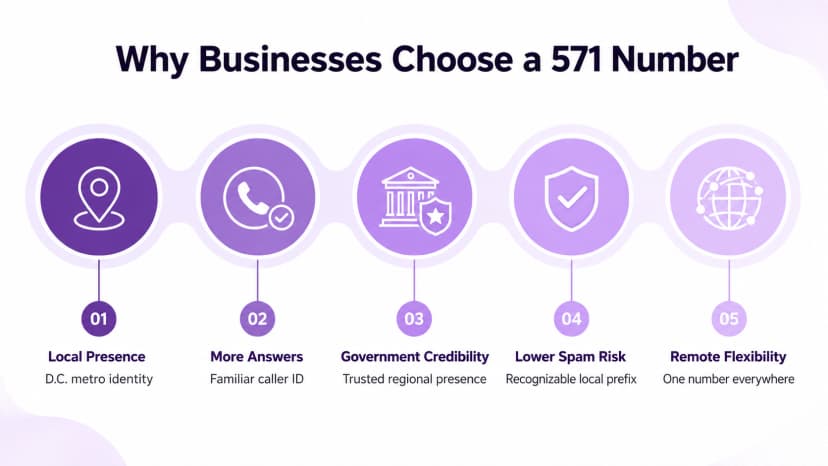
A 571 number signals that a business has real ground in the D.C. metro area, not calls routed in from somewhere else, and in a region this dense with federal agencies and contractors, that distinction can decide whether a first-time caller even answers.
Sales and support teams calling into the region get a similar lift from local presence dialing, a feature a platform like Ringflow puts on outbound calls automatically, matching them to a 571 or 703 prefix. A caller ID that already looks like a neighbor gets answered far more often than one flagged as out of state.
- Companies chasing government contracts or partnerships with the defense and technology firms clustered here get an edge — a recognizable Northern Virginia number reads as a baseline credibility check before a conversation even starts.
- A number that already carries a 571 or 703 prefix is less likely to get flagged as suspicious by spam-detection apps than one with an unfamiliar area code.
- It also travels well — a team scattered across home offices, co-working spaces, or a different state entirely can still answer, transfer, and dial back out on a 571 number exactly as if everyone sat inside the same Tysons office park.
How to Get a 571 Area Code Number
Nobody needs to set foot in Virginia to claim a 571 number — a cloud provider like Ringflow walks through the whole thing on a browser, start to finish. The general shape of it looks like this:
- 1Look for a provider that can confirm real 571 stock up front, not just a nationwide search box that may or may not return one.
- 2Scroll through the options and pick something a client will actually remember, not just the first sequence on the list.
- 3Fill in the account details the signup form actually asks for — a company name, a working email, and a card on file is generally the whole list.
- 4Route it into whatever will actually answer — a desk phone, a team queue, an auto-attendant — and dial it once from an outside line to confirm it rings before it goes on a business card.
Pricing usually comes down to the plan wrapped around the number rather than the number itself. Ringflow, for instance, folds call routing, voicemail transcription, and a basic auto-attendant into its standard plans, so those features rarely show up as separate line items on the bill.
None of this requires giving up a number already in use, either. Phone number porting carries an existing 703 or 571 line over to a new provider, and every customer who has that number saved keeps dialing it exactly as before.
571 Dialing Rules and Frequent Mix-Ups
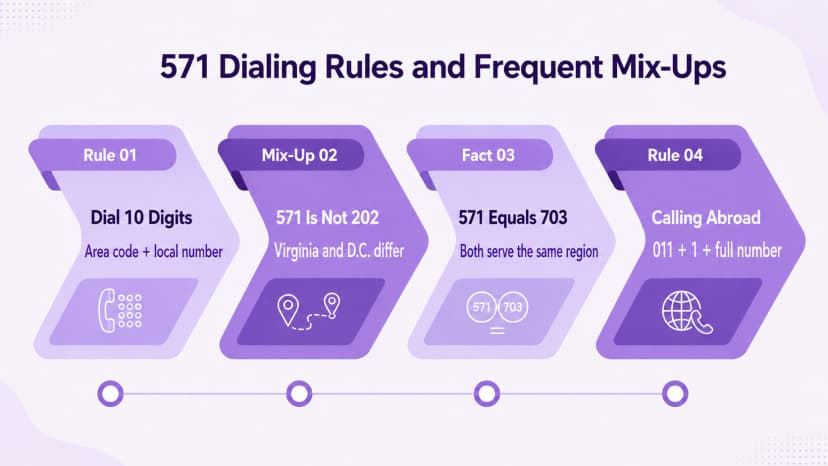
A dropped digit is the single biggest headache the overlay creates: dial only seven and the call simply will not connect, whether it is crossing Arlington or moving between two desks in the same suite. The FCC's own ten-digit dialing guide covers exactly why overlay regions like this one require the full number every time.
A cloud phone system usually papers over the rule entirely, padding out whatever a caller enters into a full ten-digit dial before the call ever leaves the building. Where it actually bites is older printed materials, business cards, or spreadsheet-stored contact lists that only ever recorded seven digits.
- A less obvious mix-up is confusing 571 with 202, the code across the river for Washington, D.C. proper — they sit right next to each other on a map but belong to entirely separate numbering areas.
- People also tend to read too much into which of the two codes a business carries, treating 703 as the senior option and 571 as somehow the upstart, when the digits only mark the order numbers got handed out.
- International calls stack a country code on top of the usual ten digits — 011, then 1 for the United States, then the full 571 or 703 number — a step that trips up callers dialing in from outside the country far more often than a local resident.
Conclusion
Three regulatory redraws since 1947 have brought Northern Virginia to where it stands today: a single region running two area codes at once because a fast-growing corner of the country kept outpacing whatever numbering plan was drawn for it.
Federal agencies, Data Center Alley, and an expanding Amazon presence in Arlington all draw the same conclusion for a phone number here — it needs to look like it actually belongs to the neighborhood. Ringflow can have a real 571 line running in minutes, whether that means porting an old number over or activating a brand-new one.
Ready when you are
Put a Northern Virginia Number on Your Business Card
Build instant Northern Virginia credibility with a 571 number from Ringflow. Set up in minutes — free trial, no card required.
FAQ
The 571 area code covers Northern Virginia. It has been an overlay on the 703 area code since March 1, 2000, sharing the exact same territory rather than a separate region of its own.
571 covers all of Northern Virginia, the same footprint already served by 703, including Arlington, Alexandria, Fairfax, Reston, and Tysons.
571 and 703 cover the identical territory. 703 dates back to 1947 and once covered all of Virginia before later splits, and 571 was added in 2000 once the Northern Virginia portion of 703 started running low on numbers.
Find a cloud phone provider that can confirm real 571 stock, choose from what is on offer, and finish the signup online. There is no need for a Virginia mailing address, and the line is usually live within hours.
Yes. With 571 and 703 layered over the same Northern Virginia ground, the full area code plus seven-digit number is required on every local call, even between two lines in the same office.