
Introduction
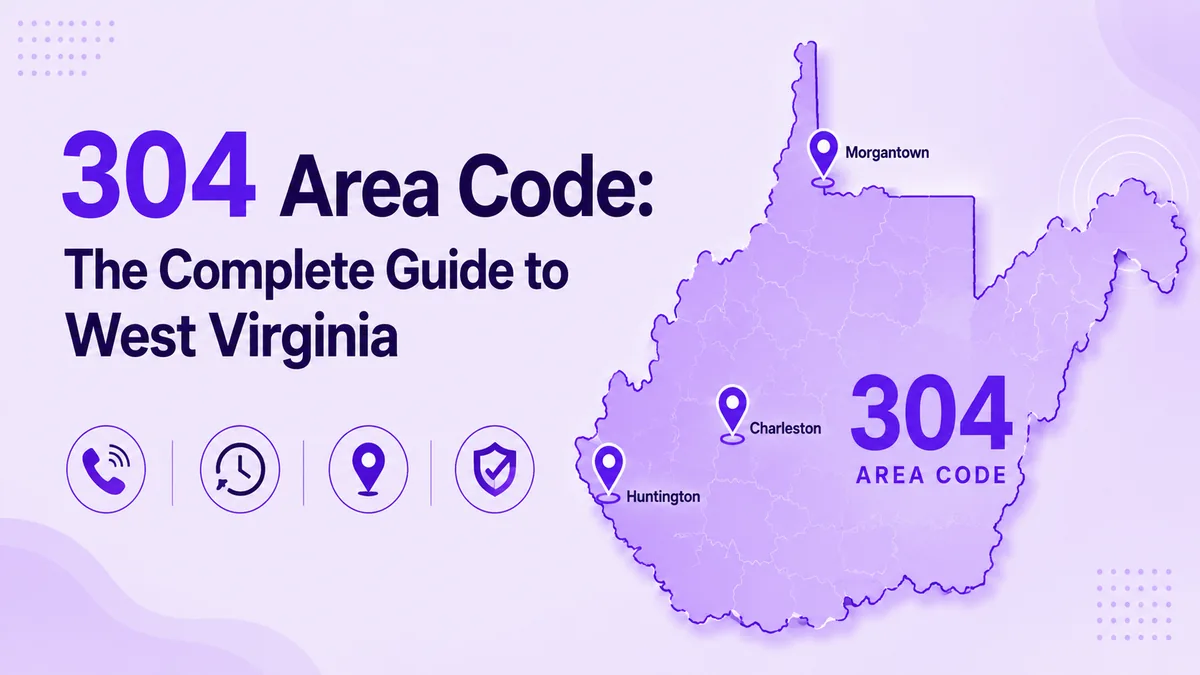
304 covers the entirety of West Virginia — one of only a handful of codes in the country that once served a whole state solo. An unfamiliar call or text from it raises the usual three questions: where it's actually from, how dialing works, and whether it's safe.
Covered here: the full statewide reach, the 681 overlay that changed dialing rules for everyone, and how a business serving West Virginia can claim a local number of its own — everything needed to dial a 304 number, answer one, or set one up with no second-guessing.
- This area code has covered the entire state of West Virginia since 1947, unlike most states with several regional codes.
- A 2009 overlay added area code 681 statewide, so every call now needs all 10 digits.
- A call from this area code isn't automatically a scam, but caller ID spoofing makes any area code fair game for fraud.
- Businesses serving West Virginia can get a local number in minutes without opening a physical office there.
What Is the 304 Area Code?
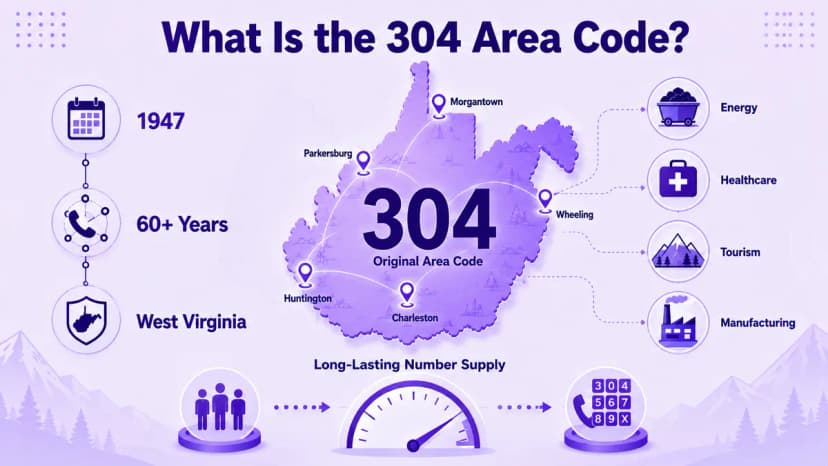
304 traces back to the North American Numbering Plan's 1947 launch, part of the original 86-code rollout. Where most states split into multiple codes almost immediately as demand grew, West Virginia's single code held every city and county in the state solo for more than six decades — a run that ties it to state identity itself rather than to any one city.
Search results for "304 area code west virginia" mostly name the statewide coverage and skip past how the later overlay actually functions — worth untangling here, whether it's written "304 area code" or reversed to "area code 304."
West Virginia's economy has long centered on coal and energy production, though healthcare, tourism, and manufacturing have grown into major employers over the past two decades.
Why One Code Covered an Entire State for So Long
Most states needed new area codes decades ago as population and phone lines grew, especially with fax machines and modems adding extra demand in the 1990s. West Virginia's smaller population meant its original area code had enough capacity to last far longer than codes in more populous states.
Where Is This Area Code Located?
Charleston anchors the state as its capital, but this area code covers every corner of West Virginia equally.
Cities and Communities Covered
- Charleston, the state capital and largest city
- Huntington, a major hub in the state's western region
- Morgantown, home to West Virginia University
- Parkersburg, an industrial city along the Ohio River
- Beckley, a key city in the southern coalfields
Together, these cities represent every major region of the state, from the eastern panhandle to the western river valleys. Kanawha County, home to Charleston, issues more numbers than any other county in the state.
Every carrier's own lookup tool confirms the same statewide map, Martinsburg and Wheeling included among the smaller communities that fall inside it.
The 304/681 Overlay: A Statewide First
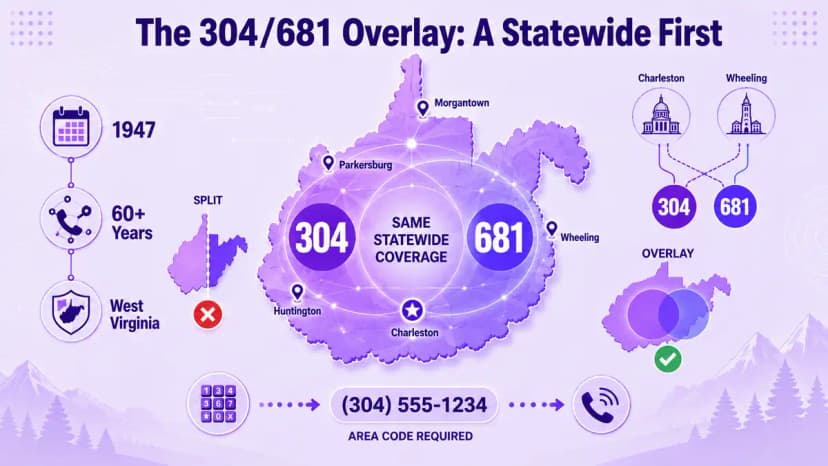
Regulators added area code 681 as an overlay in 2009, once the original numbering supply started running low statewide. Unlike a typical split, which divides a state into separate regions, this overlay covers the exact same statewide footprint as the original code.
That distinction is the exact detail most guides skip entirely: a caller in Charleston and a caller in Wheeling could each be assigned either code, since both now share identical coverage. No geographic line separates the two area codes anywhere in the state.
Since the overlay took effect, every call statewide needs all ten digits, area code included, even between two neighbors on the same street. A 7-digit dial simply fails to connect anymore, no matter how local the call actually is.
West Virginia is one of a small number of states where an entire overlay applies statewide instead of to just one metro area, which is worth knowing if your business operates in multiple parts of the state.
How to Get a 304 Area Code Phone Number
A West Virginia number, whether for an in-state resident or a business building a presence there remotely, is a few minutes of setup once the right provider's picked.
- 1Pick a provider stocking West Virginia numbers that's actually built for business, not just personal lines.
- 2Filter what's available by city or prefix.
- 3Claim a number and assign it to a team member, device, or call flow.
- 4Set voicemail, forwarding, and hours before it goes live.
- 5Keeping an old number instead? Porting transfers it without starting from zero.
Ringflow surfaces open prefixes before anything's locked in, making it simple to land on a number tied to a specific West Virginia city when that detail matters to customers.
A provider's search returns the full 304 inventory instantly, so narrowing down to something tied to Charleston, Huntington, or Morgantown specifically takes seconds, not digging.
A quick round of test calls through a softphone app on a laptop catches any routing or voicemail issues well before a real customer ever dials in.
Is This Area Code Associated With Scams?
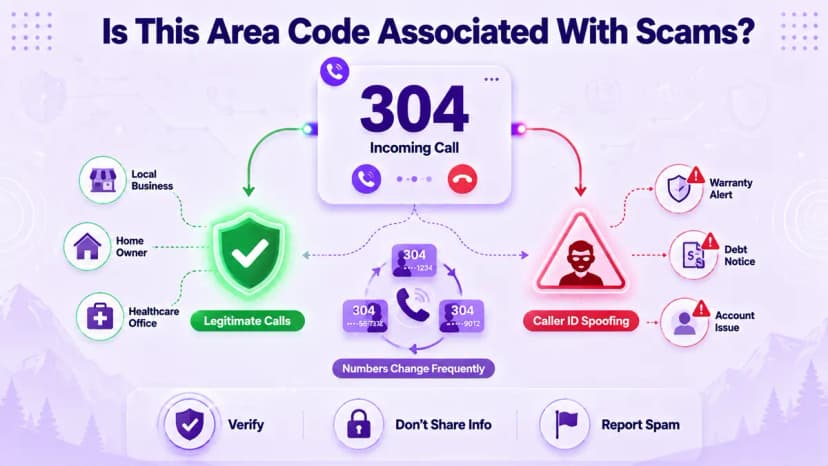
304 doesn't carry any built-in risk just for being recognizable — the overwhelming majority of calls and texts on it come from genuine West Virginia residents, local businesses, or companies with a real footprint there.
The actual threat is spoofing, and it works on any prefix, 304 included: scammers fake the local look, then push urgency to get an answer — a warranty about to lapse, a debt suddenly overdue, an account that "needs verifying" this instant.
Robocall complaints tied to spoofed local numbers have trended upward nationally for years, and West Virginia's regulators log complaints for the state the same way everyone else does. A Charleston or Huntington number on caller ID confirms nothing reliable about who's actually calling.
Blocking one spoofed number rarely helps for long, since scammers just move to the next once the old one's flagged. Reporting to a carrier does more lasting good — that's the data carriers use to train spam filters against the next round.
The safe default holds regardless of area code: never share personal information mid-call, hang up on any unsolicited payment request, and verify independently before acting on anything that feels urgent.
Should Your Business Get a Local Number?
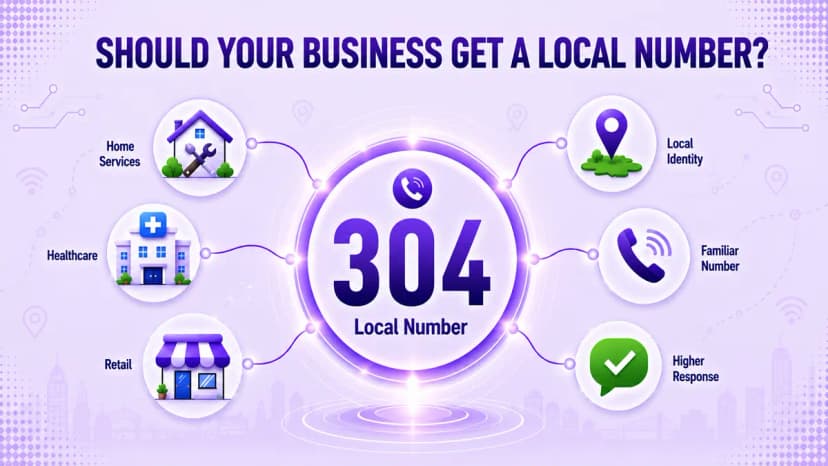
To a West Virginia customer, a local number makes a specific promise: this business understands the state and doesn't cost a long-distance call to reach. That promise lands harder here than in most places, since one code covering an entire state has become genuine local identity for residents.
Home services, healthcare, and retail see the biggest lift from it, since those customers tend to want someone who feels genuinely local before they'll book anything. The team behind the number doesn't need to actually sit in West Virginia — a remote staff answers the same local-looking line just fine, since the presence lives entirely in what shows up on caller ID.
A search for 304-prefixed businesses turns up plenty of established local names, and that's exactly the borrowed credibility a new number picks up by matching the prefix — a statewide shipping retailer benefits from it just as much as a single-location shop does.
Ringflow activates a West Virginia number without requiring an actual in-state office, routing calls to wherever the team is really working — useful for testing the market before committing to anything permanent.
Add local presence dialing to outbound calls on top of that, and a West Virginia customer sees a familiar area code calling back instead of an out-of-state number they'd otherwise let go to voicemail.
Conclusion
304 has answered for all of West Virginia since 1947, and it now shares that statewide footprint with the newer 681 overlay — every call needs the full ten digits as a result, a detail that still trips up longtime residents. The area code doesn't add any risk on top of that; spoofing does all the actual damage, regardless of which digits it's wearing.
Choosing a provider actually built for business over a bare consumer plan makes the rest easy. Ringflow can have a West Virginia number routing calls within minutes, with the tools a growing team needs from the start.
Ready when you are
Tired of West Virginia Customers Ignoring Out-of-State Calls?
See how Ringflow gets your West Virginia number active in minutes, with call routing built in from day one. Get a free trial with Ringflow.
Frequently Asked Questions
It's West Virginia's original 1947 area code, covering the entire state on its own for decades. It now shares that same statewide footprint with the newer 681 overlay, added in 2009.
It covers the entire state of West Virginia, including Charleston, Huntington, Morgantown, and Parkersburg. No other state shares this coverage area, since the code was built around West Virginia's exact borders. All of West Virginia runs on Eastern Time, so scheduling calls is simple wherever you are reaching in the state.
The overlay took effect in 2009, once the original numbering supply started running low. Ten-digit dialing became mandatory for every call statewide once the transition period ended.
Choose a business phone provider that offers West Virginia numbers, then search and select an available one. Most providers activate the number within minutes and let you set up forwarding right away. A business anywhere can activate a local number in this area code and route its calls to any location, which builds a West Virginia presence without a local office. Most business phone plans include a local number at no extra charge beyond the monthly subscription.
Yes, answering is safe, since simply picking up a call can't compromise your information on its own. Stay cautious about sharing details or making payments if the caller pressures you urgently.