
Introduction
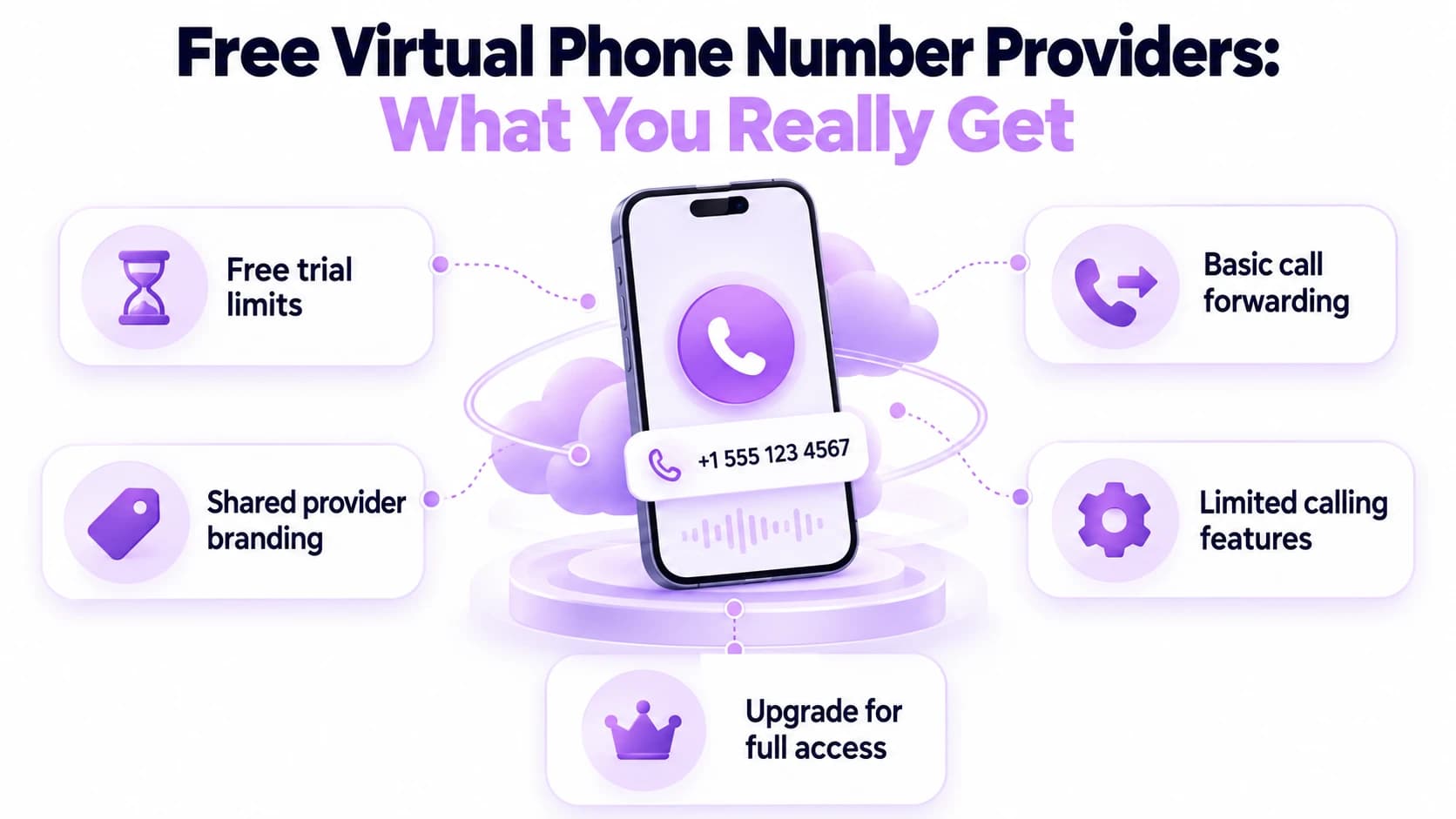
Searching for free virtual phone number providers turns up a long list of apps, websites, and trials, and they are not all the same thing. Some give you a number you can keep using at no cost, some give you a number for a few days, and some simply let you test a paid plan. Knowing which is which keeps you from building on a number that disappears.
This guide from Ringflow explains the difference between free and trial numbers, shows how to compare providers, and describes what to expect from a free personal plan such as Google Voice. You will also see what business trials offer, which limits catch people out, and how to choose. Each section stands alone, so jump to the part you need.
Free vs Free Trial: What the Label Means
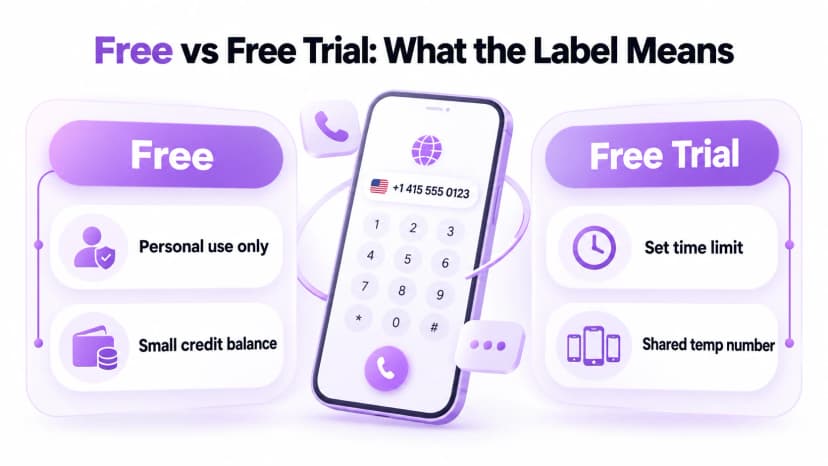
A free virtual phone number is one you can keep without paying, usually in return for ads, limited features, or personal-use rules. A free trial is a paid plan with a time limit, after which the virtual phone number is released or billed. Both are called free, yet they suit very different jobs. Read the signup terms before you hand the new virtual phone number to friends or customers, because changing it later is a hassle.
If you mainly want to make calls, our guide to free online calls explains how calling that is not tied to a SIM card works over the internet. That background helps here, because the same technology sits behind every provider, free or paid. The real difference lies in who pays for the calls, how long the number lasts, and what you are allowed to do with it, so ask before you rely on it.
- Free plan: no charge, but often limited to personal use, with ads or fair-use caps.
- Free trial: full features for a set period, then a paid plan or the number is released.
- Free credit: a small balance that runs out, after which calls and texts stop.
- Shared verification number: a temporary virtual phone number that other people may be using too.
- Ask first: who owns the number, and what happens when the free period ends?
- Read the fine print: free offers often carry usage limits that appear only in the terms.
How to Compare Free Virtual Phone Number Providers
Compare free providers on a few plain points before you sign up. Check the countries and area codes on offer, whether texting and calling both work, and whether you can choose your own virtual phone number or must accept one that is assigned. Then look at how long the virtual phone number stays active when you do not use it, since some free numbers are reclaimed after a period of silence.
Free apps supported by ads or paid upgrades, as covered in our guide to TextNow, show how this trade works in practice. You get a usable number, and the provider earns from advertising or from people who upgrade. That is a fair deal, but features and terms can change, so recheck the plan every few months if you rely on it for important calls.
- Coverage: check the countries and area codes before you register.
- Features: confirm that both calls and texts are included.
- Choice: see whether you can pick the virtual phone number or are assigned one.
- Inactivity: ask how long an unused number stays yours.
- Terms: check whether business use is allowed on the free plan.
- Ads: expect some advertising, and see whether a paid upgrade removes it.
- Support: find out where to get help if the number stops working.
- Security: look for two-step sign-in so nobody else can take over your number.
Google Voice as a Free Personal Number
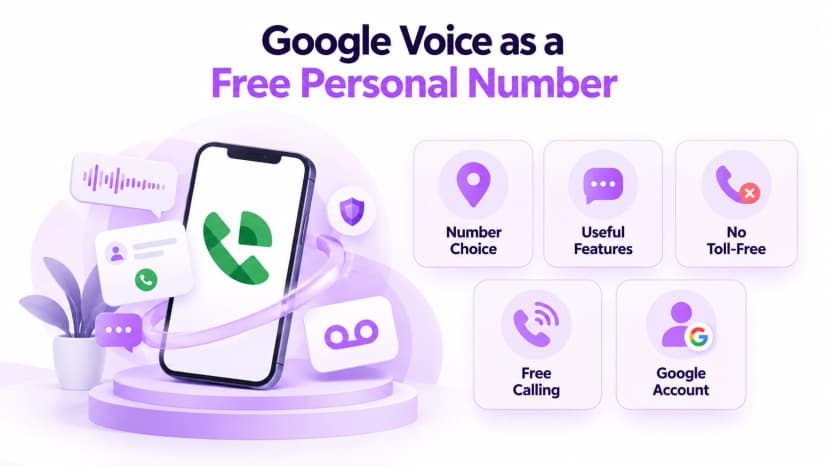
Google Voice is the best-known free personal option in the United States. Its official page describes a basic plan at no cost, and a Google Account is all you need to start. Once you are signed in, you can search for a virtual phone number by city or area code and select one that suits you. Calls, texts, and voicemail then run through the web and mobile apps.
The Google Voice setup guide lists the steps and the limits. Google Voice does not offer 1-800 numbers, and almost all calls from the US to the US and Canada are free, though a few specific numbers cost 1 cent per minute. Calls to other countries are charged at listed rates, so check them before you dial abroad.
- Number choice: US users can choose their own virtual phone number by city or area code.
- Features: voicemail transcripts, spam protection, call screening, and blocking.
- No toll-free: Google Voice does not offer 1-800 numbers.
- Calling: almost all calls from the US to the US and Canada are free.
- Account: signing up requires a Google Account.
- Plans change: confirm current details on the official page before you rely on it.
- Spam tools: Google describes spam call blocking and call screening for users.
Free Trials for Business Phone Numbers
Business phone providers rarely give numbers away forever, but many let you test a plan first. A trial usually gives you a real local or toll-free virtual phone number, mobile and desktop apps, and tools such as call routing, voicemail, and texting. It is the closer match when the number will appear on invoices, ads, or a business listing, because you are testing the real service.
Treat a trial as a rehearsal. Place test calls from outside your office, check that voicemail arrives, and try the apps on the phones your team actually uses. Ringflow offers a free trial with local and toll-free numbers, so you can run that test before you port the number you already use. Confirm the end date and what happens to the number afterwards.
- Real number: a trial usually gives you a working local or toll-free line.
- Full tools: routing, voicemail, and texting are often included.
- End date: note when the trial stops and how billing starts.
- Porting: ask whether you can move an existing number in during the trial.
- Cancel cleanly: check how to leave without being charged.
- Costs after: compare the monthly price once the trial period ends.
- Team test: have two or three colleagues try the apps.
- Voicemail check: leave a test message and confirm it reaches the right inbox.
Limits of Free Numbers: Verification, Recycling, Porting
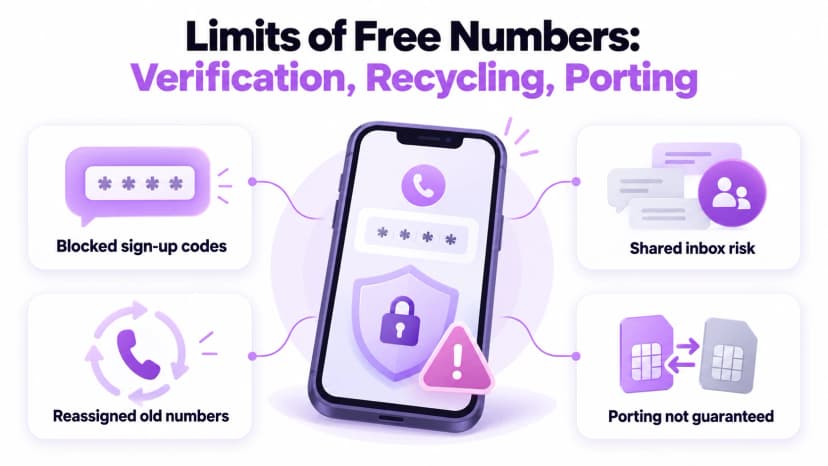
Free numbers come with limits that matter more than the price. Some websites and apps that send one-time codes block numbers that belong to virtual or shared services, so a free virtual phone number may fail when you try to register an account. A number shared among many people can also receive messages meant for someone else, which is a privacy risk for anything important.
Recycling is the second limit. A number you stop using can be released and later given to someone else, and the next owner may receive your old texts and reset links. Porting is the third, because a free number may not be portable at all. Before you attach a number to a bank, a work account, or your customers, ask whether you can take it with you.
- Verification: some services refuse virtual numbers for sign-up codes.
- Shared numbers: other people may see messages sent to the same number.
- Recycling: an unused number may be released and reassigned.
- Portability: check whether a free number can move to another provider.
- Account recovery: avoid free numbers for banking and your main email.
- Business use: do not print a free number on cards or listings.
- Privacy: never share personal details by text on a number others can see.
How to Choose the Right Provider
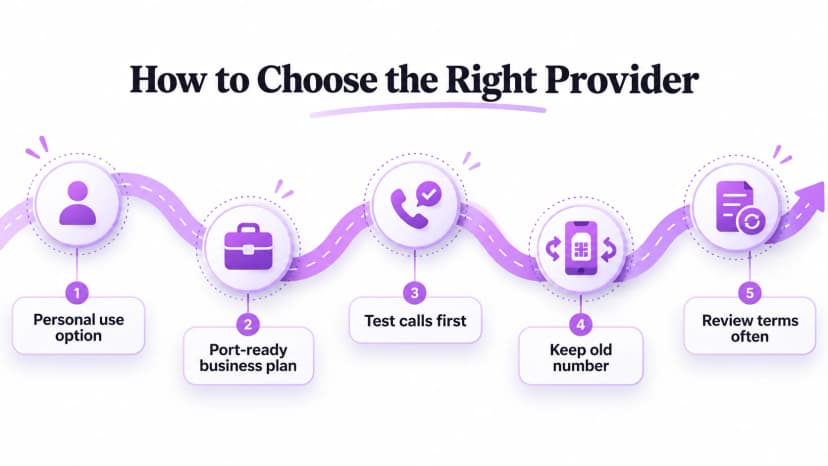
Start with the job. If you want a second line for friends, deliveries, or marketplace listings, a free personal plan may be enough. If you want a virtual phone number customers will call for years, choose a paid plan or a trial that leads to one. The cost of changing a published number later usually outweighs the monthly fee.
Write down what you need, such as texting, a particular area code, team access, or portability, then test two providers against that list. Keep the first month low risk by using the number only for tasks you can move. If it works, keep it. If it does not, you have lost nothing important and can try another provider without much disruption.
- Personal use: a free plan suits low-stakes calls and texts.
- Business use: pick a plan you can port out of.
- Test first: place calls and send texts before you publish the number.
- Keep a backup: hold your old number until the new one proves reliable.
- Review: recheck plan terms every few months, since offers change.
- Budget: decide what you would pay monthly if the free option disappeared, and plan for it.
- Exit plan: know how you would move your contacts to a new number, and tell them early.
Conclusion
Free virtual phone number providers fall into two groups: free personal plans with limits, and business trials that lead to a paid service. Match the group to the job, check the terms, and keep an eye on verification, recycling, and porting, because each one can quietly ruin a plan. Those three questions prevent most of the problems people run into with free numbers, and they take only a few minutes to check.
If the number is for customers, test a real service before you publish it. Ringflow's free trial includes local and toll-free numbers, mobile and desktop apps, and texting, and it lets you try routing and voicemail before you decide, which makes the choice easier. Write down your needs, compare two options, and choose the one you can keep for the long term.
Ready when you are
Try a Business Number Before You Commit
Start a free trial of Ringflow with a local or toll-free number, business texting and apps for mobile and desktop, and port your existing number when you're ready.
Frequently Asked Questions
Some are, with limits; trials end in billing or number release.
Check the terms; a business trial is usually safer because you can port a number in.
Some do, so sign-up codes may fail.
It has a basic plan at no cost.
Yes, an unused number may be reassigned.