
Introduction
A missed call from a number you don't recognize raises two questions: who was it, and should you call back? Looking up the number answers the first more often than you might expect, and a few free checks help with the second.
This guide covers what a reverse lookup can tell you, free checks, caller ID names, paid people-search sites, scam warning signs, why a number can't reveal a location, and how to block and report calls.
- Start free: search the number, check the area code, read the caller ID name and any spam label, and let voicemail answer.
- STIR/SHAKEN call authentication can help flag a spoofed number, but it cannot tell you who is calling.
- People-search sites resell data-broker and public-record information that may be wrong, and the FCRA governs reports used for housing, job, credit or insurance decisions.
- A phone number alone does not reveal a live location. Seeing someone's location takes their consent or legal process.
What a Reverse Phone Lookup Can and Cannot Tell You
A reverse phone lookup runs a directory backward: you start with the number and search for who is behind it. US phone companies printed reverse directories for decades and distributed them to law enforcement and public libraries, and by the early 2000s ad-supported versions were online.
Trying to find somebody by phone number works best when that somebody is a business, since companies publish their numbers. Landline customers can pay to keep a number unlisted, which leaves it out of public directories, or unpublished, which also withholds it from 411. Mobile numbers are hardest: there is no central database of cell phone numbers, so sites claiming to be free tend to return partial or inaccurate details.
| What you want to know | Can a lookup tell you? |
|---|---|
| State or region the number was assigned to | Usually, from the area code |
| Name of a business that called | Often, through a web search or caller ID |
| Name behind a private mobile number | Not reliably |
| Whether the caller ID was faked | Not on its own |
| Where the phone is right now | No |
Even a match has limits. An area code shows where a number was assigned, not where a mobile caller is now, and the FTC warns that scammers spoof caller ID, sometimes copying your own area code.
How Do You Look Up a Phone Number for Free?
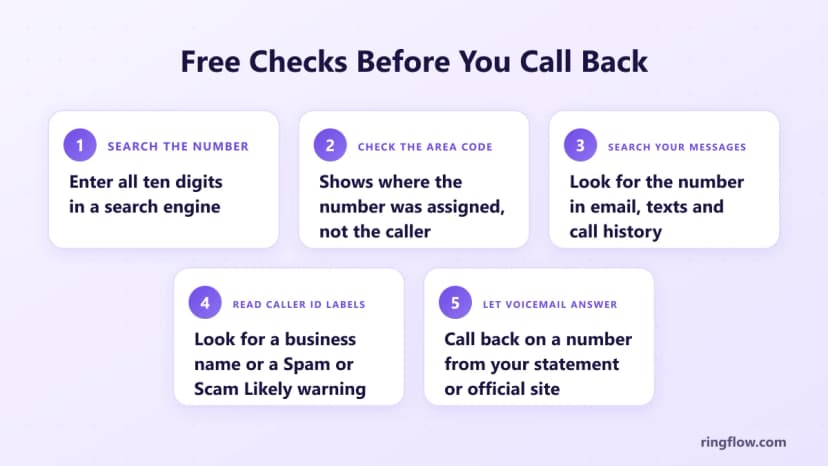
The best way to look up phone numbers is to start with checks that cost nothing and never ask for a card number. Stop as soon as you know enough to decide what to do.
- 1Search the full number. Enter all ten digits in a search engine, with and without dashes. Businesses often appear right away.
- 2Check the area code. Our area code directory shows which state it belongs to, and our guide to the US phone number format explains the other digits.
- 3Search your own records. Check email, texts and call history; a pharmacy or contractor you contacted may be calling back.
- 4Read the caller ID. A business name, or a label such as "Spam" or "Scam Likely," tells you a lot before you pick up.
- 5Let voicemail screen the call. Real callers can leave a message. If one claims to be your bank or an agency, call back on the number from your statement or the official website.
Using Caller ID and CNAM to Identify Callers
Caller ID has two parts. The number travels with the call, but the name is often looked up separately: the receiving phone company queries a caller name database, known as CNAM, and displays the name on file. Our explainer on how CNAM caller ID names work covers the details.
Names show up less consistently on mobile, and some calls display only "Wireless Caller" or a location. Google's Phone app sends numbers that aren't in your contacts to Google to identify business caller ID names and spam, while Verizon puts caller name ID in its paid Call Filter Plus tier.
Treat a name as a clue, not proof. The FCC notes that STIR/SHAKEN call authentication can help show when a displayed number may be spoofed, but it doesn't tell you who is calling.
Paid People-Search Services: What You Actually Get
People-search sites are a type of data broker. The FTC says they compile reports from other data brokers, public social media profiles and public records such as property, voter registration and criminal records, then sell those reports to anyone willing to pay. Sites that find information by phone number draw on the same pools.
That data isn't necessarily checked. In a 2023 case, the FTC said two background report sites advertised the most accurate information available while relying on third-party data they didn't verify, told users that people had criminal or arrest records when the record was a traffic ticket, and charged monthly subscription fees for full reports.
If a site offers a free trial, the FTC warns you'll likely be charged unless you cancel in time, so note the deadline and watch your statements.
The Fair Credit Reporting Act (FCRA) also applies. A report used as a factor in someone's eligibility for housing, employment, credit or insurance is a consumer report, and its seller must follow accuracy and permissible-purpose rules. The FTC has said a website disclaimer doesn't exempt a site that markets its reports for tenant or employee screening.
Worried about your own listing? The FTC's guide to people search sites that sell your information explains that most let you opt out, though your details can reappear as public records change.
How to Check If a Number Is Spam or a Scam
Your carrier may already screen calls for you. AT&T's ActiveArmor blocks fraud calls and can block spam or send it to voicemail. Verizon's free Call Filter detects spam and lets you report numbers. T-Mobile's ScamShield labels suspected scam calls "Scam Likely," and Google's Phone app can show "Suspected spam caller."
Carriers also use STIR/SHAKEN, which lets the originating carrier sign a call's caller ID so other carriers can validate it. The FCC required providers to implement it in the IP portions of their networks by June 30, 2021. It helps catch faked numbers but doesn't vouch for whoever is using a real one, as our guide to STIR/SHAKEN attestation explains.
Labels miss things, so judge the call itself. Warning signs the FTC highlights include:
- Pressure to act immediately, before you can check the story.
- A demand to pay by wire transfer, gift card, cryptocurrency or payment app.
- A caller claiming to be a government agency who wants to confirm sensitive information.
- Threats of arrest or deportation.
- Requests for your Social Security number or passwords.
- A robocall telling you to press a number to reach a live operator.
If a caller claims to be your bank, a utility or an agency, hang up and call the number on your statement or the official website. Never read a verification code sent to your phone back to a caller.
Why You Cannot Track a Phone's Location Without Consent
Many searches to trace a phone number are really asking where the caller is. A phone number alone doesn't reveal a live location, and the area code only shows where it was assigned. Carriers guard location data closely: AT&T says that, except in emergencies, it requires a search warrant or probable cause court order for every government request for location information, real-time or historic.
That leaves two legitimate routes to another person's location:
- Consent. The person chooses to share, for example with their Apple Family Sharing group or with trusted family members or friends through Google's Find Hub.
- Legal process. Report threats or harassment to local police, who can seek carrier records through a warrant or court order. The carrier deals with investigators, not with you.
The one location lookup you can run yourself is for your own missing phone. On iPhone, use Find My on another Apple device or at iCloud.com/find, which works only if Find My was turned on before the phone was lost. On Android, Google's Find Hub, previously called Find My Device, can locate, ring, lock or erase a signed-in phone at android.com/find.
Services that claim to follow another person's phone from its number, without that person knowing, are not a legitimate lookup method. If a caller makes you fear for your safety, contact local police.
What to Do About Unwanted Calls
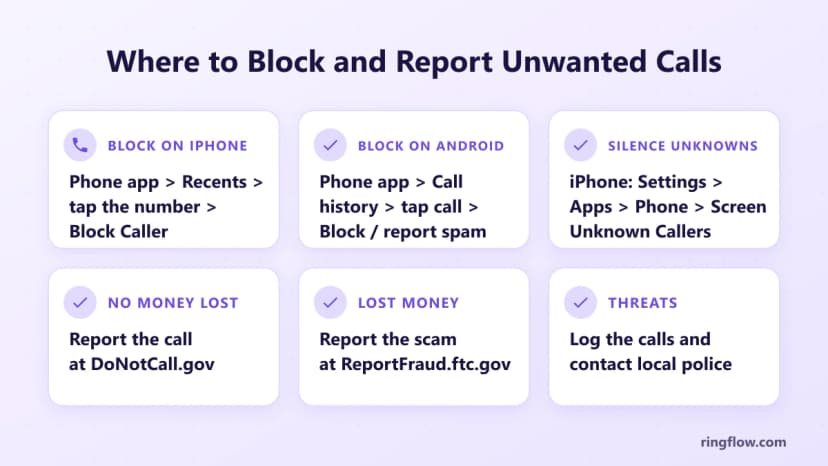
Blocking a number takes seconds on both major phone platforms:
- iPhone: in the Phone app, tap Recents, tap the number, then tap Block Caller. Blocked callers can still leave voicemail, but you aren't notified and they aren't told.
- Android with Google's Phone app: tap More, then Call history, select the call and tap Block / report spam. Some steps need Android 6.0 or later.
- Unknown callers on iPhone: go to Settings, tap Apps, then Phone, and set Screen Unknown Callers to Silence to send calls from numbers not in your contacts to voicemail. FaceTime has its own Silence Unknown Callers switch.
- Private numbers on Android: in the Phone app's settings, open Blocked numbers and turn on Unknown.
Then report the call. If you didn't lose money, use DoNotCall.gov and include the caller ID number and any callback number. If you lost money to a scam, report it at ReportFraud.ftc.gov.
Registering your own number on the National Do Not Call Registry is free and never expires. Sales calls can take up to 31 days to stop, but the registry won't stop scammers making illegal calls.
For threatening or harassing calls, log dates and times, save voicemails and contact local police. On AT&T home phone lines, Call Trace (*57) lets the carrier trace telephone numbers behind these calls, but AT&T gives the results only to law enforcement, not to you.
How Businesses Show Their Name on Outgoing Calls
Your own business calls face the same checks: a search, the area code, the caller ID name and a spam label. The traditional step is registering a caller ID name for each outbound number, usually through your phone provider, so carriers that run a CNAM lookup display your business name.
Branded calling aims to show a verified business name with authenticated calls. In October 2025, the FCC proposed requiring providers to give consumers accurate caller name and call branding information, and an April 2026 FCC notice still described those requirements as rules it may adopt.
Consistent, recognizable numbers still do a lot of the work. Ringflow's cloud phone system provides local numbers in US area codes and toll-free numbers, forwards calls to mobile and desktop apps, and can port the number your customers already know.
Conclusion
Tracking down a phone number should start with free checks: search the digits, read the area code, caller ID name and spam label, and let voicemail screen anything uncertain. Paid reports may add a name, but their data can be wrong and can't stand in for FCRA-compliant screening.
Block and report spam, and take threats to the police instead of tracing a caller yourself. For businesses, a registered caller name and consistent numbers help, and Ringflow's local and toll-free numbers come with a free trial and number porting.
Ready when you are
Want Customers to Know It's You Calling?
Get local numbers in US area codes or a toll-free number that rings on your mobile and desktop apps. Try Ringflow free, and port the number your customers already know.
FAQ
Search all ten digits online, then check the area code, caller ID name and any spam label. Business numbers usually turn up quickly, but private mobile numbers often don't, because there is no central database of cell phone numbers. Paid people-search data can be wrong.
For many numbers, yes: a web search, the area code, caller ID, spam labels and your carrier's free spam tools cost nothing. Free methods can't show where a phone is. If calls are threatening, contact local police, who can seek carrier records through legal process.
No. A phone number alone does not reveal a live location, and carriers such as AT&T require a warrant or probable cause court order for government location requests, except in emergencies. Seeing someone's location takes their consent, such as family location sharing, or a police investigation. You can still locate your own lost phone with Find My or Find Hub.
Let the call go to voicemail, then search the number and check the area code, caller ID name and any spam warning. If the caller claims to be your bank or an agency, hang up and call the number on your statement or the official website. Caller ID can be spoofed, so a familiar name isn't proof.
Searching a number online is an everyday step, and the FTC notes that people-search sites sell reports to anyone willing to pay. The limits are about use. Under the Fair Credit Reporting Act, a report used for housing, employment, credit or insurance decisions must come from a seller that follows FCRA rules.