
Introduction
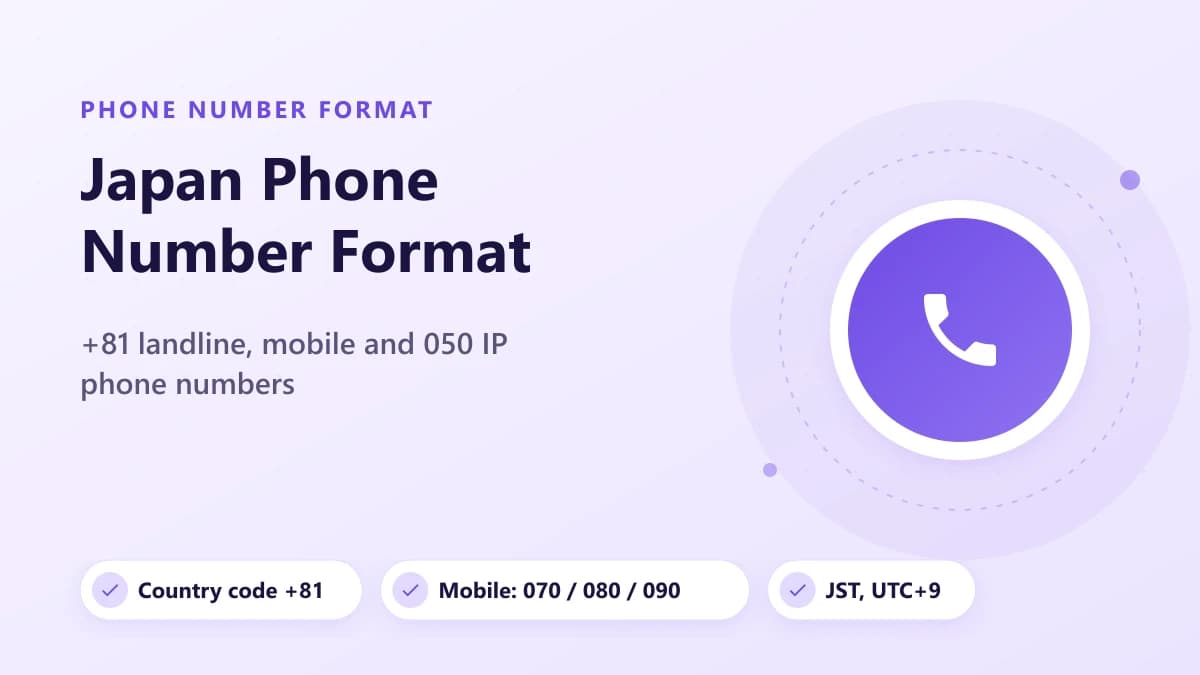
A Japan phone number carries a leading 0 when it is dialed inside the country, and +81 takes over from that 0 when the number is written for callers abroad. Landlines have 10 digits counting the 0, while mobile numbers have 11 and start with 070, 080 or 090.
Below you'll find how Japanese phone numbers are structured, how to recognize a cell phone number, which area codes serve Tokyo, Osaka and other cities, and sample numbers in both formats. The later sections cover the routes a foreign business can take to a Japanese virtual number, the identity checks involved, and how to time calls from the US.
- Japan's country code is +81. Drop the domestic prefix 0 in international format, so 03-XXXX-XXXX becomes +81 3-XXXX-XXXX.
- Mobile numbers begin 070, 080 or 090 and have 11 digits. Japan's communications ministry has also added 060 for mobile use, but carriers announced a delay to its launch in July 2026.
- 050 numbers are for IP telephony, and 0120 and 0800 numbers are toll-free.
- Mobile carriers must confirm a customer's identity at contract, and 050 app phone services have been under the same duty since 1 April 2024.
Japanese Phone Number Format (+81)
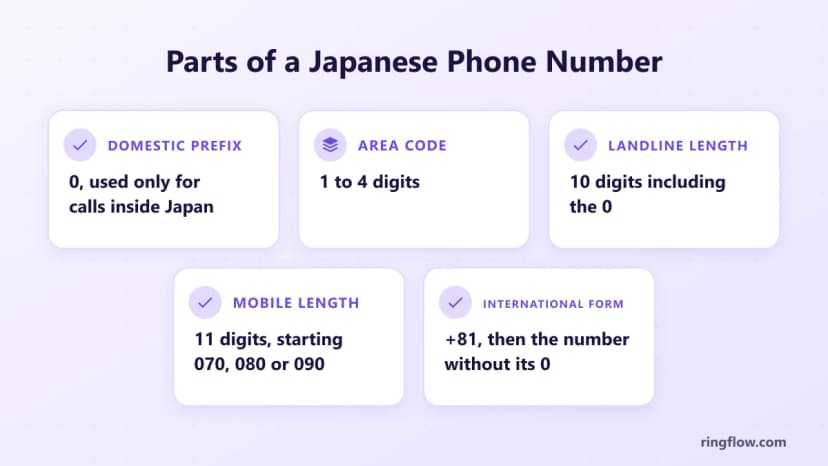
The Ministry of Internal Affairs and Communications (MIC) splits a fixed-line number into four parts: the domestic prefix 0, the area code (shigai-kyokuban), a local exchange code and the subscriber number. Those parts add up to 10 digits. The area code can be one to four digits long, and the rest of the number shrinks or grows around it.
That first 0 only applies to calls placed within Japan. For an international audience, replace it with +81: Osaka's 06-XXXX-XXXX becomes +81 6-XXXX-XXXX, and a mobile written 080-XXXX-XXXX becomes +81 80-XXXX-XXXX. The same rule covers every Japanese phone number format in the table.
| Number type | Starts with | Length with the 0 |
|---|---|---|
| Landline (geographic) | 0 plus a 1- to 4-digit area code | 10 digits |
| Mobile | 070, 080 or 090 | 11 digits |
| Mobile, newer range | 060 | 11 digits |
| IP telephony (non-geographic) | 050 | 10 or 11 digits |
| Toll-free | 0120 | 10 digits |
| Toll-free | 0800 | 11 digits |
| Navi Dial | 0570 | 10 digits |
The landline, mobile and toll-free lengths come from the numbering Q&A published by Japan's Ministry of Internal Affairs and Communications (MIC). The IP telephony length is the range given for all non-geographic 0X0 codes, and 020 is used for paging and data services.
Japanese Mobile Numbers (070, 080, 090)
A Japanese cell phone number is 11 digits long when you include its 0. Saved in a phone in Japan it looks like 090-XXXX-XXXX, and on an international business card it reads +81 90-XXXX-XXXX. Those opening digits are the quickest clue that you have a Japan mobile number, with one caution: toll-free 0800 numbers share their first three digits with 080 mobiles.
The prefix does not name a carrier. Japan has four nationwide mobile providers (NTT Docomo, KDDI, SoftBank and Rakuten Mobile), and the numbering plan assigns 070, 080 and 090 to mobile service in general rather than to any one of them.
Those three ranges are running low. MIC changed the Telecommunications Numbering Plan on 20 December 2024 to add 11-digit mobile numbers beginning with 060, originally due from July 2026 onward. Its 060 page says carriers announced a postponement on 8 July 2026, so a 060 number is still unusual. Existing 070, 080 and 090 numbers are unaffected.
Landline Area Codes: Tokyo, Osaka and Beyond
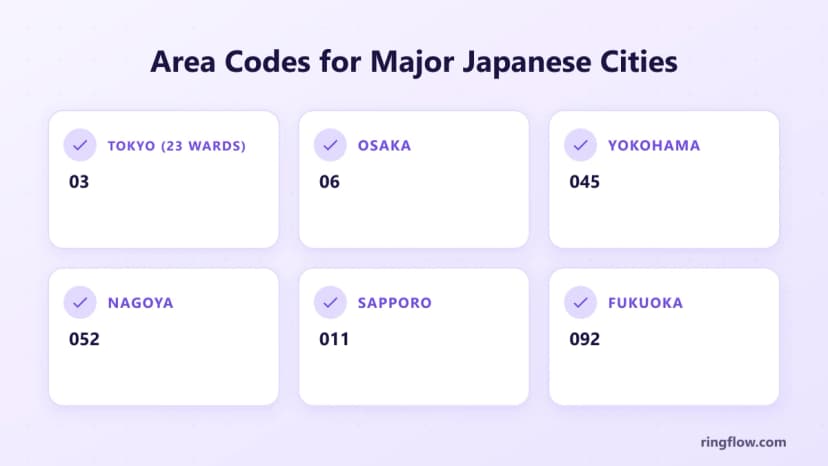
Every geographic number has nine digits after the 0, so area code length decides how many digits are left for local numbers. Dense cities get short codes: Tokyo's single-digit 3 leaves eight local digits. Rural areas get long ones, such as 82486 for Takano in Hiroshima Prefecture, which leaves just four.
| City | Area code (dialed in Japan) | Pattern |
|---|---|---|
| Tokyo (23 special wards) | 03 | 03-XXXX-XXXX |
| Osaka | 06 | 06-XXXX-XXXX |
| Yokohama | 045 | 045-XXX-XXXX |
| Nagoya | 052 | 052-XXX-XXXX |
| Sapporo | 011 | 011-XXX-XXXX |
| Kyoto | 075 | 075-XXX-XXXX |
| Kobe | 078 | 078-XXX-XXXX |
| Fukuoka | 092 | 092-XXX-XXXX |
| Sendai | 022 | 022-XXX-XXXX |
| Hiroshima | 082 | 082-XXX-XXXX |
| Nara | 0742 | 0742-XX-XXXX |
A Tokyo phone number does not always start with 03. That code covers the 23 special wards and Komae, while Hachioji in western Tokyo uses 042 and Niijima island uses 04992.
Codes climb from north to south. Sapporo on Hokkaido has 011, and Kagoshima in the far south has 099. Okinawa was still under US occupation when the system was designed, so after its return to Japan in 1972 its numbers were slotted in between Miyazaki and Kagoshima, with codes beginning 098.
Japanese Phone Number Examples
These samples keep the subscriber digits as X, so none of them points to a real line. Put in real digits only when the owner of the number has given it to you.
| Example | Dialed in Japan | International format |
|---|---|---|
| Tokyo office line | 03-XXXX-XXXX | +81 3-XXXX-XXXX |
| Osaka office line | 06-XXXX-XXXX | +81 6-XXXX-XXXX |
| Kyoto landline | 075-XXX-XXXX | +81 75-XXX-XXXX |
| Nara landline | 0742-XX-XXXX | +81 742-XX-XXXX |
| Mobile (090) | 090-XXXX-XXXX | +81 90-XXXX-XXXX |
| Mobile (070) | 070-XXXX-XXXX | +81 70-XXXX-XXXX |
A few short numbers and prefixes are worth knowing too:
- 110: police. On mobile phones, 112 and 911 redirect here.
- 119: ambulance and fire brigade.
- 118: maritime emergencies.
- 184 before a number: withholds your caller ID for that call. 186 sends it.
How to Dial a Japan Phone Number From the US
Start with 011, the code for leaving the North American Numbering Plan, add 81, and finish with the Japanese number minus its first 0. A Tokyo office line becomes 011 81 3 XXXX XXXX, and a cell phone becomes 011 81 90 XXXX XXXX. Mobile users can press + at the start and skip the 011.
The mistake to watch for is keeping the 0, as in 011 81 03, which leaves the domestic prefix where it no longer belongs. For exit codes from other countries and more dialing detail, see our Japan country code guide.
Getting a Japanese Virtual Number as a Foreign Business
A company based outside Japan has three broad options. The right one depends on what callers should see: a mobile number, a city landline, or a non-geographic internet number.
A Mobile Contract With a Japanese Carrier
A line from NTT Docomo, KDDI, SoftBank or Rakuten Mobile comes with a 070, 080 or 090 number. Japan's Mobile Phone Improper Use Prevention Act requires carriers to confirm who is signing the contract, so plan for an identity check and ask the carrier in advance which documents it accepts from a foreign company or a non-resident.
A 050 IP Phone Number
Numbers in the 050 range are issued for IP telephony through internet service providers and phone apps. Because 050 is non-geographic, it suits a business that wants a Japanese number without picking a city. According to MIC, 050 app phone services have been covered by the same identity verification duty as mobile contracts since 1 April 2024, so expect a check here as well.
A City or Toll-Free Number Through a Provider
Some providers offer numbers with city codes such as 03 or 06, or toll-free 0120 and 0800 numbers, that forward calls to phones outside Japan. Requirements vary by provider and number type, so ask what paperwork and local address, if any, they need before you print a Tokyo number on anything.
New to numbers that live in the cloud instead of on a SIM? Our virtual phone number explainer covers the basics. For a contrast with Japan's layered area codes, the +852 Hong Kong guide describes a plan with no area codes at all.
Time Zone and Call Timing
All of Japan uses Japan Standard Time (JST), which is UTC+9, and the country does not observe daylight saving time. The gap with the US therefore changes only when US clocks do, in March and November.
- US Eastern Time: Japan is 13 hours ahead during daylight saving time and 14 hours ahead during standard time.
- US Pacific Time: Japan is 16 hours ahead during daylight saving time and 17 hours ahead during standard time.
In practice, a summer evening in the US lines up with the next morning in Japan. A 7 p.m. call from New York in July reaches Tokyo at 8 a.m. the following day, and a 5 p.m. call from Los Angeles lands at 9 a.m. Our best time to call Japan page suggests calling windows.
Conclusion
Japanese phone numbers follow a consistent logic. A 0 opens every domestic number and turns into +81 abroad, landlines total 10 digits with shorter codes for bigger cities, and mobile numbers total 11 with 070, 080 or 090 up front. With that pattern in mind, you can format a number correctly, tell a cell phone from an office line, and avoid the extra 0 that trips up international calls.
US teams with customers or partners in Japan can make those calls from a Ringflow business line, answering and dialing from mobile and desktop apps. You can pick a local number in a US area code or a toll-free number for American callers, move your current number over through number porting, and test it with a free trial.
Ready when you are
Reach Japan From Your US Business Line
Pick a number in a US area code or a toll-free line on Ringflow, bring your current number over with porting, and try the apps free before you commit.
FAQ
A Japanese landline number is 10 digits including the leading 0: the 0, a one- to four-digit area code, a local exchange code and a subscriber number, such as 03-XXXX-XXXX in Tokyo. Mobile numbers are 11 digits and start with 070, 080 or 090.
It starts with 070, 080 or 090 and has 11 digits in total, written as 090-XXXX-XXXX inside Japan. In international format the 0 is dropped, giving +81 90-XXXX-XXXX.
Remove the leading 0 and put +81 in front. Tokyo's 03-XXXX-XXXX becomes +81 3-XXXX-XXXX, and a mobile 080-XXXX-XXXX becomes +81 80-XXXX-XXXX. When dialing from the US, you can replace the + with 011.
The usual routes are a mobile contract with a Japanese carrier, a 050 IP phone number, or a city or toll-free number through a provider. Mobile carriers must verify the contract holder's identity under Japanese law, and 050 app phone services have had the same duty since 1 April 2024, so check which documents are accepted before applying.
A safe sample keeps the subscriber digits as placeholders, such as 03-XXXX-XXXX for a Tokyo landline or 090-XXXX-XXXX for a mobile. In international format those become +81 3-XXXX-XXXX and +81 90-XXXX-XXXX.
Numbers beginning with 050 are used for IP telephony, meaning calls carried over the internet through service providers or apps. They are not tied to a city the way 03 or 06 landline numbers are.