

Introduction
Choosing a free video calling app sounds easy until a group call cuts off after forty minutes, or a relative cannot join because they lack the app. Most free tools work well for short chats, yet each one has limits on time, people, or devices. A quick look at those limits saves a lot of frustration later. Anyone searching for the top 20 free video calling app wants honest limits, not a padded list.
This guide from Ringflow explains what to look for in a free video calling app, then compares the limits of Zoom, Google Meet, and Microsoft Teams. You will also see how FaceTime, WhatsApp, and Discord fit in, how to improve call quality, and when a business needs more than a free plan. Each section stands alone, so you can read only the parts you need.
What to Look For in a Free Video Calling App
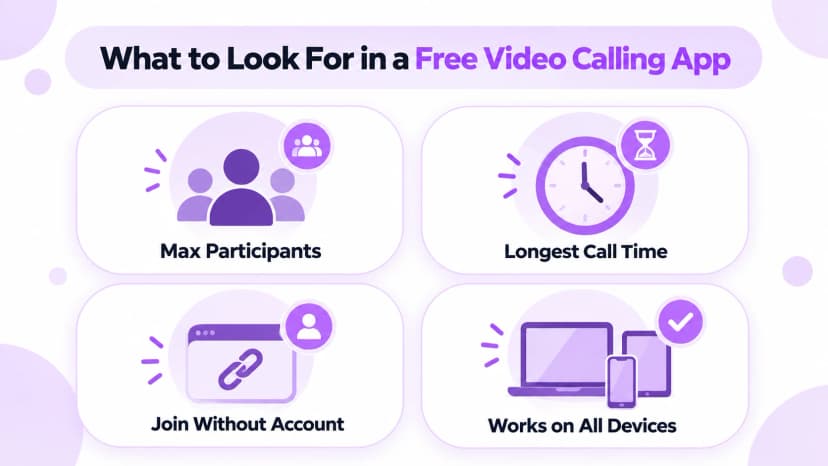
Start with who you will call and how often. A free video calling app that suits two friends may fail for a team of ten, because group calls often have shorter time limits than one-on-one calls. Check the maximum number of people, the longest call length, and whether guests can join without installing anything. Those three points decide most choices, and they take a minute to check.
Price is only part of the picture, so read what the free plan leaves out. Recording, large rooms, and admin controls are often kept for paid plans. If you mostly want voice rather than video, our guide to free online calls lists simple options. Test the app with a real call before you ask others to join, so surprises happen to you first.
- People: check the maximum number of participants on the free plan.
- Time: find the longest group call before it ends automatically.
- Guests: see whether people can join from a link without an account.
- Devices: confirm the video calling app works on phones, tablets, and computers.
- Extras: recording and admin tools are often paid features.
- Privacy: review what the app collects and who can join a room.
- Cost: read the plan page, since free limits can change.
Free Plan Limits: Zoom, Google Meet, and Teams
Zoom, Google Meet, and Microsoft Teams Free are each a video calling app that allows up to 100 participants on its free plan. The difference is time. Zoom caps group meetings at 40 minutes, while Google Meet and Teams Free cap them at 60. One-on-one calls are treated differently, and they can run much longer. Always check the app's own plan page, since limits change from time to time, and old articles can be wrong.
Google Meet lets a free personal account host a one-on-one call for up to 24 hours, and guests can join by link or code with the host's approval. Zoom's paid plans remove the group time cap. Teams Free adds chat and storage but leaves out recording and admin controls. When a group call ends, you can simply start a new meeting, though everyone has to rejoin.
- Zoom: up to 100 participants and 40 minutes for group meetings.
- Google Meet: up to 100 participants and 60 minutes for group calls.
- Teams Free: up to 100 participants and 60 minutes per meeting.
- One-on-one: Zoom has no time cap, and Meet allows up to 24 hours.
- Paid plans: these lift the group time cap on all three.
- Check often: every video calling app changes limits and plan names over time.
- Guests: Google Meet guests can join by link or code with host approval.
- Extras: Teams Free includes chat and storage but not recording.
FaceTime, WhatsApp, and Discord
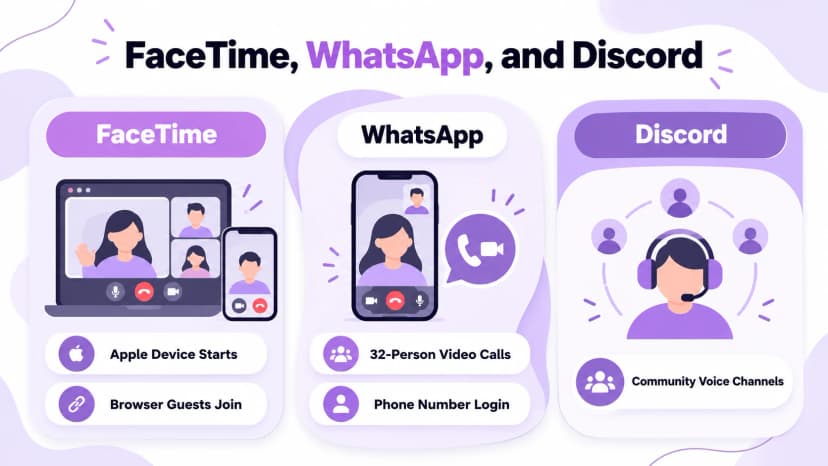
FaceTime is a video calling app built into Apple devices, and starting a call needs an iPhone, iPad, or Mac. Apple lets people on Android and Windows join through a browser link, though some features, such as screen sharing, may not be available to them. For households that already use Apple devices, it is the simplest option and needs no extra account or signup.
WhatsApp supports group video calls of up to 32 people, and it works wherever the app is installed. Discord suits communities, with voice and video channels that stay open for people to drop in. Both apps connect only people who have them, so check that everyone can install one before you choose it for a family or club. A single holdout can slow everyone down.
- FaceTime: needs an Apple device to start a call.
- Guests: Android and Windows users can join through a browser link.
- WhatsApp: group video calls of up to 32 people.
- Discord: voice and video channels suited to communities.
- Everyone needs the app: a video calling app like WhatsApp or Discord only connects its own users.
- Phone number: WhatsApp ties your account to a phone number.
- Best for: families, clubs, and groups that already share one app.
- Screen sharing: some features may be limited for guests who join by link.
How to Get Better Video Call Quality
Call quality depends more on your connection than on the video calling app. A stable Wi-Fi signal, a quiet room, and a headset make a bigger difference than switching providers. Close other apps that use bandwidth, and move closer to the router if the picture freezes. If you can, plug in with a cable for important calls, since wired connections are steadier than wireless ones.
Video calls run over the same internet technology as other internet phone services. Our VoIP call quality tips explain jitter, latency, and packet loss in plain language, and the same fixes help on video. If a call keeps dropping, turn off your camera first, because audio needs far less bandwidth than video. You can turn the camera back on later, once the connection settles.
- Connection: use Wi-Fi close to the router, or a cable.
- Headset: it cuts echo and background noise.
- Lighting: put a light in front of you, not behind.
- Bandwidth: close other apps and downloads during the call.
- Camera off: switch to audio if the connection struggles.
- Update: install the latest version of the video calling app before you join.
- Test first: join a short test call a few minutes early.
- Mute: mute your microphone when you are not speaking.
- Background: use a plain or blurred background to reduce distractions.
What Happened to Skype and Google Duo
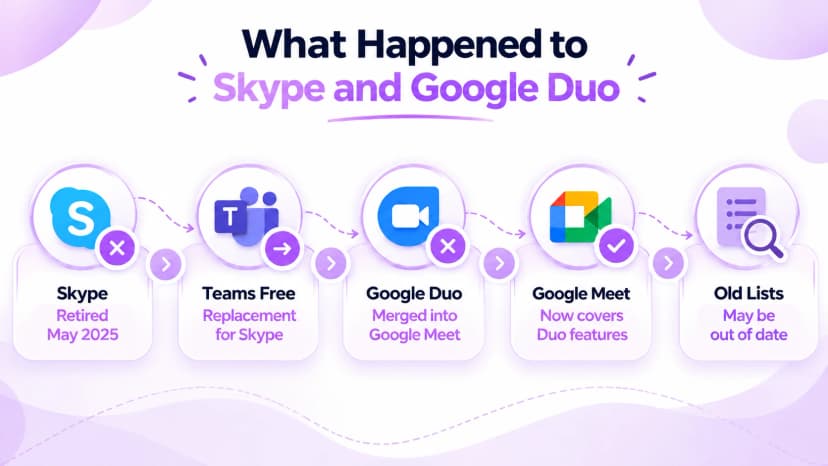
Many older lists still recommend Skype and Google Duo, but neither is a current video calling app. Skype was retired for consumers on 5 May 2025, and Microsoft moved users toward Teams Free. Google Duo was merged into Google Meet starting in 2022, so it no longer exists as a separate app. A list that still includes them is out of date, so check the date on any article you read.
If you used Skype, the Teams Free meeting guide from Microsoft explains how a free meeting works, including the 100-person and 60-minute limits. Contacts and chats can usually be brought over by signing in with your old Skype account, although not every item transfers. Decide which old chats you still need before you switch, because some old messages may not carry over.
- Skype: retired for consumers on 5 May 2025.
- Google Duo: merged into Google Meet starting in 2022.
- Teams Free: the replacement Microsoft points Skype users to.
- Google Meet: the app that now covers what Duo did.
- Old lists: treat any list that names Skype or Duo with care.
- Migration: sign in with your old Skype account to bring contacts.
- Check: confirm which chats and files you still need before moving.
When a Business Needs More Than a Free App
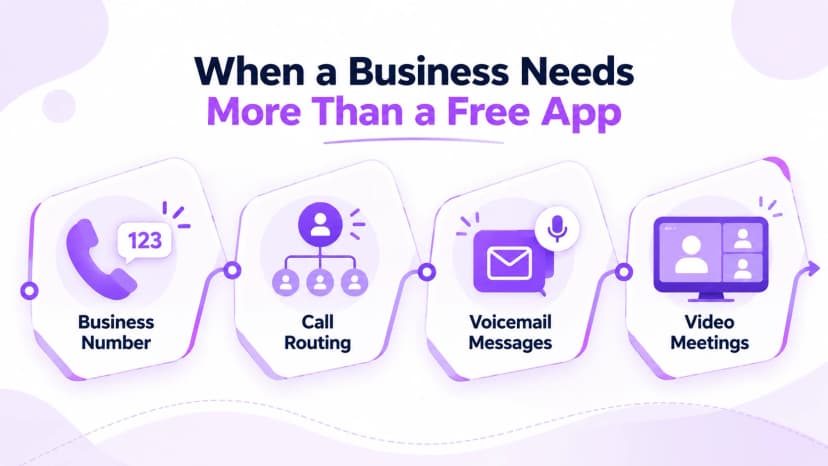
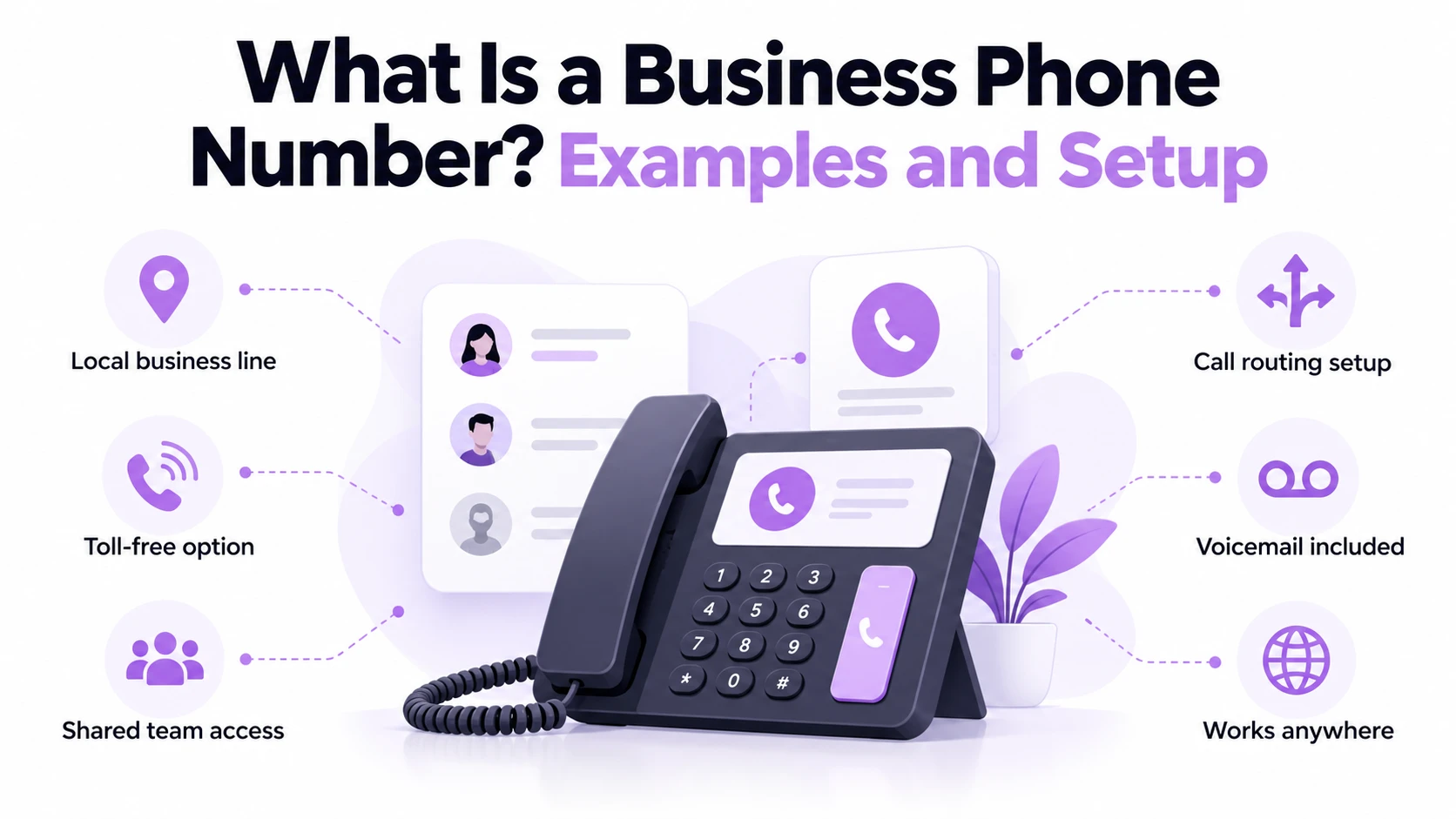
Free apps work well for friends and small teams, but a business has different needs. Customers expect to reach you on a phone number, calls need to be logged, and staff need to join from any device. A free video calling app does not give you a business number, call routing, or voicemail, so many teams end up juggling several tools and logins.
A cloud phone system brings voice, texting, and video meetings into one place. Ringflow gives a team a business number and a video calling app for mobile and desktop, plus video meetings alongside calls, so staff do not switch between tools. A free trial lets you test it with real calls before you decide. Compare it with your current tools first, and ask your team what they need most.
- Business number: customers call one number, not personal mobiles.
- Routing: send calls to the right person or team.
- Voicemail: customers can leave a message when no one answers.
- Video meetings: hold them in the same app as your calls.
- Records: keep call history for reviewing and training.
- Free trial: test Ringflow with your team before you pay.
- Mobile and desktop: staff can answer and join from any device.
- Texting: send business texts from the same number.
- Security: ask how the provider protects calls and accounts.
Conclusion
The best free video calling app depends on who you call. Zoom, Google Meet, and Teams Free each allow up to 100 people, with time caps of 40 or 60 minutes for groups. FaceTime and WhatsApp suit friends and families, and Discord suits communities. Skype and Google Duo are gone, so skip any list that still recommends them, including any top 20 free video calling app roundup.
If your team needs more than a free plan, test a business option before you commit. Ringflow offers a free trial with a business number, mobile and desktop apps, and video meetings, so you can compare it with your current setup. Write down your needs, try two apps, and keep the one you will actually use every week.
Ready when you are
Need a Video Calling App Built Into Your Business Line?
Ringflow's cloud phone system includes a video calling app and video meetings alongside your business calls, on mobile and desktop apps. Start a free trial and test the video calling app with your team.
Frequently Asked Questions
It depends on group size and call length; Zoom, Meet, and Teams allow 100 people.
No. Skype was retired for consumers on 5 May 2025.
Group meetings last 40 minutes; one-on-one calls have no cap.
Yes, through a browser link, but only an Apple device can start the call.
Up to 32 people.