Introduction
A UCaaS platform touches almost every internal conversation a business has, phone calls, video meetings, chat threads, which makes it a bigger security surface than most IT teams treat it as. Toll fraud rates on cloud communications platforms have been rising in recent years, and vishing calls that spoof a trusted number to extract sensitive information keep getting harder to distinguish from the real thing.
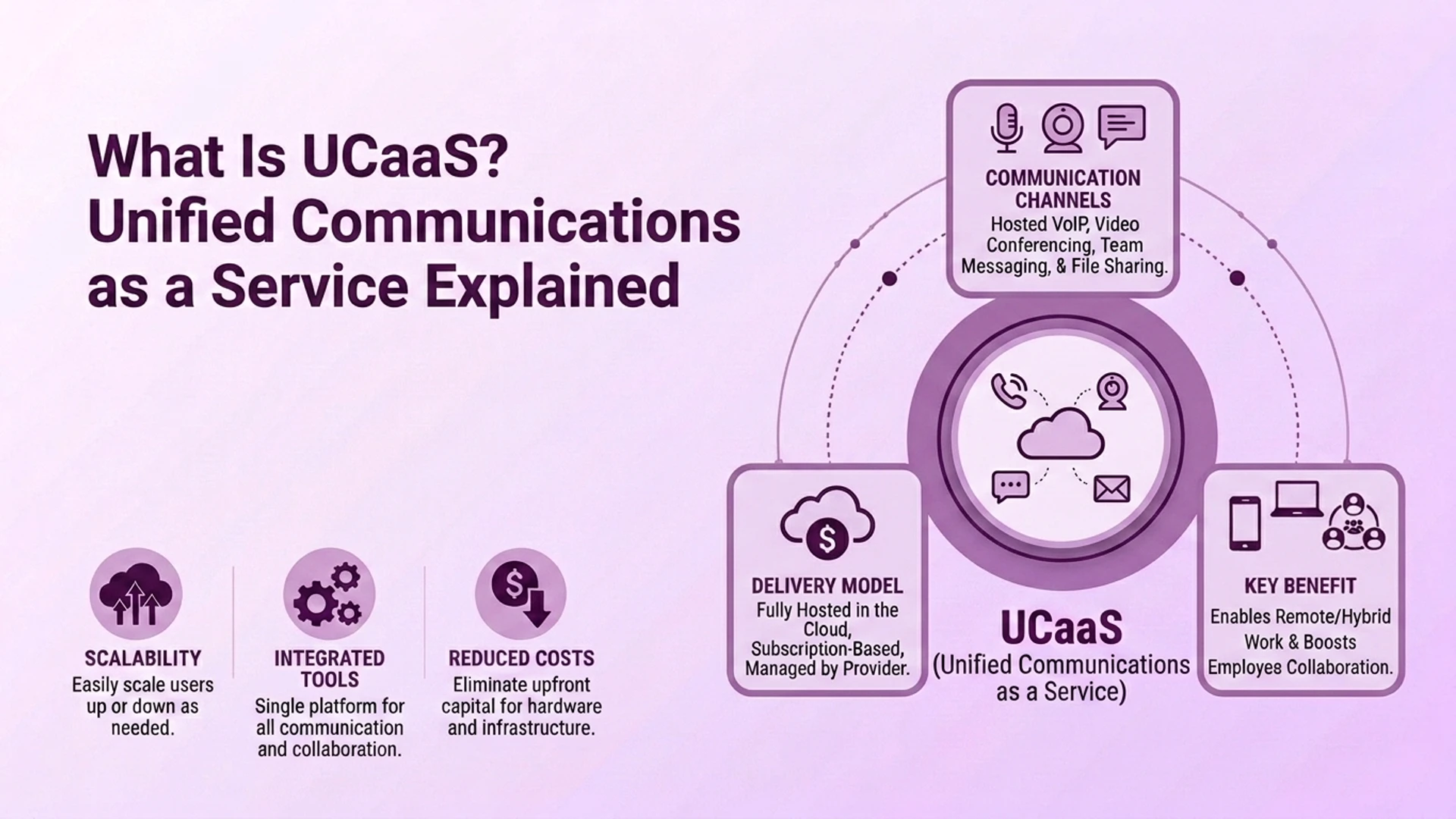
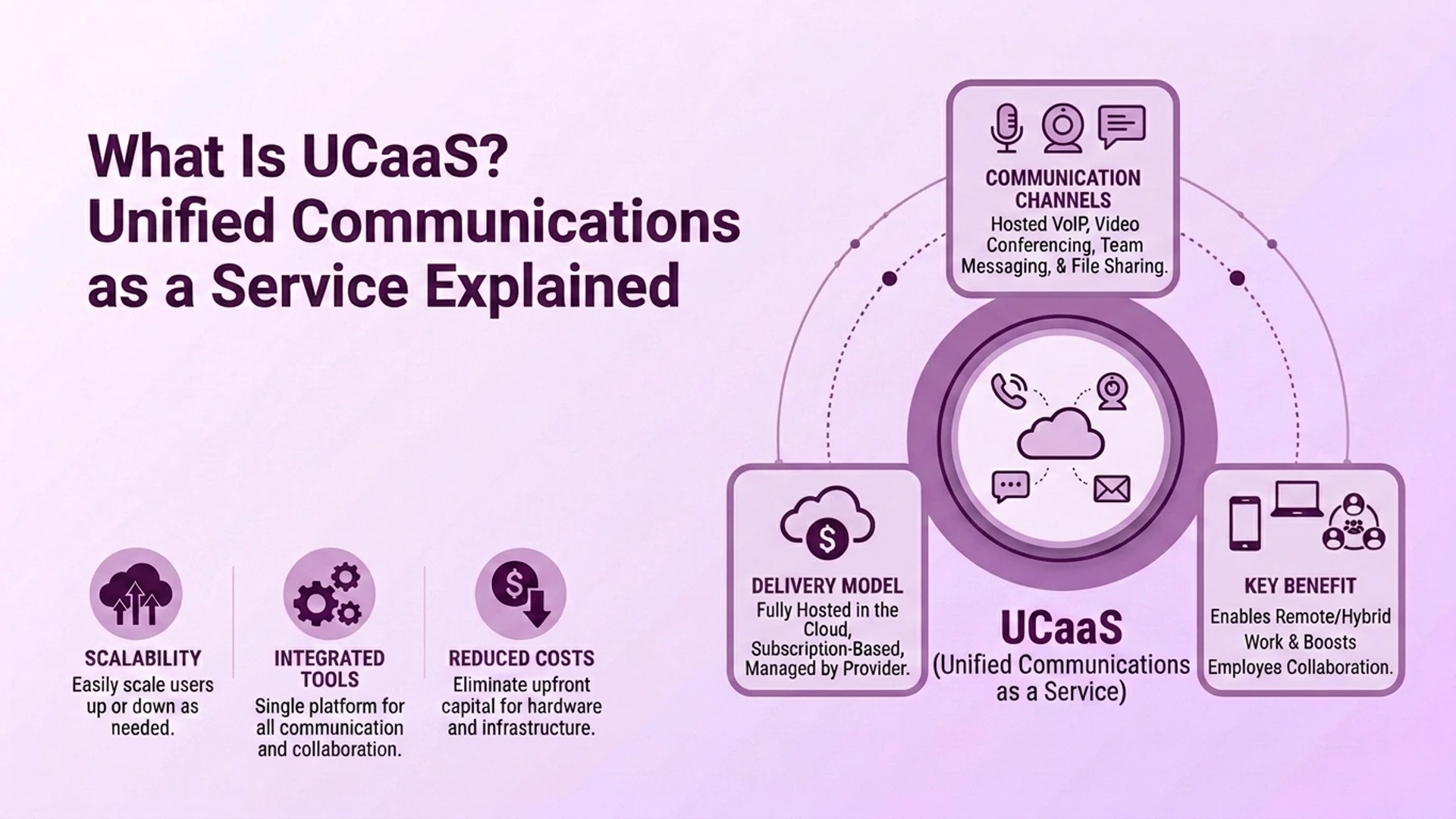
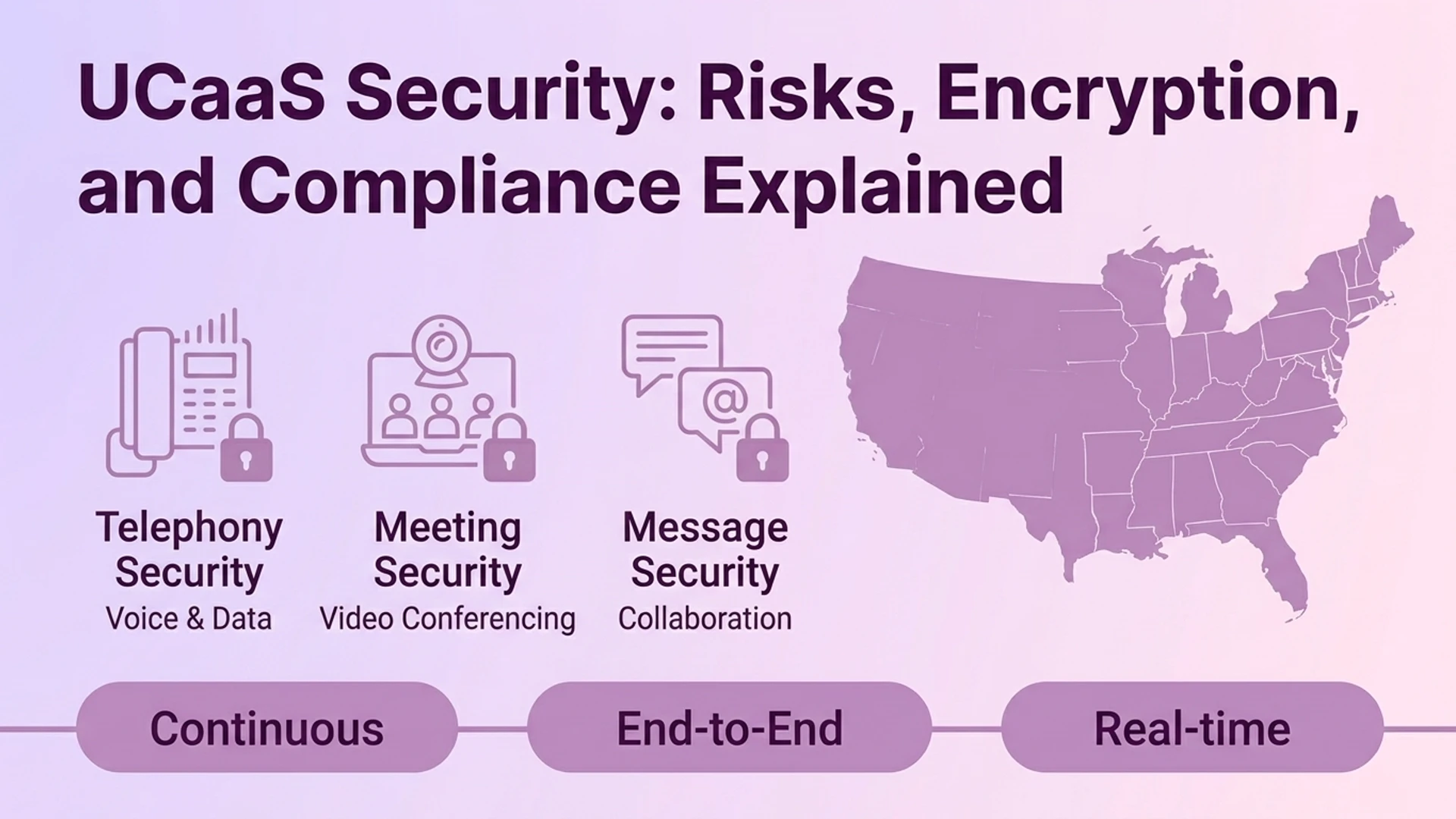
UCaaS security refers to the practices, encryption standards, access controls, and compliance certifications that protect a Unified Communications as a Service platform and the calls, messages, and meetings running through it. It spans everything from how voice traffic is encrypted in transit to whether the vendor can prove it meets frameworks like SOC 2 or HIPAA.
This guide covers the biggest risks specific to UCaaS, what proper encryption looks like, which compliance standards actually matter, how toll fraud and vishing work, and what to check before trusting a vendor with a business's internal communications.
What Does "UCaaS Security" Actually Cover?
UCaaS security isn't one setting a business turns on. It spans the same four components that make up the UCaaS definition itself, business telephony, PSTN connectivity, video meetings, and messaging, and each one carries its own exposure. A phone call can be intercepted. A messaging thread can be accessed by the wrong account. A video meeting link can be shared outside the intended group. A PSTN connection can be hijacked for toll fraud.
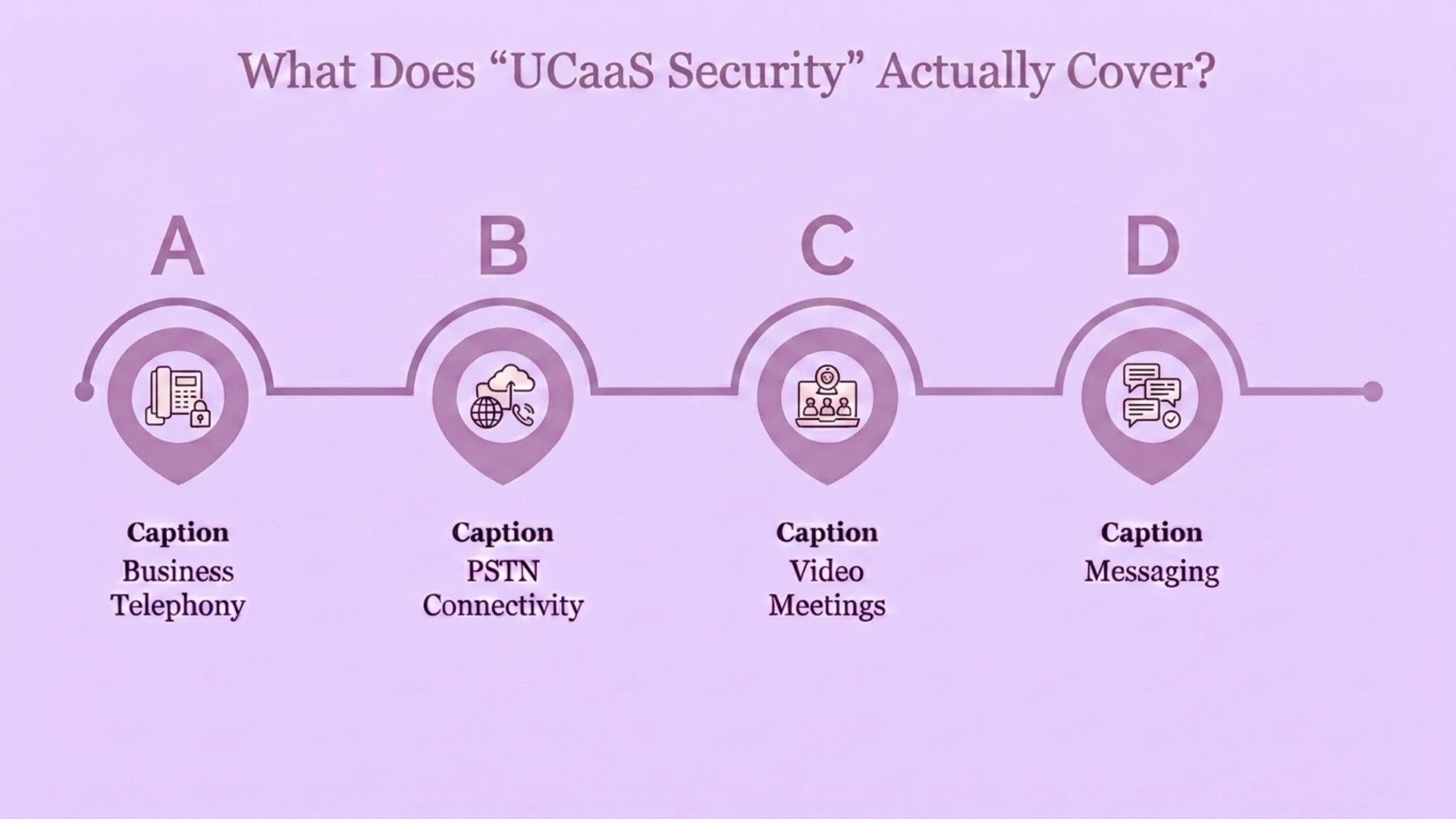
Because a single UCaaS login often controls all four channels at once, a single compromised account can expose more than a typical email breach would, voice recordings, chat history, and meeting content included.
What Are the Biggest Security Risks in UCaaS?
The risks that come up most often in security assessments of UCaaS platforms include:
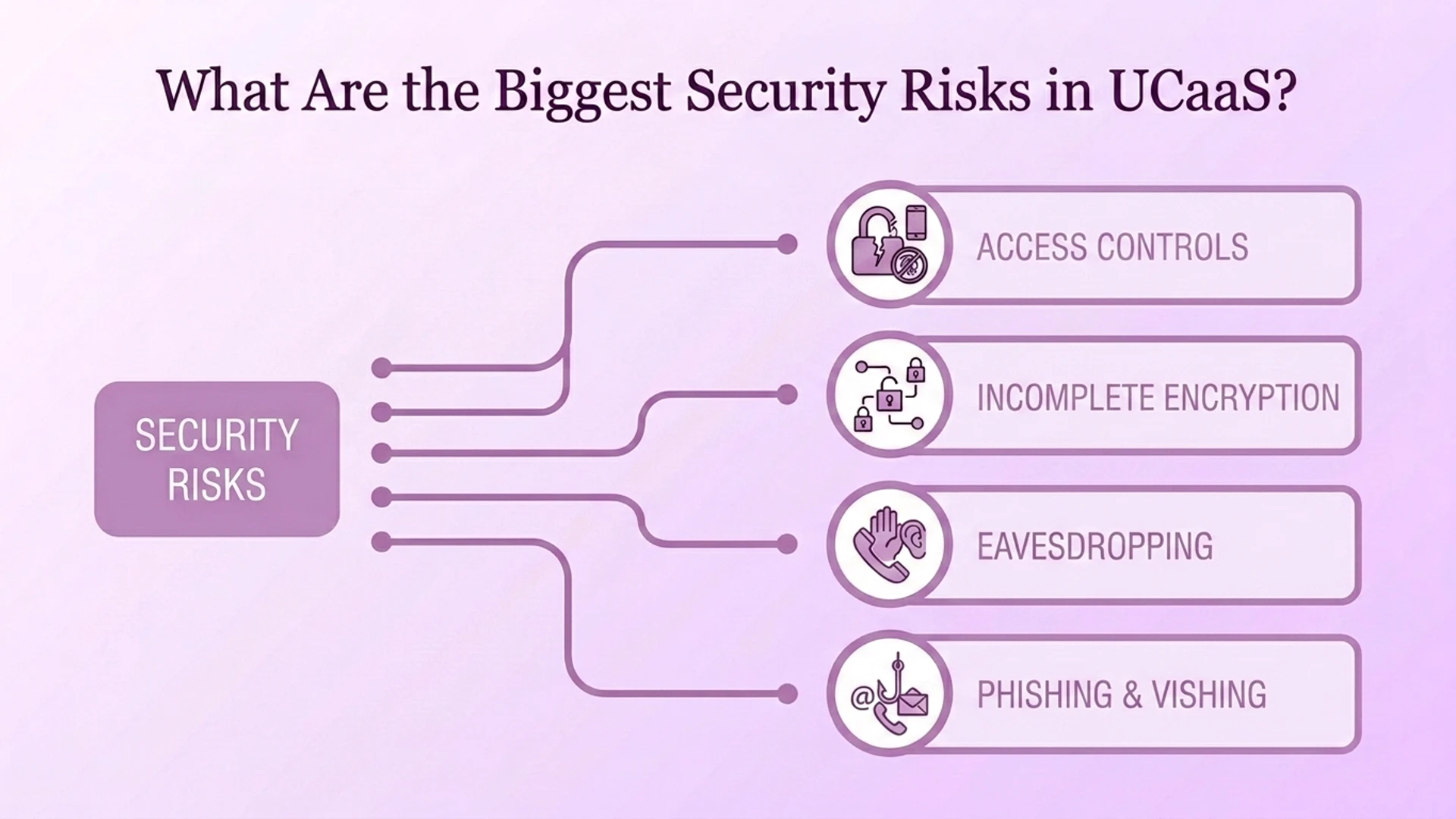
- Weak access controls — accounts without multi-factor authentication or overly broad permissions
- Incomplete encryption — voice or video traffic left unencrypted on part of its route
- Eavesdropping and interception — unencrypted calls intercepted on unsecured or public networks
- Phishing and vishing — attackers using email or spoofed calls to extract credentials or sensitive data
- Malware introduced through integrations — third-party apps connected to the UCaaS platform creating new entry points
- Toll fraud — unauthorized use of a business's phone system to route expensive calls at its expense
Most of these trace back to configuration and authentication gaps rather than flaws in the cloud infrastructure itself, which is also why they're largely preventable with the right settings turned on from day one. Reviewing a vendor's public Security page, and confirming what's actually documented there matches what's promised in a sales call, is one of the fastest ways to spot the gap between marketing and reality.
How Should UCaaS Data Be Encrypted?
Proper UCaaS encryption covers two different states data can be in. Data in transit, meaning calls, messages, and video actively moving across the network, should be encrypted using TLS 1.3 or a later version. Data at rest, meaning stored recordings, transcripts, and account information, should be encrypted using AES-256.
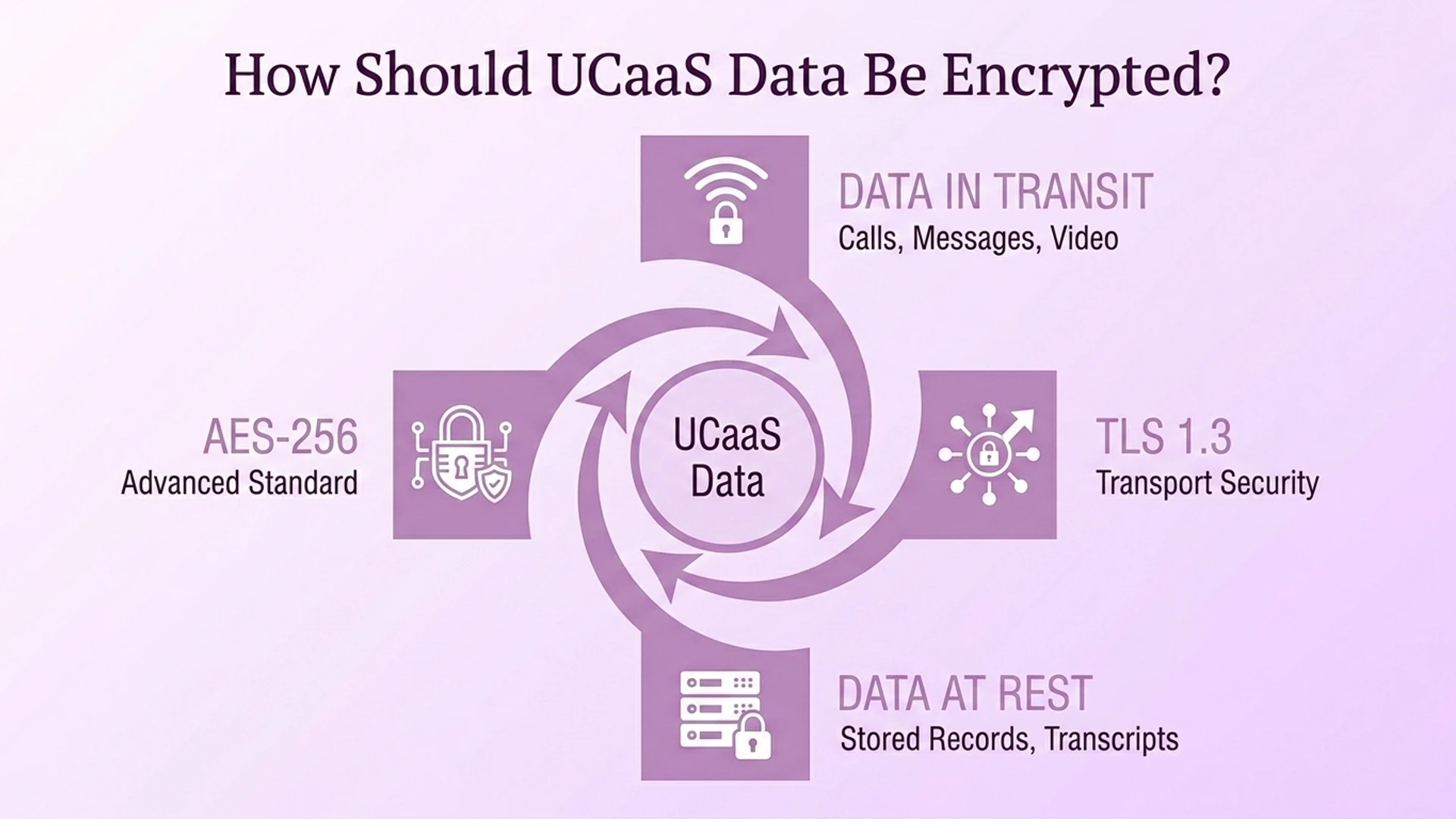
Voice and video traffic deserve specific attention here, since it's tempting for vendors to treat them as an afterthought next to text-based data. A call left unencrypted anywhere along its path, even briefly, is a call that can be intercepted on an unsecured network. Businesses evaluating a vendor should ask directly whether encryption applies end-to-end across every channel, not just to stored files.
Which Compliance Standards Apply to UCaaS?
Three frameworks come up most often when evaluating a UCaaS vendor's security posture:
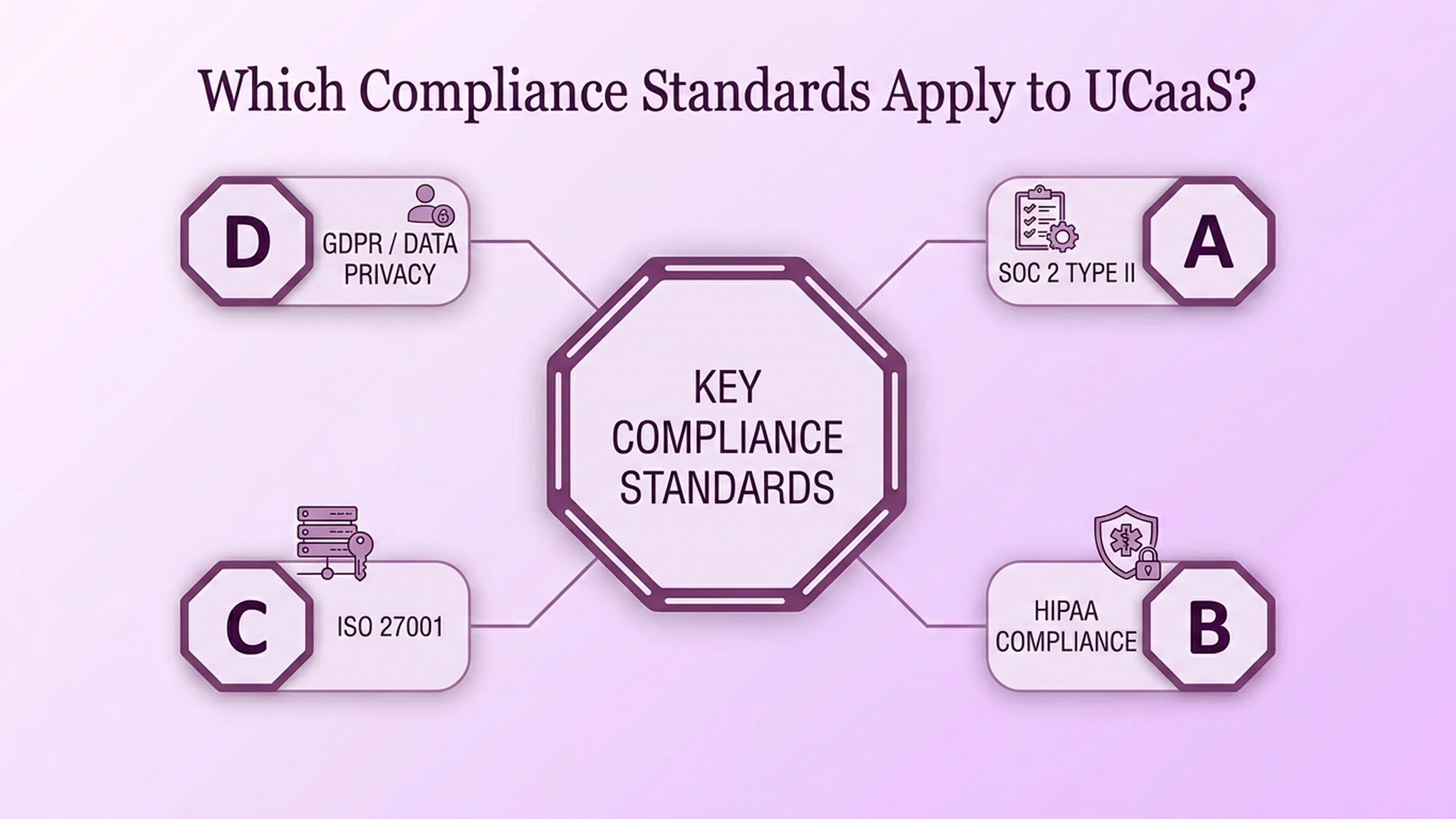
- 1SOC 2 Type II covers security, availability, processing integrity, confidentiality, and privacy controls, verified by an independent auditor over a period of months rather than a single point-in-time check.
- 2HIPAA applies to any UCaaS platform handling protected health information. Compliant platforms need a signed business associate agreement and technical safeguards that keep PHI segregated from general business communications rather than mixed into the same data streams.
- 3GDPR applies to UCaaS platforms handling the personal data of individuals in the European Union, covering how that data is stored, processed, and, when required, deleted.
None of these certifications guarantee a platform is unbreachable, but a vendor that can't produce current documentation for the framework relevant to its industry is a reasonable one to question further before signing a contract.
What Are Toll Fraud and Vishing, and How Do They Target UCaaS?
Toll fraud happens when someone gains unauthorized access to a business's phone system, often through a weak password or an unmonitored account, and uses it to place expensive international or premium-rate calls that the business ends up paying for. It's been a growing problem across UCaaS platforms in recent years, in part because some providers are still building out the fraud-detection capabilities that traditional telecom carriers developed over decades.
Vishing works differently. An attacker calls an employee, often spoofing a phone number that looks like it belongs to a bank, vendor, or coworker, and talks the target into revealing a password, account number, or other sensitive detail over the phone rather than through email. Because UCaaS platforms make it easy to call from a recognizable business number, they can just as easily be used to spoof one.
This exact combination of toll fraud and vishing risk inside UCaaS environments is examined in detail by Teligistics, a telecom expense and security research firm that tracks fraud trends across cloud communications platforms.
What Should Businesses Look for in a Secure UCaaS Vendor?
A handful of practical checks separate a genuinely security-conscious UCaaS vendor from one that just says the right words in a sales deck:
- Multi-factor authentication available and enforceable for every user account
- Granular permission controls so employees only have access to what their role requires
- Login and activity tracking with logs a business can actually audit after the fact
- Real-time anomaly alerts for unusual call volume, login locations, or account behavior
- Current compliance documentation for SOC 2, HIPAA, or GDPR, whichever applies
- Regular third-party security audits, not just internal self-assessment
Employee training matters just as much as any setting in the admin panel, since vishing and phishing both rely on a person, not a system, making the wrong call.
Does Ringflow Face the Same Security Considerations?
Yes, in principle, even though Ringflow isn't a UCaaS platform. It's built as a Cloud Contact Center and AI Sales Platform, which means it carries a similar security surface to UCaaS in some respects, encrypted calling, account access controls, Enterprise-grade compliance needs, and different ones in others, given its focus on customer-facing call volume and AI-driven call optimization rather than internal team messaging.
The underlying evaluation criteria, encryption in transit and at rest, strong authentication, and verifiable compliance certifications, apply to any cloud communications platform regardless of category. Businesses should confirm Ringflow's current certification details directly with Ringflow rather than assume they mirror what's typical for UCaaS vendors specifically.
Conclusion
UCaaS security comes down to a short list that's easy to state and harder to verify: is everything encrypted end-to-end, are accounts protected by more than a password, can the vendor prove its compliance claims with current documentation, and does it have real defenses against toll fraud and vishing rather than just a page on its website mentioning them.
None of that is exotic. Most of it is standard cloud security practice applied to phone calls instead of files, which is exactly why it's easy for a business evaluating features and pricing to forget to ask about it until something goes wrong.
Ready when you are
Evaluating Security Before Choosing a Communications Platform?
See how Ringflow's Cloud Contact Center and AI Sales Platform approaches encryption, access controls, and compliance for customer-facing calling.
Frequently Asked Questions
The most common UCaaS security risks include weak access controls, incomplete encryption, eavesdropping on unencrypted calls, phishing and vishing attacks, toll fraud, and vulnerabilities introduced through third-party integrations. Most of these risks stem from misconfiguration or weak authentication rather than flaws in the underlying cloud infrastructure itself.
Reputable UCaaS providers encrypt data in transit using TLS 1.3 or higher and encrypt stored data using AES-256. Voice and video traffic should also be encrypted end-to-end rather than left as plain audio streams, since unencrypted calls can be intercepted on unsecured networks.
It depends on the vendor and configuration, not the category itself. A UCaaS platform can be made HIPAA compliant if it isolates protected health information from general business communications, signs a business associate agreement, and applies the required encryption and access controls. Not every UCaaS vendor offers this by default.
Toll fraud happens when attackers gain unauthorized access to a business's phone system and route expensive international or premium-rate calls through it, leaving the business to cover the charges. UCaaS platforms have seen rising toll fraud rates in recent years, partly because some providers are still building out fraud detection capabilities.
Vishing is voice phishing: an attacker calls pretending to be a trusted contact, bank, or vendor, often spoofing a familiar caller ID, in order to convince someone to share passwords, account numbers, or other sensitive information over the phone rather than through email or text.
Look for SOC 2 Type II, which covers security, availability, and confidentiality controls, along with HIPAA compliance if handling health data and GDPR alignment for EU users. These certifications don't guarantee perfect security, but their absence is a reasonable reason to ask a vendor more questions before signing a contract.
Yes, in principle. Any cloud communications platform, whether it's UCaaS or a Cloud Contact Center and AI Sales Platform like Ringflow, should be evaluated against the same baseline: encryption in transit and at rest, strong access controls, and relevant compliance certifications. Businesses should confirm current certification details directly with Ringflow rather than assume they carry over from the UCaaS category.