
Introduction
Most businesses choose their wholesale VoIP provider the wrong way — starting with the rate sheet and working backward.
The result is a provider that looks cheap on paper but bleeds money through failed connects, no-answer rates that climb without explanation, and zero integration with the tools your team actually uses. The 2026 market has shifted.
Top-tier providers now deliver AI tooling, white-label infrastructure, and contact center features alongside bulk voice capacity. This guide cuts through the noise: here's how to evaluate providers correctly, and which six are worth your time.
What to Look for in a Wholesale VoIP Provider in 2026
A wholesale VoIP provider is a carrier-grade supplier that sells high-volume voice capacity — SIP trunks, termination routes, DID numbers — at bulk rates for businesses to use directly or resell. The right provider combines Tier-1 network access, compliance infrastructure, and platform integrations that turn voice minutes into business intelligence.
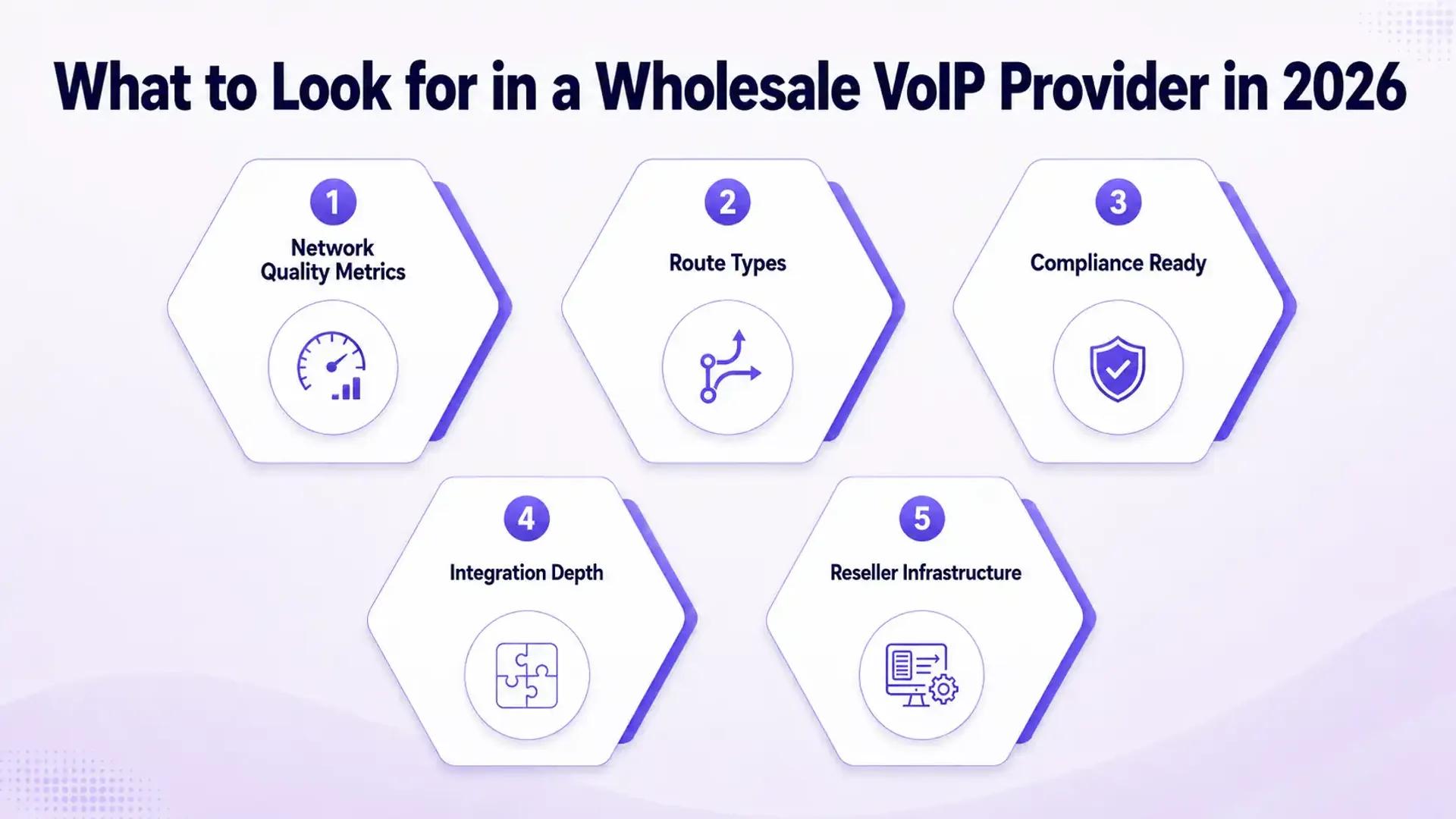
The evaluation framework has changed. In 2026, the providers pulling ahead aren't competing on per-minute rates alone. They're competing on:
- Network quality metrics over headline rates. Answer Seizure Ratio (ASR), Post Dial Delay (PDD), and Average Length of Call (ALOC) tell you more about a provider than their rate card. An ASR below 55% on a key destination means your agents are dialing into silence — no discount compensates for that.
- Route types that match your traffic. CLI (Calling Line Identification) routes preserve caller ID and suit customer-facing calls. Non-CLI routes are cheaper but strip caller ID — acceptable for automated notifications, not for live sales conversations. CC (Call Center) routes are built for high-volume outbound contact centers and carry the stability that automated dialing requires.
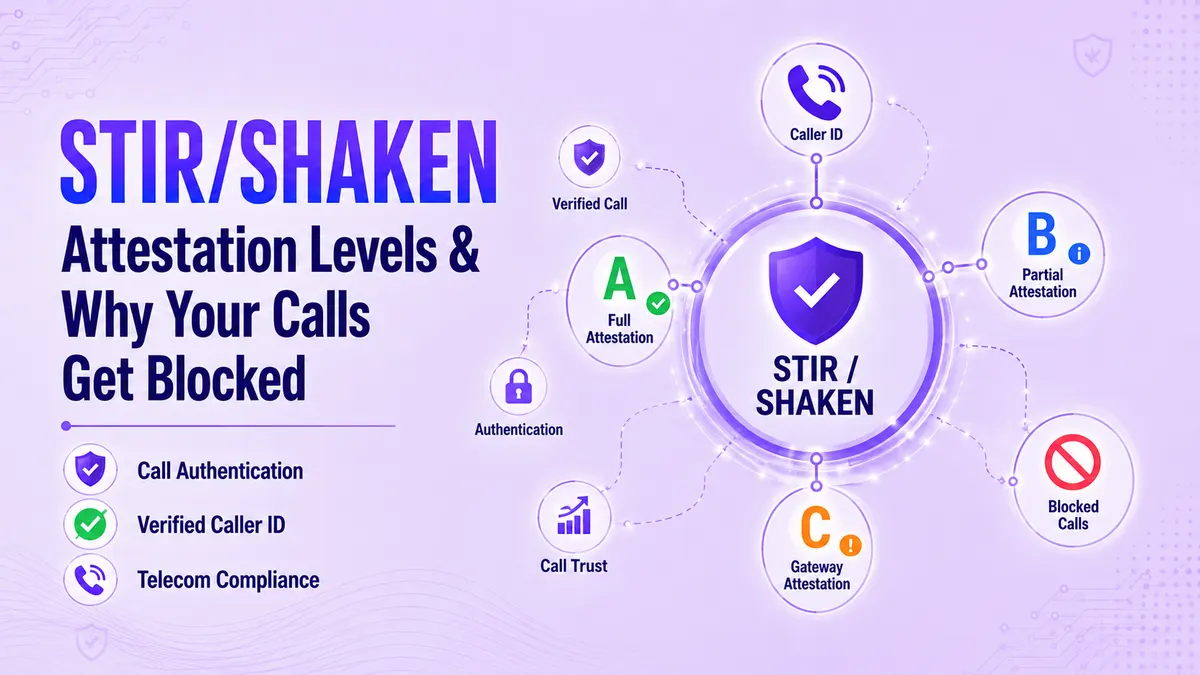
- Compliance out of the box. STIR/SHAKEN for US outbound traffic, E911 routing, GDPR data handling for international traffic, and HIPAA-compatible infrastructure for healthcare are table-stakes in 2026 — not optional add-ons.
- Integration depth. A provider whose voice capacity plugs directly into your CRM and contact center platform is a different product from one that only delivers a SIP trunk. Every call that logs automatically to HubSpot or Zoho is data you didn't have before.
- Partner and reseller infrastructure. For ITSPs and MSPs, white-label options, rate management portals, and billing tools determine whether a provider is actually buildable into a reseller business — or just a pipeline you pay monthly.
Before shortlisting any provider, review the wholesale VoIP fundamentals guide for the full evaluation framework.
Types of Wholesale VoIP Services
"Wholesale VoIP" is an umbrella term. Providers package voice capacity in several distinct ways, and the right mix depends on whether you're running calls directly or reselling them under your own brand.
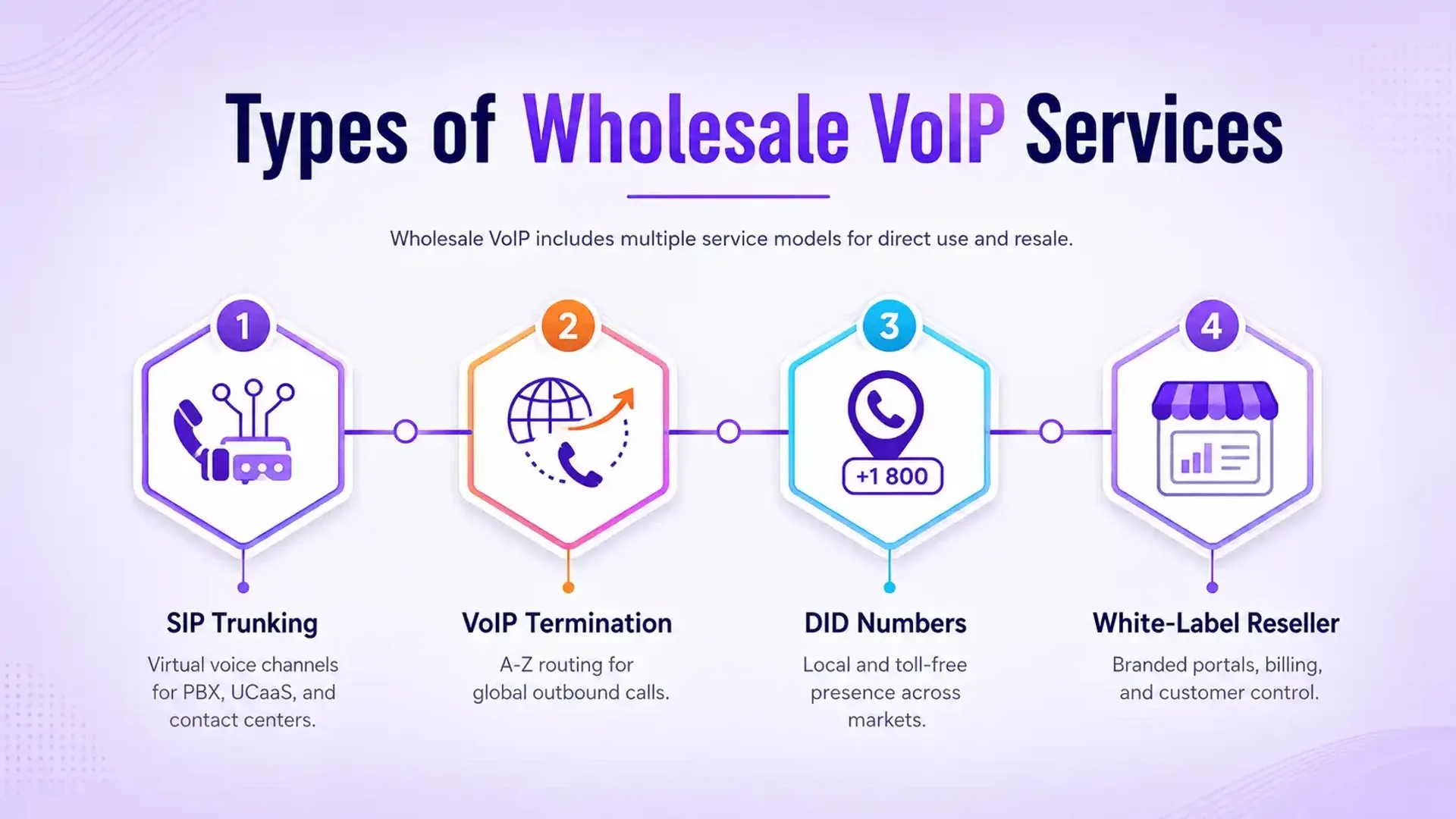
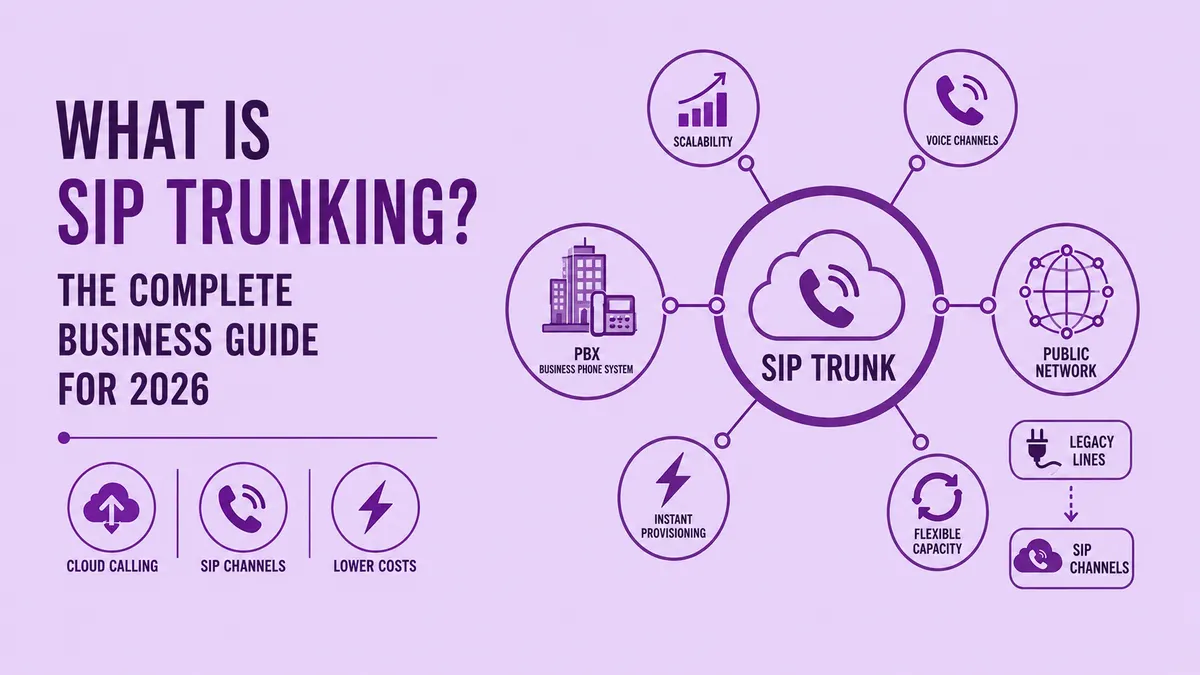
SIP trunking. Virtual voice channels that connect your PBX, UCaaS platform, or contact center to the public telephone network over the internet. SIP trunks scale up or down in minutes — adding 50 seats is a portal change, not a hardware order.
This is the dominant delivery method for business outbound calling in 2026.
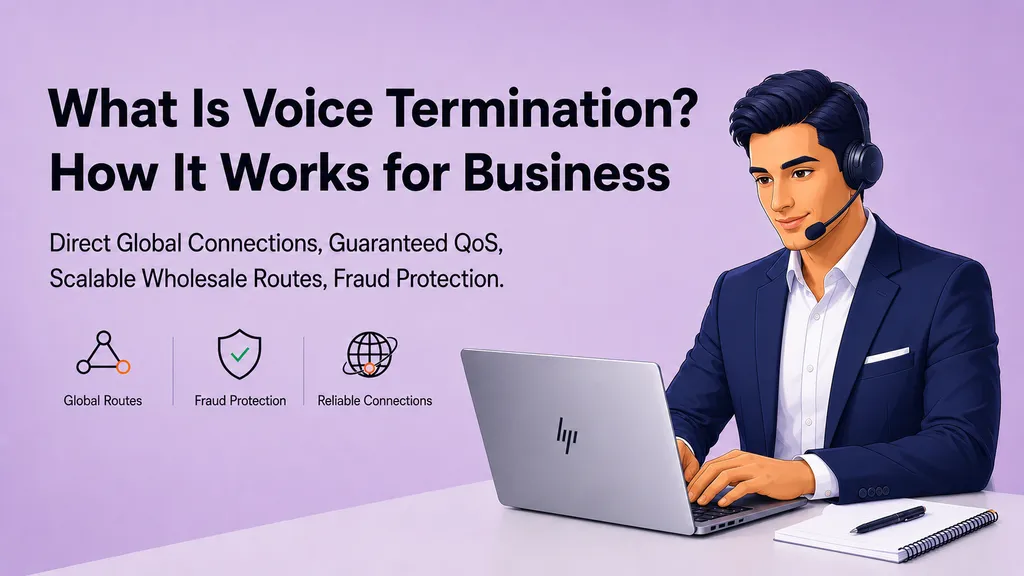
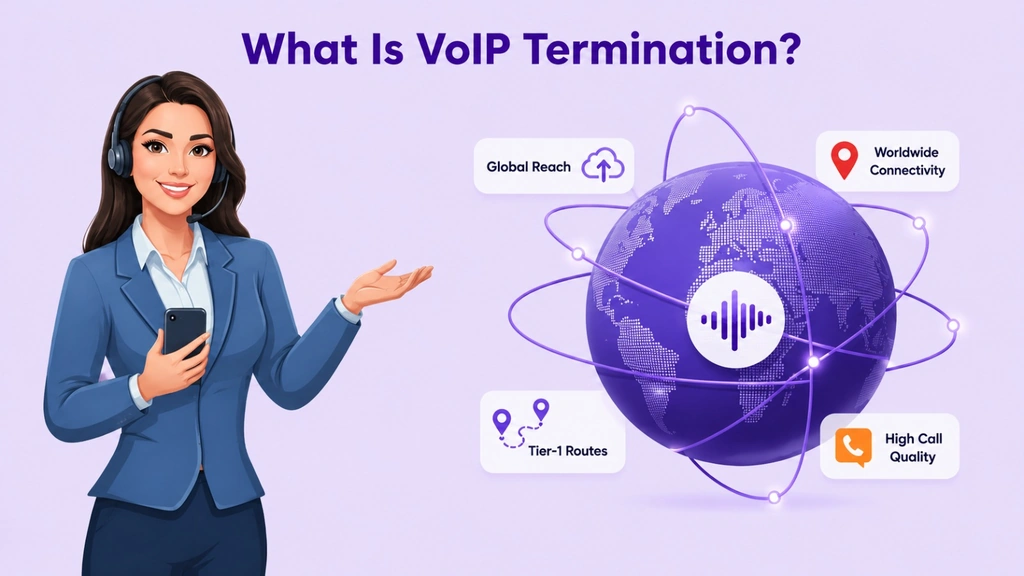
VoIP termination (A-Z routing). Outbound call delivery to any destination worldwide, billed per minute against a rate deck. A-Z termination is what carriers use to reach hundreds of countries, with CLI and Non-CLI routes priced separately.
Termination quality — measured by ASR, PDD, and ALOC — varies sharply by route, so this is where provider selection matters most.
DID numbers (origination). Direct Inward Dialing numbers give you local or toll-free presence in specific area codes and countries without a physical office there.
A business running campaigns across five US markets can assign a local number to each, lifting answer rates with familiar caller ID.
White-label and reseller services. Carrier-grade capacity packaged with rate management, billing, and customer portals so ITSPs, MSPs, and VARs can sell branded voice services. The provider runs the network; you own the customer relationship and the margin.
Most growing businesses end up using a combination — SIP trunking for day-to-day calling, A-Z VoIP termination for international reach, and DID numbers for local presence across markets.
Benefits of Wholesale VoIP for Business
Wholesale VoIP isn't just a cheaper phone bill — it changes what a communication stack can do. The benefits compound as call volume grows.
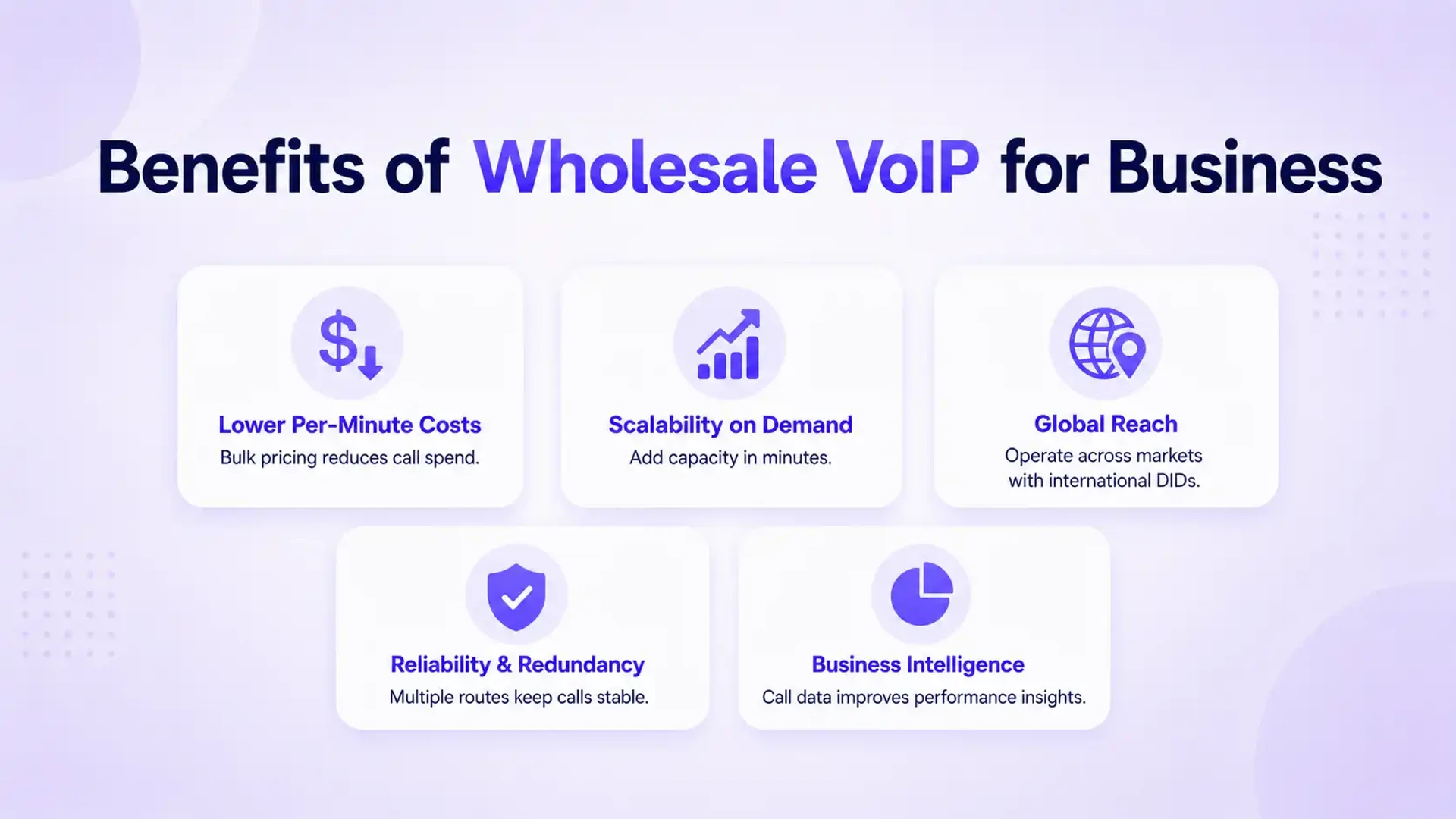
- Lower per-minute costs. Bulk rates run a fraction of retail pricing, with the gap widening on international routes where legacy carriers still charge heavy premiums.
- Scalability on demand. Trunk capacity and concurrent-call limits adjust through a portal in minutes — no provisioning delays, no overbuying for peak traffic you only hit twice a year.
- Global reach. A-Z termination and international DID numbers let a single team operate across dozens of markets with local presence and clean caller ID.
- Reliability and redundancy. Tier-1 interconnects and multiple carrier paths mean a single route degrading doesn't drop your calls — traffic re-routes automatically.
- Business intelligence. When wholesale capacity plugs into a contact center and CRM, every call becomes data: ASR by campaign, agent performance, and pipeline impact instead of an anonymous per-minute charge.
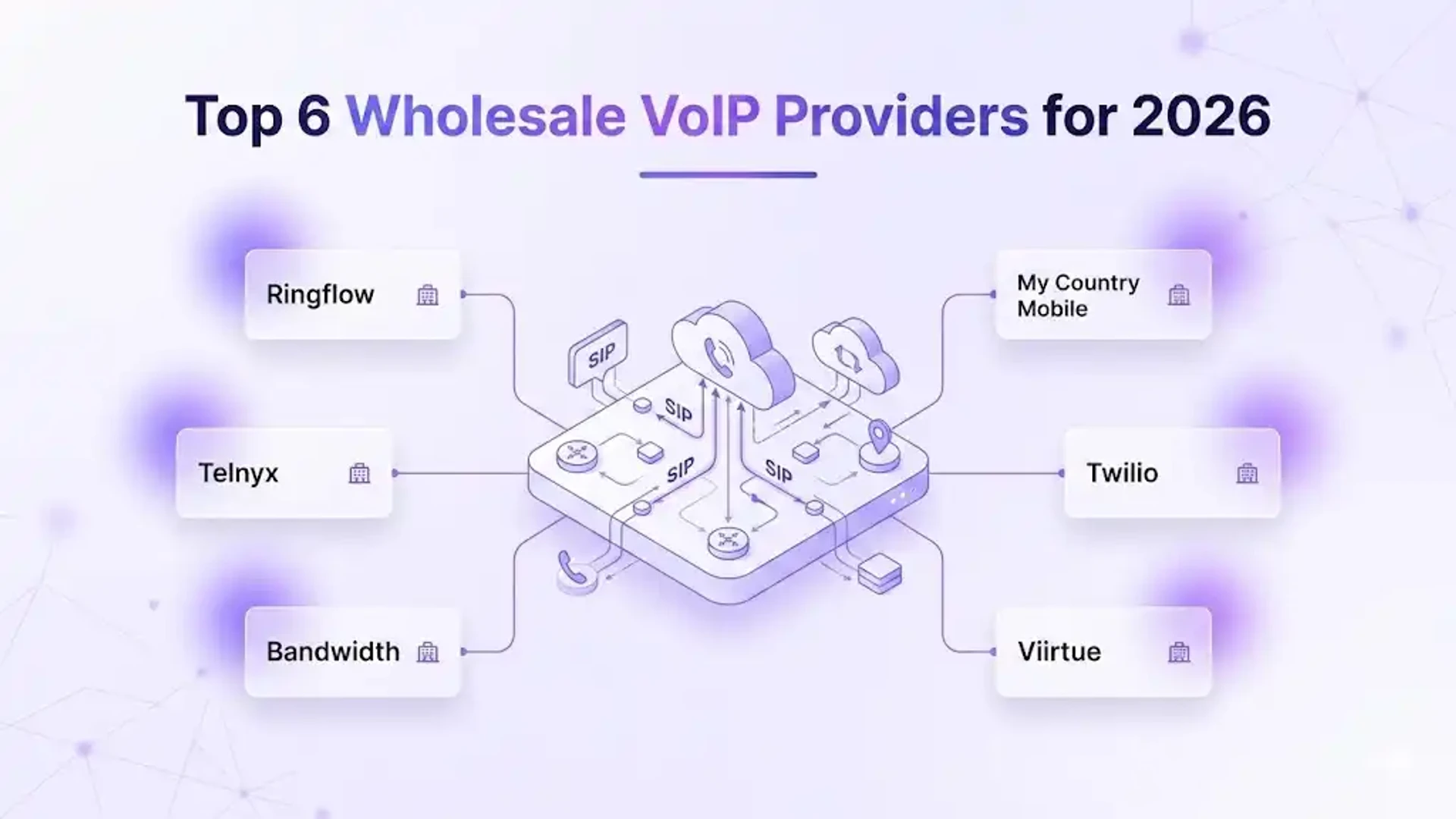
Top 6 Wholesale VoIP Providers for 2026
Here are the top wholesale VoIP providers for 2026, evaluated on network quality, global coverage, pricing, and contact center integration.
1. Ringflow
Ringflow operates as a cloud contact center and AI Sales Platform that also delivers wholesale-grade voice capacity — a combination most pure-play carriers don't offer.
SIP trunking connects to Ringflow's inbound and outbound contact center stack natively, meaning wholesale minutes feed directly into Live Call Tracking, Call Data Analytics, and AI Sales Coaching without middleware. For outbound teams, Dynamic DID Handling assigns campaign-specific virtual numbers per traffic stream.
Rotating Caller ID cycles outbound numbers automatically to prevent spam-flagging on high-volume dialers. CRM integrations with HubSpot and Zoho log every call as a record, tying voice traffic to pipeline data.
Best for: Contact centers, outbound sales teams, and SMBs that need wholesale voice capacity and contact center intelligence in one platform.
2. Telnyx
Telnyx is an API-first wholesale provider with SIP trunking across 65+ countries, pay-as-you-go pricing, and no minimum commitments. Their RESTful API gives developers full control over number provisioning, routing logic, and call events — making them strong for tech teams building custom communication workflows.
STIR/SHAKEN is implemented and their elastic SIP trunking scales automatically under load.
Best for: Technology companies and developer-led teams building VoIP features into their own products.
3. Bandwidth
Bandwidth operates direct-to-carrier infrastructure across North America, which means their termination routes avoid the reseller layers that introduce latency and quality degradation. Their API-first architecture suits contact center platforms and CPaaS builders.
Direct access to local, toll-free, and vanity numbers across the US is a specific strength.
Best for: Enterprises and contact center software vendors needing direct carrier access in the US market.
4. My Country Mobile
My Country Mobile covers international termination across a wide destination set with a management portal that suits resellers building white-label voice offerings. Their platform includes A-Z termination, UCaaS features for resale, and AI-powered call routing tools. Pricing is transparent for international routes.
Best for: Resellers and ITSPs focused on international traffic and white-label UCaaS bundling.
5. Twilio
Twilio's programmable voice API is the most widely deployed in the market. For businesses building custom contact center flows, IVR systems, or voice-enabled applications, Twilio's infrastructure scales reliably. Per-minute pricing with no contracts suits variable traffic.
The trade-off: Twilio is an infrastructure layer, not a turnkey contact center solution.
Best for: Development teams integrating voice capabilities into custom business applications.
6. Viirtue
Viirtue targets MSPs specifically — combining wholesale voice with a quote-to-cash billing stack, telecom tax automation, and white-label UCaaS.
In 2026 they added AI voice agents and real-time sentiment analysis to their reseller package, making them a differentiated option for channel partners building managed communication services.
Best for: MSPs and channel partners needing a full reseller stack with integrated billing and AI features.
Provider Comparison Snapshot
| Provider | Best For | CLI Routes | AI Features | CRM Integration | White-Label |
|---|---|---|---|---|---|
| Ringflow | Contact centers + AI sales | ✓ | AI Coaching, AI Call Optimization | HubSpot, Zoho | ✓ |
| Telnyx | Developer/API teams | ✓ | Limited | Via API | ✓ |
| Bandwidth | Enterprise US direct | ✓ | Limited | Via API | ✓ |
| My Country Mobile | International resellers | ✓ | Basic routing AI | Limited | ✓ |
| Twilio | Custom voice apps | ✓ | Via Flex | Via API | Limited |
| Viirtue | MSP channel | ✓ | AI voice agents | Via stack | ✓ |
Why Contact Centers Need More Than Cheap Minutes
A wholesale provider that only delivers a SIP trunk leaves the most valuable part of the call untouched.
The conversation itself — what was said, how long the call ran, whether the agent followed the right talk track, whether the lead was qualified — becomes invisible once the voice pipe ends.
Ringflow's architecture treats wholesale voice capacity as the foundation, not the ceiling. Every call that routes through the platform feeds Call Data Analytics and AI Team Performance monitoring. Supervisors see agent performance, campaign-level ASR, and call duration patterns in one dashboard.
AI Sales Coaching surfaces guidance during live calls — not in a post-call review that happens two days later. Per FCC guidelines on VoIP compliance, STIR/SHAKEN applies to every provider on this list.
That's the gap between a provider and a platform. Wholesale minutes are the input. What you build on top of them determines the output.
Conclusion
The best wholesale VoIP provider for your business isn't the one with the lowest headline rate — it's the one whose network quality, compliance posture, and integration depth match what your team actually does with voice traffic.
For contact centers and outbound sales operations, that means a provider whose wholesale capacity connects directly to call analytics, CRM records, and AI coaching tools.
Ringflow delivers that stack in one platform, so your team stops managing infrastructure and starts using the data every call generates.
For related coverage, check out our Mexico phone number format guide and Canada phone number format guide.
Ready when you are
See Why Contact Centers Choose Ringflow
Wholesale-grade voice capacity with AI Sales Coaching, Dynamic DID, Rotating Caller ID, and CRM-native call logging — all in one platform. No middleware. No infrastructure overhead.
FAQ
A wholesale VoIP provider sells high-volume voice calling capacity — SIP trunks, termination routes, and DID numbers — at bulk rates. Businesses use this capacity either directly for their own operations or resell it under their own brand. Wholesale differs from retail VoIP in that it's priced for volume, not per-user, and typically requires more technical setup to deploy.
CLI (Calling Line Identification) routes preserve the caller's phone number so it appears correctly on the recipient's display. These routes suit customer-facing calls where caller ID credibility affects answer rates. Non-CLI routes strip caller ID and carry lower per-minute costs — they're appropriate for automated notifications or bulk messaging where identity isn't a factor.
Three metrics matter: Answer Seizure Ratio (ASR) — the percentage of calls that connect successfully, with healthy rates typically above 55–65% by destination; Post Dial Delay (PDD) — the gap between dialing and first ring, ideally under 3 seconds; and Average Length of Call (ALOC), which reflects whether connections are stable and conversations are completing normally.
Reputable providers implement STIR/SHAKEN call authentication, which is required under FCC rules for US voice traffic. STIR/SHAKEN verifies that a caller's number matches what they claim, reducing robocall and spoofing risk. Always confirm a provider's STIR/SHAKEN implementation before routing live US outbound traffic through their network.
Yes, via SIP trunking or API access. SIP trunking connects your contact center software directly to the provider's network. API-enabled providers allow call event data — start time, duration, caller ID, disposition — to sync with CRM systems like HubSpot or Zoho automatically. Platforms like Ringflow handle this natively, so every call logs as a CRM record without custom engineering.